
 When a family places a loved one in a nursing home or assisted living facility, they entrust the facility with one of the most important people in their lives. They trust that the staff will provide attentive and respectful care, and that their loved one will be safe. They trust that the people in charge will notice if something is wrong and address it immediately. When this trust is violated and an elderly person is harmed by abuse, neglect, or exploitation, the consequences can be catastrophic, and the path forward is rarely clear.
At Hughey Law Firm, we represent families throughout South Carolina whose elderly loved ones have been harmed by abuse or neglect in nursing homes, assisted living facilities, memory care centers, and by private caregivers. Since 2007, we have resolved over 1,000 elder abuse, nursing home, and assisted living cases in South Carolina, including over 600 cases resolved for $100,000 or more. Over seventy percent of our practice is dedicated to elder abuse cases, which means this is not a secondary service we offer alongside other injury work. It is the work this firm was built to do.
Why Do Families Throughout South Carolina Trust Hughey Law Firm for Elder Abuse Cases?

Unlike most personal injury firms, which handle elder abuse as one practice area among many, Hughey Law Firm specializes in it. Hughey Law Firm is different, and our expertise is verifiable. Here’s what you need to know about us:
- Nathan Hughey, our founder, began his legal career defending nursing homes. Before founding the Hughey Law Firm in 2007, Nathan spent years representing nursing homes and care facilities in personal injury litigation cases. He understands how these facilities are managed, how they document care, how they respond to incidents, and how their legal teams approach defending claims. He now uses that knowledge exclusively to protect the people those facilities are supposed to serve.
- Nathan Hughey teaches other attorneys about elder abuse law. He has delivered continuing legal education presentations on the subject to attorneys in South Carolina, demonstrating a level of expertise that is recognized and relied on by the legal community.
- Attorneys and law firms across South Carolina refer elder abuse cases to us. Lawyers throughout South Carolina, including firms that handle other types of personal injury cases, refer their elder abuse cases to Hughey Law Firm because of our experience and track record in this area of practice. These referrals bring cases from every corner of South Carolina to us, not just from Charleston.
- Over 70% of our caseload consists of elder abuse cases. We are not a firm that handles car crashes, workers’ compensation, and elder abuse under one roof with equal resources distributed across each area. Our firm is focused and our expertise runs deep.
- Since 2007, we have resolved over 1,000 elder abuse cases in South Carolina. These cases include virtually every type of elder abuse and neglect, such as wrongful death, falls, broken bones, pressure ulcers, dehydration, malnutrition, medication errors, sexual assault, emotional abuse, and financial exploitation.
Over 600 cases resolved for $100,000 or more. A sampling of results includes:
- $1,000,000 recovered for elder abuse resulting in pressure sores in a nursing home
- $875,000 recovered for a client who suffered a broken neck and pelvis in a wheelchair accident
- $497,500 recovered for a client who fell and broke their hip in a nursing home
The results described above are specific to those cases and are not intended to predict or guarantee the outcome of any future case. Each case is unique, and outcomes depend on the particular facts and legal circumstances involved. Hiring a lawyer is an important decision that should not be based solely on advertisements.
South Carolina Elder Abuse Guide
- What Is Elder Abuse?
- Types of Elder Abuse
- Warning Signs of Elder Abuse
- Where Elder Abuse Happens in South Carolina
- Who Can Be Held Liable for Elder Abuse in South Carolina?
- South Carolina Elder Abuse Laws
- What Compensation Is Available in Elder Abuse Cases?
- What to Do if You Suspect Elder Abuse in South Carolina
- How Our South Carolina Elder Abuse Lawyers Can Help
- Why Families Throughout South Carolina Choose Hughey Law Firm
- South Carolina Cities and Communities We Serve
- Frequently Asked Questions
What is Elder Abuse?
Elder abuse is any intentional or negligent act by a caregiver or other person that causes or poses a serious risk of causing harm to a vulnerable adult. This can include physical, emotional, or sexual harm; financial exploitation; or the failure to provide adequate care. Elder abuse can occur in care facilities, private homes, or any setting where an elderly person depends on others for their well-being.
In South Carolina, elder abuse is addressed through civil and criminal law. Civil law allows injured victims and their families to pursue compensation, while criminal law addresses intentional harmful conduct by caregivers and others. These systems operate independently, and a family can pursue a civil claim regardless of whether criminal charges have been filed.
According to the National Council on Aging, approximately one in ten Americans aged sixty and older has experienced some form of elder abuse. Many cases go unreported because the victim is unable to communicate what is happening, fears retaliation, or is not believed when reporting the abuse. The actual prevalence of elder abuse in South Carolina and nationwide is believed to be much higher than the reported statistics suggest.
South Carolina’s elderly population is growing, so as more families rely on nursing homes, assisted living facilities, and in-home caregivers to care for their aging loved ones, it has never been more important to hold these facilities accountable for the care they provide.
Types of Elder Abuse
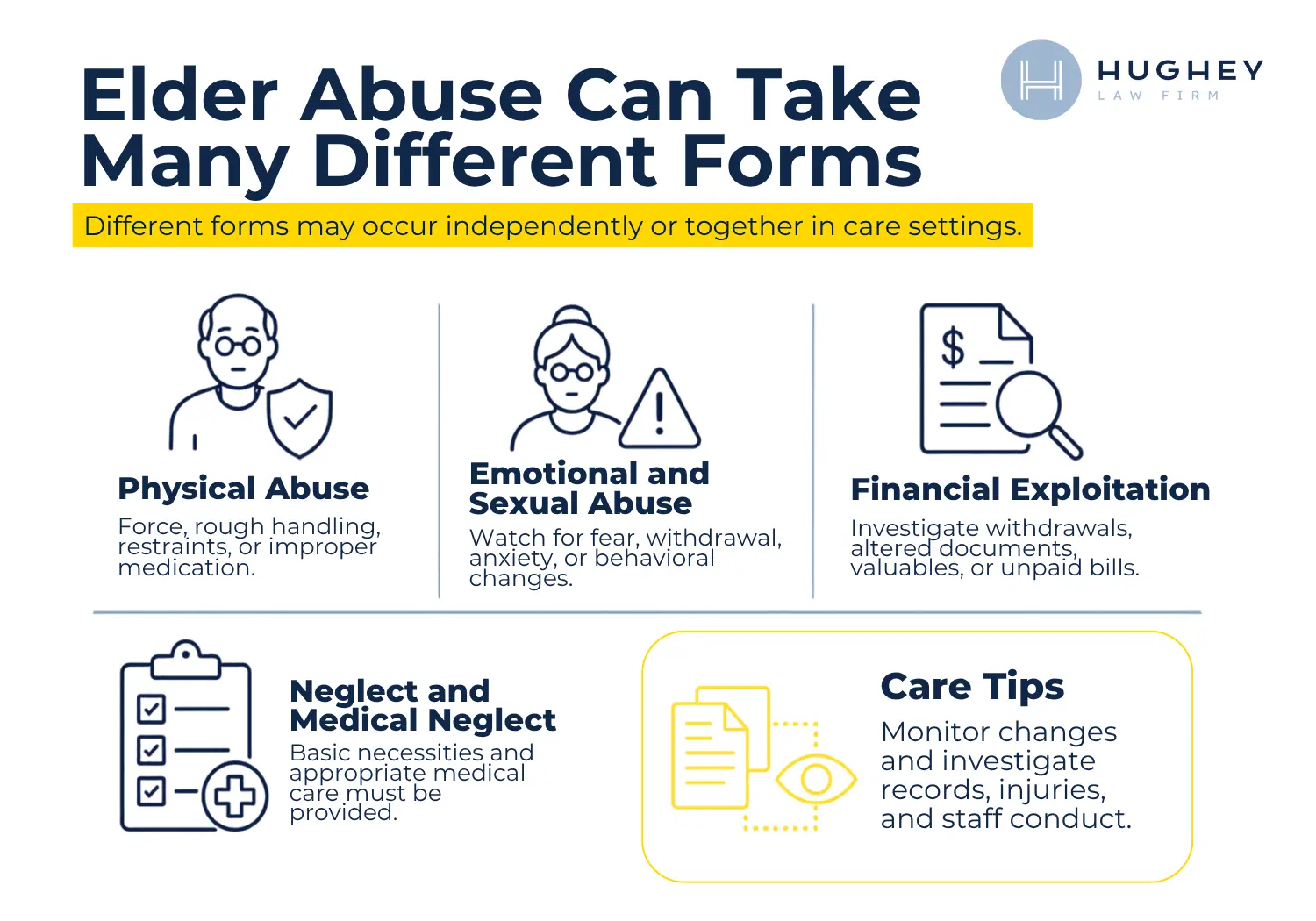
Elder abuse is not a single category of harm. Rather, it encompasses several distinct forms, each of which may occur alone or alongside others.
Physical Abuse
Physical abuse is the intentional use of force against an elderly person that results in pain, injury, or impairment. This includes hitting, pushing, shoving, rough handling during transfers or personal care, inappropriate use of restraints, and improper administration of medication. In nursing homes and assisted living facilities, physical abuse is sometimes disguised as accidental injury. This is why a thorough investigation of the facility’s records and staff conduct is critical when unexplained injuries appear.
Emotional and Psychological Abuse
Emotional abuse involves verbal or nonverbal behavior that causes psychological harm to an elderly person. Humiliation, intimidation, threats, isolation from family and friends, and demeaning treatment are some examples of it. Because this type of abuse leaves no physical evidence, it is often harder to identify and document. Signals that warrant immediate attention include changes in behavior, increased withdrawal, unusual anxiety, or fear around specific staff members.
Sexual Abuse
Sexual abuse of elderly individuals in care settings is one of the most underreported forms of elder abuse because victims are often unable to communicate what has happened to them. Yet, it’s also one of the most common. Any nonconsensual sexual contact or conduct involving an elderly person constitutes sexual abuse, even if the person has dementia or cognitive impairment. Unexplained genital injuries, changes in behavior around specific staff members, and reports by residents of sexual contact by staff members all require immediate investigation.
Financial Exploitation
Financial exploitation involves the unauthorized or improper use of an elderly person’s money, property, or assets. Those who commit financial exploitation may include care facility staff, family members, caregivers, financial advisors, or others in a position of trust. Indicators of financial exploitation include unexplained withdrawals, changes to estate documents, missing valuables, and unpaid bills despite adequate resources. Both South Carolina’s Adult Protective Services system and law enforcement have jurisdiction over financial exploitation cases.
Neglect
Neglect is defined as the failure to provide an elderly person with basic necessities, such as food, water, medical treatment, hygiene supplies, supervision, and a safe living environment. Neglect can be intentional or result from understaffing, inadequate training, or systemic failures within a care facility. It is the most common form of elder abuse and is most often concealed through incomplete or falsified documentation. Consequences include pressure ulcers, dehydration, malnutrition, falls resulting from inadequate supervision, and untreated medical conditions.
Medical Neglect
Medical neglect is a specific subcategory involving the failure to provide or obtain appropriate medical care for an elderly resident. Examples of medical neglect include delayed treatment of infections, failure to monitor and manage chronic conditions, medication errors, and absence of appropriate wound care for pressure ulcers. Medical neglect occurs when these actions fall below the standard of care that a reasonable facility or provider would deliver in the same circumstances.
Nursing Home Abuse and Neglect
Nursing home abuse and neglect encompasses all of the above categories when they occur in licensed nursing home settings. South Carolina nursing homes are subject to state licensing requirements and federal regulations under the Nursing Home Reform Act. This act establishes minimum care standards for facilities that receive Medicare and Medicaid funding. If a nursing home fails to meet these standards and a resident is harmed, the facility and any corporate ownership entities may be held liable.
Assisted Living Abuse and Neglect
Although assisted living facilities operate under a different regulatory framework than nursing homes, they owe their residents the same fundamental duty of care. Although assisted living residents are often assumed to require less intensive care than nursing home residents, many have significant medical needs that facilities are obligated to address. Like nursing home cases, abuse and neglect in assisted living settings are subject to the same civil liability framework.
Warning Signs of Elder Abuse
Elder abuse in South Carolina care facilities is often concealed by institutions. In many cases, residents cannot directly report the abuse they experience. This makes family members who regularly visit the most important and often the only reliable observers of a loved one’s daily care. Recognizing elder abuse is the first step toward stopping it and holding the responsible parties accountable. Families should watch for the following warning signs during every visit.
- Unexplained physical injuries. Bruises, cuts, burns, or fractures that can’t be adequately explained by the facility, that appear in patterns inconsistent with accidental injury, or that recur after supposedly being resolved, deserve immediate attention and documentation.
- Pressure ulcers or bed sores. Pressure ulcers of stage two or higher in a mobile resident or in a facility with adequate staffing are almost always a sign of neglect. Facilities are required to implement care plans to prevent pressure ulcers in residents at risk, so the development of these ulcers signals a failure of that duty.
- Significant unintended weight loss. Unexplained weight loss, whether sudden or progressive, is one of the most reliable indicators that a facility is failing to address nutritional neglect or underlying medical problems.
- Poor hygiene or unsanitary conditions. Residents who are not bathed, whose clothing is consistently soiled, and whose living spaces are consistently unclean are not receiving basic hygiene care, which care facilities are required to provide.
- Dehydration. Symptoms of dehydration, such as dry mouth, dark urine, confusion, and lethargy, are frequently overlooked in understaffed facilities. With attentive care, dehydration is preventable, and its presence is a serious red flag.
- Behavioral changes. If a loved one who was previously communicative and engaged has become withdrawn, fearful, or anxious, they may be experiencing emotional abuse or may be afraid of a specific staff member. These changes should never be dismissed as a normal part of aging.
- Fear around specific staff members. Regardless of whether they are able to articulate it, an elderly person who becomes noticeably agitated, frightened, or distressed in the presence of a specific staff member is communicating something important. Don’t miss those signs.
- Unexplained financial changes. Financial exploitation may be indicated by missing valuables, unexplained bank withdrawals, changes to financial documents, and unpaid bills that cannot be accounted for.
- Staff reluctance to allow private visits. Facilities that discourage or obstruct private time between residents and their families may be hiding conditions that they do not want family members to see.
None of the warning signs on this list should be attributed to aging without investigation. Each sign reflects an obligation to provide care that is either being neglected or deliberately concealed. If you have observed any of these signs during visits to a loved one in a Charleston area care facility, call (843) 881-8644 to speak with Hughey Law Firm.
Where Elder Abuse Happens in South Carolina
Elder abuse in South Carolina is not confined to nursing homes. It occurs in every setting where elderly individuals receive care. The setting determines the present risks, the level of facility regulation, and the applicable legal theories when harm occurs. Families can identify risk factors wherever their loved ones receive care by recognizing where abuse can occur.
- Although nursing homes are the most closely regulated residential care setting in South Carolina, physical and medical neglect most commonly occur there. Understaffing is the systemic driver of most nursing home neglect cases in the state.
- Assisted living facilities house residents who are often assumed to require minimal medical oversight, but who, in practice, may have complex care needs. Because of the perception that residents are more independent, assisted living abuse and neglect is frequently under-investigated.
- Memory care centers provide specialized care for residents with dementia and Alzheimer’s disease. These residents are especially vulnerable because their cognitive impairment limits their ability to report abuse. Family members may also attribute behavioral changes to the disease rather than to external harm.
- Private home caregivers are responsible for a significant portion of elder abuse cases, particularly financial exploitation and emotional abuse. They are subject to less oversight than facility staff and may have significant access to a vulnerable person’s finances, daily life, and personal relationships.
- Hospitals are less commonly recognized as settings for elder abuse, but they can involve staff misconduct and systemic failures in care that harm elderly patients.
The legal approach to an elder abuse claim depends significantly on where the abuse occurred and who was responsible for the victim’s care at the time. Call (843) 881-8644 to have the Hughey Law Firm evaluate your loved one’s specific situation.
Who Can Be Held Liable for Elder Abuse in South Carolina?
According to South Carolina law, injured elderly individuals and their families can pursue civil claims against multiple parties whose actions contributed to the abuse or neglect.
- The care facility itself
- Staff members
- Corporate ownership and management companies
- Third-party contractors
From the earliest stages of the case, an experienced elder abuse attorney will investigate all potentially liable parties to ensure that the family’s claim reflects the full scope of accountability available under South Carolina law.
South Carolina Elder Abuse Laws
South Carolina’s legal framework for addressing elder abuse encompasses a mandatory reporting system and civil liability standards governing care facilities.
Mandatory Reporting
According to South Carolina Code Section 43-35-25, certain individuals, including healthcare professionals, law enforcement officers, social workers, and care facility employees, must report suspected elder abuse to the South Carolina Department of Social Services’ Adult Protective Services program. Under South Carolina law, failure to report known or suspected elder abuse by a mandated reporter is a misdemeanor.
Anyone may report suspected elder abuse to APS by calling the statewide hotline at 1-888-CARE-211, whether or not they are a mandated reporter. Reports can be made anonymously.
Adult Protective Services
The South Carolina Department of Social Services runs the Adult Protective Services (APS) program, which investigates reports of the abuse, neglect, or exploitation of vulnerable adults aged eighteen and older. APS investigations are separate from civil legal action and criminal proceedings. An APS investigation does not prevent a family from pursuing a civil claim, and the investigation’s findings can provide useful documentation in the event of civil litigation.
Statute of Limitations for Elder Abuse Claims in South Carolina
In most cases of elder abuse and nursing home neglect in South Carolina, the injured person or their personal representative has three years from the date of the injury or its discovery to file a civil lawsuit. For wrongful death claims arising from elder abuse, the three-year period usually begins on the date of death.
South Carolina’s statute of limitations includes discovery provisions that may extend the limitations period if the injury or its cause was not reasonably discoverable at the time it occurred. Medical malpractice claims, including those in nursing home settings, have specific pre-suit notice requirements under South Carolina Code Section 15-79-125 that must be met before filing a lawsuit.
Since limitations periods and pre-suit requirements vary based on the specific facts and legal theories involved, the most reliable way to protect your family’s legal options is to contact an elder abuse attorney promptly after discovering harm.
Negligence Standards for Care Facilities
South Carolina care facilities owe their residents a duty to provide care that meets the standard that a reasonably competent facility would provide under the same circumstances. Federal nursing home regulations under 42 C.F.R. Part 483 establish minimum care standards for Medicare- and Medicaid-certified facilities. Departures from these standards can be used as evidence of negligence in civil litigation. South Carolina’s licensing regulations for nursing homes and assisted living facilities impose additional obligations, and violations of these obligations can also support a negligence claim.
What Compensation Is Available in Elder Abuse Cases?
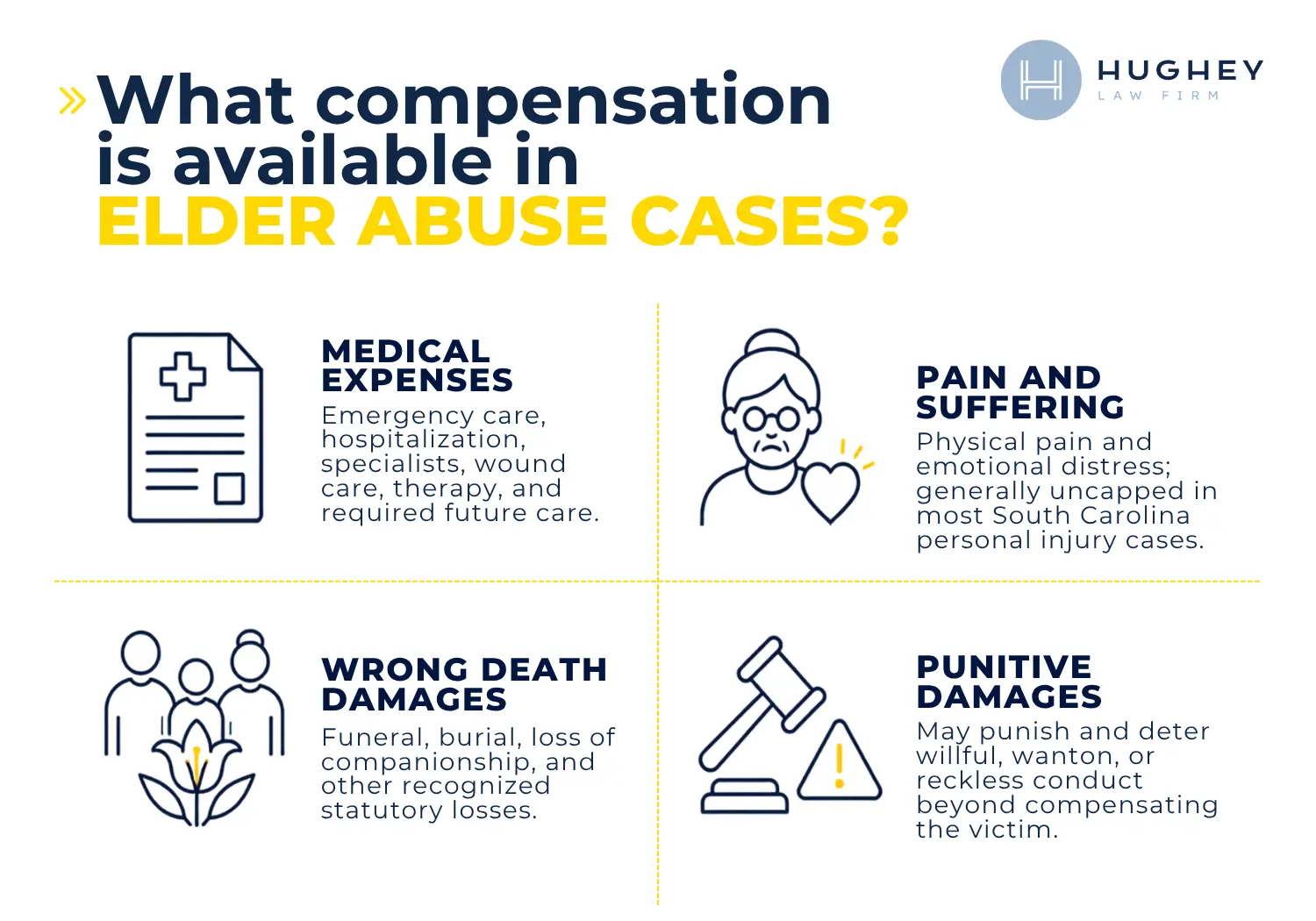
According to South Carolina law, injured elderly individuals and their families can pursue compensation for various types of damages in cases of elder abuse and nursing home neglect.
- Medical expenses include the cost of treating injuries caused by abuse or neglect. This includes emergency care, hospitalization, specialist treatment, wound care, physical therapy, and any future medical care required due to the sustained harm.
- Pain and suffering compensation covers the physical pain and emotional distress experienced by the elderly person as a result of the abuse or neglect. In most South Carolina personal injury cases, these damages are not capped and can represent a significant portion of the total recovery.
- Wrongful death damages are available when elder abuse or neglect results in death. Surviving family members may recover funeral and burial expenses, loss of companionship, and other losses recognized under South Carolina’s wrongful death and survival statutes.
- Punitive damages are available in South Carolina elder abuse cases when the defendant’s conduct is willful, wanton, or reckless. Care facilities whose staffing decisions or care practices demonstrate a conscious disregard for resident safety may be subject to punitive damages intended to punish the facility and deter similar conduct, which go beyond compensating the victim.
Costs of enhanced care may be recoverable if the victim’s injuries require a higher level of care than would have been necessary if the abuse or neglect had not occurred.
What to Do if You Suspect Elder Abuse in South Carolina
If you suspect elder abuse or neglect in a South Carolina care facility or by a private caregiver, the steps you take in the immediate aftermath will determine the safety of the resident and the completeness of the legal record on which any investigation or claim will depend. The most important documentation is often only available in the first hours after suspicion arises. If you suspect your loved one is being abused or neglected, take the following steps immediately:
- First, remove your loved one from immediate danger, if possible.
- Document everything you observe.
- Request medical records.
- Report the suspected abuse to Adult Protective Services.
- Report the suspected abuse to the facility administrator.
- Contact the South Carolina Department of Health and Environmental Control (DHEC).
- Speak with an elder abuse attorney before contacting the facility’s insurer.
The facility’s insurer may contact you shortly after an incident occurs. What you say during these initial conversations may affect the value of the subsequent claim. Let Hughey Law Firm manage those communications from the start by calling (843) 881-8644.
How Our South Carolina Elder Abuse Lawyers Can Help
Elder abuse cases require a specific combination of investigative capabilities, medical expertise, knowledge of elder care regulations, and experience in civil litigation. Hughey Law Firm has spent more than thirty years building these capabilities, allowing families to focus on their loved ones rather than navigate a legal process they were never meant to face alone. We handle every aspect of the legal process when taking on an elder abuse case.
- We investigate the facility
- We preserve evidence
- We work with medical and expert witnesses
- We negotiate with insurers and defense attorneys
- We take cases to trial when necessary
We handle all elder abuse cases on a contingency fee basis. Contact us today at (843) 881-8644 to speak with a South Carolina elder abuse attorney.
Why Families Throughout South Carolina Choose Hughey Law Firm
Hughey Law Firm’s reputation in South Carolina elder abuse litigation is based on our thirty-year history of dedicated advocacy for families whose loved ones have been harmed in care settings. This record has earned us peer referrals from attorneys across the state and has resulted in the resolution of over 1,000 cases since 2007. Here’s what distinguishes our representation:

- We have an unmatched focus on elder abuse: Over 70% of our cases involve elder abuse, nursing homes, and assisted living facilities. Our firm was built around this work, and the depth of experience that this focus provides is unmatched by a generalist personal injury firm.
- Nathan Hughey has a unique background: His years spent defending nursing homes, followed by decades holding them accountable, gives our attorneys a one-of-a-kind perspective on these cases that no other South Carolina firm can replicate.
- We have a track record that speaks for itself: We have resolved over 1,000 elder abuse cases in South Carolina. Over 600 cases have been resolved for $100,000 or more. These case results reflect our firm’s consistent and serious advocacy for every family we represent.
- We have a statewide reach: We represent families throughout South Carolina, not just in Charleston. Law firms and attorneys from across the state refer elder abuse cases to Hughey Law Firm because of our experience and proven track record in this practice area.
- We provide compassionate and personal representation: Families come to us during some of the most painful moments of their lives, that’s why we handle these cases with the seriousness and compassion they deserve. You will always know the status of your case and your questions will always be answered by someone familiar with it.
- There’s no fee unless we recover: We handle elder abuse cases on a contingency fee basis, so you will not pay any legal fees unless we secure compensation for your family.
If you believe your loved one has been abused or neglected, call (843) 881-8644 to schedule a free consultation, fill our contact form or connect through live chat to speak with our team.
South Carolina Cities and Communities We Serve
At Hughey Law Firm, we represent victims of elder abuse and their families throughout South Carolina. We primarily serve Charleston, Mt. Pleasant, Summerville, North Charleston, Goose Creek, Hanahan, James Island, West Ashley, Daniel Island, Johns Island, Columbia, Greenville, Spartanburg, Myrtle Beach, Florence, Hilton Head, Beaufort, and Rock Hill.
Since other South Carolina law firms refer elder abuse cases to us, we have experience handling cases in courtrooms across the state, not just in Charleston-area courts.
 Speak With a South Carolina Elder Abuse Lawyer Today
If a loved one has been harmed in a South Carolina nursing home or assisted living facility, or by a caregiver, Hughey Law Firm can help your family understand what happened and what legal options are available to you. You don’t have to navigate this situation alone, and the initial consultation is free.
Call (843) 881-8644 for a free consultation, fill out our contact form, or use live chat to speak with our team now. We represent families throughout South Carolina and are available to discuss your situation at no cost or obligation.
Additional Charleston Elder Abuse Practice Areas:
- Nursing Home Abuse
- Assisted Living Facility Abuse
- Dehydration/Malnutrition
- Nursing Home Sexual Assault
- Spinal Cord Injury
- Pressure Sores & Bed Sores
- Wandering/Elopement
Disclaimer: The information on this page is for informational purposes only and does not constitute legal advice. Every case is different. Past results do not guarantee future outcomes. Hiring a lawyer is an important decision that should not be based solely on advertisements. Ask us to send you free written information about our qualifications and experience before you decide. The Hughey Law Firm is located in Charleston, South Carolina.
Frequently Asked Questions
About Elder AbuseThe timeline varies based on the case’s complexity, the number of defendants, the severity of the injuries, and whether the case settles or proceeds to trial. Straightforward cases may be resolved within one to two years. Complex cases involving significant injuries, multiple defendants, or disputed liability may take longer. An attorney can provide a more specific timeline after reviewing the facts of your situation.
We handle elder abuse cases on a contingency fee basis, which means you won’t pay any upfront costs or attorney fees unless we secure compensation for your family. Our fee comes from that recovery. The initial consultation is free and confidential.
Yes. We represent elder abuse victims and their families throughout South Carolina. Attorneys and law firms across the state refer elder abuse cases to us because of our experience and track record in this practice area. We have handled cases in communities across South Carolina, from the Lowcountry to the Upstate.
Yes. When elder abuse or neglect in a South Carolina care facility results in death, the personal representative of the deceased’s estate may file a wrongful death claim on behalf of eligible survivors. These claims are governed by South Carolina’s wrongful death statutes and may include compensation for medical expenses, funeral costs, loss of companionship, and other recognized damages. Contact Hughey Law Firm as soon as possible to ensure the claim is evaluated within the applicable limitations period.
Elder abuse refers to intentional harmful conduct directed at an elderly person. This can include physical violence, sexual assault, emotional abuse, and financial exploitation. Elder neglect, on the other hand, refers to the failure to provide adequate care, whether intentional or resulting from systemic failures in a care setting. Both forms of harm are actionable under South Carolina civil law, and both can have serious physical consequences for vulnerable elderly residents. In practice, abuse and neglect often occur together in the same facility.
Signs include unexplained withdrawal from activities previously enjoyed, increased anxiety or fearfulness, changes in behavior around specific staff members, refusal to communicate in front of caregivers, and statements reflecting humiliation, threats, or intimidation. Emotional abuse often accompanies other forms of abuse and neglect, but it may not be recognized as abuse by families, who may attribute behavioral changes to the resident’s medical conditions.
Dementia and cognitive impairment do not eliminate the right to pursue a claim for elder abuse or neglect. Physical evidence, medical records, documentation of staff conduct, facility inspection findings, and expert medical testimony can establish what happened without requiring the victim’s testimony. Many of Hughey Law Firm’s most significant elder abuse cases involved residents who were unable to communicate their experiences.
In most cases, the statute of limitations is three years from the date of the injury or its discovery. Wrongful death claims arising from elder abuse typically have a three-year limitations period from the date of death. However, medical malpractice cases involving care facilities have specific pre-suit notice requirements. Contact an attorney promptly to ensure that all applicable deadlines are identified for your specific situation.
Yes. South Carolina law allows injured residents and their families to pursue civil claims against nursing homes whose neglect harmed a resident. You can bring claims against the operating facility, its management company, and other entities whose decisions contributed to the neglect. An elder abuse attorney can evaluate whether a viable claim exists based on the specific circumstances.
You can report suspected elder abuse to South Carolina Adult Protective Services by calling 1-888-CARE-211. You may also report it to local law enforcement, the facility administrator in writing, or the South Carolina Department of Health and Environmental Control (DHEC). Any person may report suspected elder abuse, even if they are not a mandated reporter.
We move quickly to preserve evidence and obtain records, including charts, care plans, medication administration logs, staffing and training documentation, and incident reports. We also review prior complaints and regulatory history and work with appropriate experts when needed. To speak with our team, call (843) 881-8644 or contact us online.
Many injury claims fall under a three-year statute of limitations, but the correct deadline depends on the facts, the parties involved, and how the harm occurred. Acting quickly helps preserve records and witness information.
Arbitration agreements can affect how a dispute is resolved, but they do not automatically eliminate accountability. Do not feel pressured to sign on the spot. Ask for a copy, review it carefully, and consider legal guidance before agreeing.
Preserve bank statements, billing records, and facility account logs. Document missing property and unusual withdrawals, and report concerns through appropriate channels. Financial exploitation often overlaps with coercion or neglect, so a broader investigation may be needed.
If you believe your loved one is at risk, safety comes first. You can transfer them while an investigation is pending. Before moving, request copies of records (care plan, medication administration records, incident reports), and document any refusal to provide them.
If there is immediate danger, call 911. For long-term care facilities, you can report concerns through South Carolina’s Long Term Care Ombudsman Program. For suspected abuse, neglect, or exploitation of a vulnerable adult outside a facility, you can report through Adult Protective Services.
Elder abuse can include physical abuse, sexual abuse, emotional abuse, neglect, financial exploitation, and improper restraint. Many cases also involve systemic problems like understaffing, poor training, and unsafe policies that put residents at risk.
Common warning signs include unexplained bruises or fractures, repeated falls, sudden fearfulness, poor hygiene, dehydration, rapid weight loss, pressure injuries, unexplained medication changes, and missing valuables. If staff restricts visits or discourages private conversations, take that seriously. If you are concerned, call (843) 881-8644, use live chat, or contact Hughey Law Firm through our website.