
 A resident who wanders away from a Charleston nursing home is in serious danger. Wandering and elopement are well-known risks among residents with dementia or Alzheimer’s disease. This means that facilities have a legal duty to plan for these risks. Failing to properly supervise an at-risk resident can result in a fall, assault, exposure to the elements, or a fatal accident outside the facility.
These incidents are not unpredictable accidents. They are almost always preventable with proper assessment, supervision, and security measures. If a facility fails to take these steps and a resident is injured or dies as a result, the facility can be held legally accountable.
Our attorneys at The Hughey Law Firm represent families in Charleston, North Charleston, and throughout South Carolina whose loved ones were harmed because a nursing home or assisted living facility failed to prevent wandering or elopement.
Why Do Families Throughout South Carolina Trust Hughey Law Firm for Elder Abuse Cases?
Unlike most personal injury firms, which handle elder abuse as one practice area among many, Hughey Law Firm specializes in it. Hughey Law Firm is different, and our expertise is verifiable. Here’s what you need to know about us:
- Nathan Hughey, our founder, began his legal career defending nursing homes.
- Nathan Hughey teaches other attorneys about elder abuse law.
- Attorneys and law firms across South Carolina refer elder abuse cases to us.
- Over 70% of our caseload consists of elder abuse cases.
- Since 2007, we have resolved over 1,000 elder abuse cases in South Carolina.
Over 600 cases resolved for $100,000 or more.
- $1,000,000 recovered for elder abuse resulting in pressure sores in a nursing home
- $875,000 recovered for a client who suffered a broken neck and pelvis in a wheelchair accident
- $497,500 recovered for a client who fell and broke their hip in a nursing home
The results described above are specific to those cases and are not intended to predict or guarantee the outcome of any future case. Each case is unique, and outcomes depend on the particular facts and legal circumstances involved. Hiring a lawyer is an important decision that should not be based solely on advertisements.
Charleston Nursing Home Wandering and Elopement Guide
- What Are Nursing Home Wandering and Elopement?
- Common Causes of Charleston Nursing Home Wandering and Elopement
- Dangers of Wandering and Elopement for Nursing Home Residents
- Who Can Be Held Liable for Wandering and Elopement Injuries?
- Compensation Available in Charleston Wandering and Elopement Cases
- South Carolina Nursing Home Elopement Laws and Regulations
- What Families Should Do After a Wandering or Elopement Incident
- Frequently Asked Questions
What Are Nursing Home Wandering and Elopement?
Wandering and elopement occur when a nursing home resident leaves their designated area without proper supervision. Wandering refers to aimlessly moving around the facility, while elopement occurs when a resident leaves the facility or a secure area without staff knowledge or permission. Wandering and elopement are distinct but related risks in nursing home and assisted living environments. Both are foreseeable and legally actionable if a facility fails to assess, document, and manage them with adequate supervision and security protocols:
- Wandering involves aimless or repetitive movement that can put a resident at risk, even if they remain inside the facility. For example, a wandering resident may walk into another resident’s room, which could lead to conflict or an altercation. They may also enter areas such as stairwells, kitchens, and chemical storage closets that are not meant for resident access. Wandering most often occurs in residents with cognitive impairment, including dementia or Alzheimer’s disease. The National Institute on Aging highlights wandering and getting lost as some of the most critical life-threatening behaviors associated with progressive memory loss.
- Elopement happens when wandering goes a step further. It is when a resident leaves a supervised, secure area unnoticed and unsupervised, often leaving the facility entirely. Elopement is far more dangerous than wandering because a resident who leaves the building is exposed to traffic, inclement weather, and an environment that is no longer monitored by staff.
Facilities are required to assess every incoming resident for wandering risk and document the assessment in the resident’s care plan. If a facility fails to identify this risk, or identifies it but fails to act on it, then an injury resulting from wandering or elopement is the direct result of that institutional failure. If your loved one was injured or killed in a wandering or elopement incident at a Charleston area facility, call (843) 881-8644 to speak with Hughey Law Firm.
Common Causes of Charleston Nursing Home Wandering and Elopement
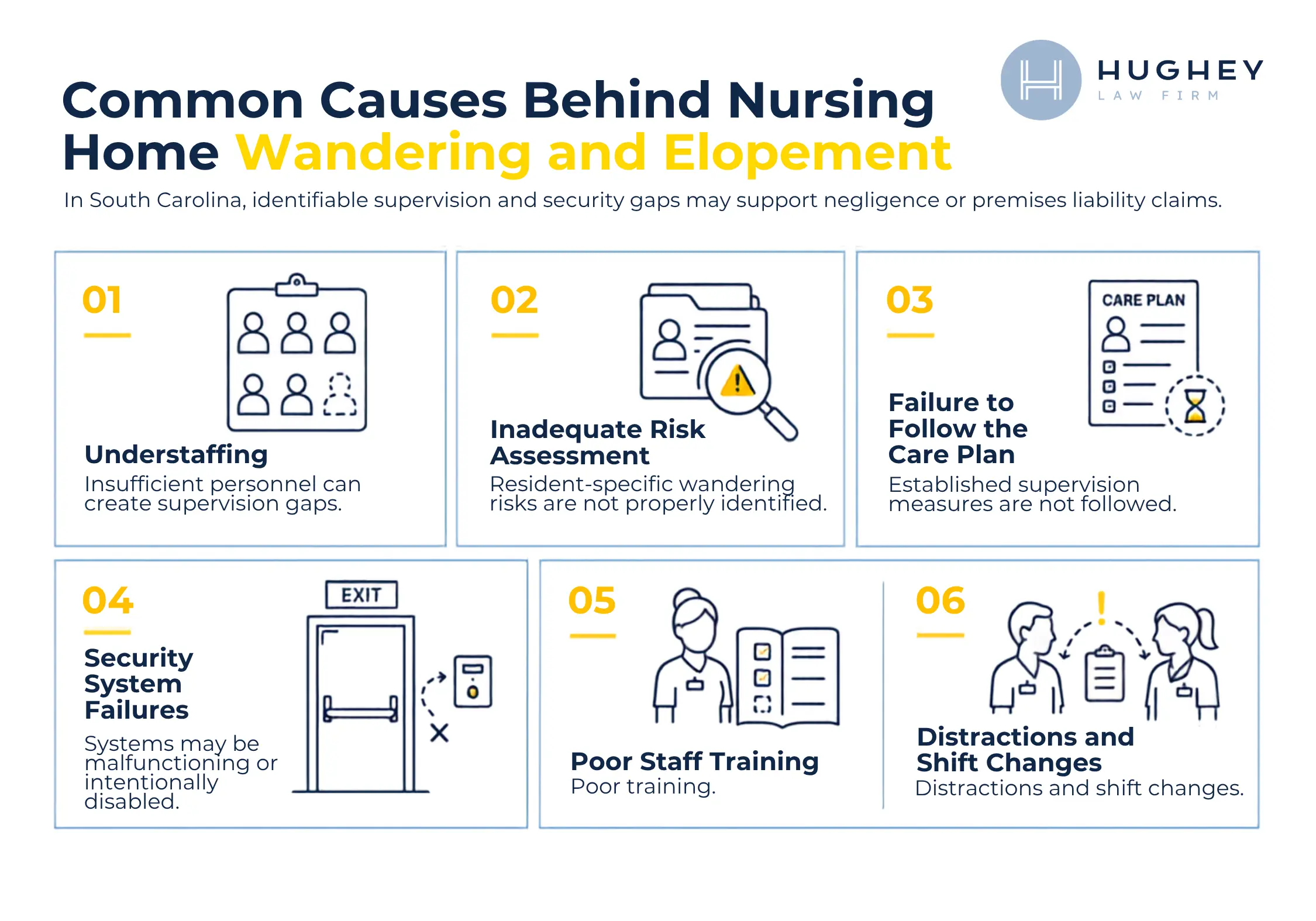
In Charleston, wandering and elopement incidents in nursing homes and assisted living facilities almost always stem from identifiable gaps in supervision or security systems, rather than from unforeseeable accidents. This is why such incidents form the basis for premises liability and negligence claims against the facilities where they occur. The following are the most common causes identified in wandering and elopement cases handled by Hughey Law Firm.
- Understaffing
- Inadequate risk assessment
- Failure to follow the care plan
- Malfunctioning or disabled security systems
- Poor staff training
- Distractions and shift changes
Each of these causes is a violation of the standard of care required by South Carolina law of licensed nursing homes and assisted living facilities. Call (843) 881-8644 to speak with our Charleston nursing home wandering and elopement lawyer about whether one of these failures contributed to your loved one’s incident of wandering or elopement.
Dangers of Wandering and Elopement for Nursing Home Residents
The consequences of unsupervised wandering or elopement can be severe and, in many cases, fatal.
A resident who wanders inside the facility risks falling, getting into altercations with other residents, and getting injured by entering restricted or hazardous areas, such as kitchens or chemical storage rooms.
A resident who elopes faces an even greater danger. Residents who leave a facility have been struck by vehicles in hit-and-run accidents, suffered serious falls outside, been assaulted by strangers, and experienced exposure injuries, including hypothermia and frostbite, which can lead to amputation. In the most tragic cases, elopement results in death, sometimes from drowning, exposure, or being struck by a vehicle while disoriented near roadways.
Residents with dementia or Alzheimer’s are especially vulnerable outside of a supervised setting because they often cannot find their way back, communicate their location, or recognize danger. This is precisely why Charleston nursing homes and assisted living facilities are legally required to proactively prevent these incidents, rather than merely respond after the fact.
Who Can Be Held Liable for Wandering and Elopement Injuries?
Nursing homes and assisted living facilities are obligated to know the location of every resident at all times. This obligation does not pause during shift changes, mealtimes, or busy periods. If a facility fails to meet this obligation and a resident wanders or leaves the facility, several parties may be held legally responsible.
- The facility itself
- Facility administrators
- Individual staff members
- Third-party security or maintenance contractors
Facilities that have been found to have falsified or altered required documentation, including logs that account for every resident’s whereabouts, face additional scrutiny in these elder abuse cases.
Compensation Available in Charleston Wandering and Elopement Cases
Families pursuing a wandering or elopement claim against a Charleston nursing home or assisted living facility may be eligible for compensation in four categories. These categories may expand to include wrongful death and punitive damages if the facility’s conduct was particularly egregious. The following categories of compensation are available in wandering and elopement cases in Charleston:
- Economic damages cover concrete financial losses, including emergency medical treatment, hospitalization, surgery, rehabilitation, and funeral or burial expenses in fatal cases.
- General damages address the human cost of the incident, including pain and suffering, emotional trauma, and the loss of companionship suffered by surviving family members.
- Wrongful death damages are available when a wandering or elopement incident results in a resident’s death. South Carolina law allows the personal representative of the estate to pursue this claim on behalf of surviving family members.
- Punitive damages may be available under South Carolina Code Section 15-32-510 when there is clear and convincing evidence that the facility’s conduct was willful, wanton, or reckless, such as a documented pattern of ignoring known security failures.
The availability of punitive damages in cases involving documented patterns of ignored security failures distinguishes them from most other premises liability claims. This distinction can substantially affect the total value of a wandering or elopement case. Call (843) 881-8644 and a nursing home wandering and elopement attorney will discuss the full scope of your family’s claim.
South Carolina Nursing Home Elopement Laws and Regulations
South Carolina nursing homes must comply with state and federal regulations that govern resident safety and supervision. The South Carolina Adult Protection Code, established via the Omnibus Adult Protection Act, imposes civil and criminal penalties on facilities that neglect the basic safety needs of vulnerable adults. Federal regulations under 42 C.F.R. Part 483 require nursing homes to assess every resident for risk of wandering and provide a safe environment. Noncompliant facilities risk losing Medicare and Medicaid funding.
Facilities must also maintain accurate and regular documentation accounting for each resident’s location. This documentation is critical evidence in wandering and elopement cases, especially when gaps, inconsistencies, or signs of alteration after an incident are present.
What Families Should Do After a Wandering or Elopement Incident
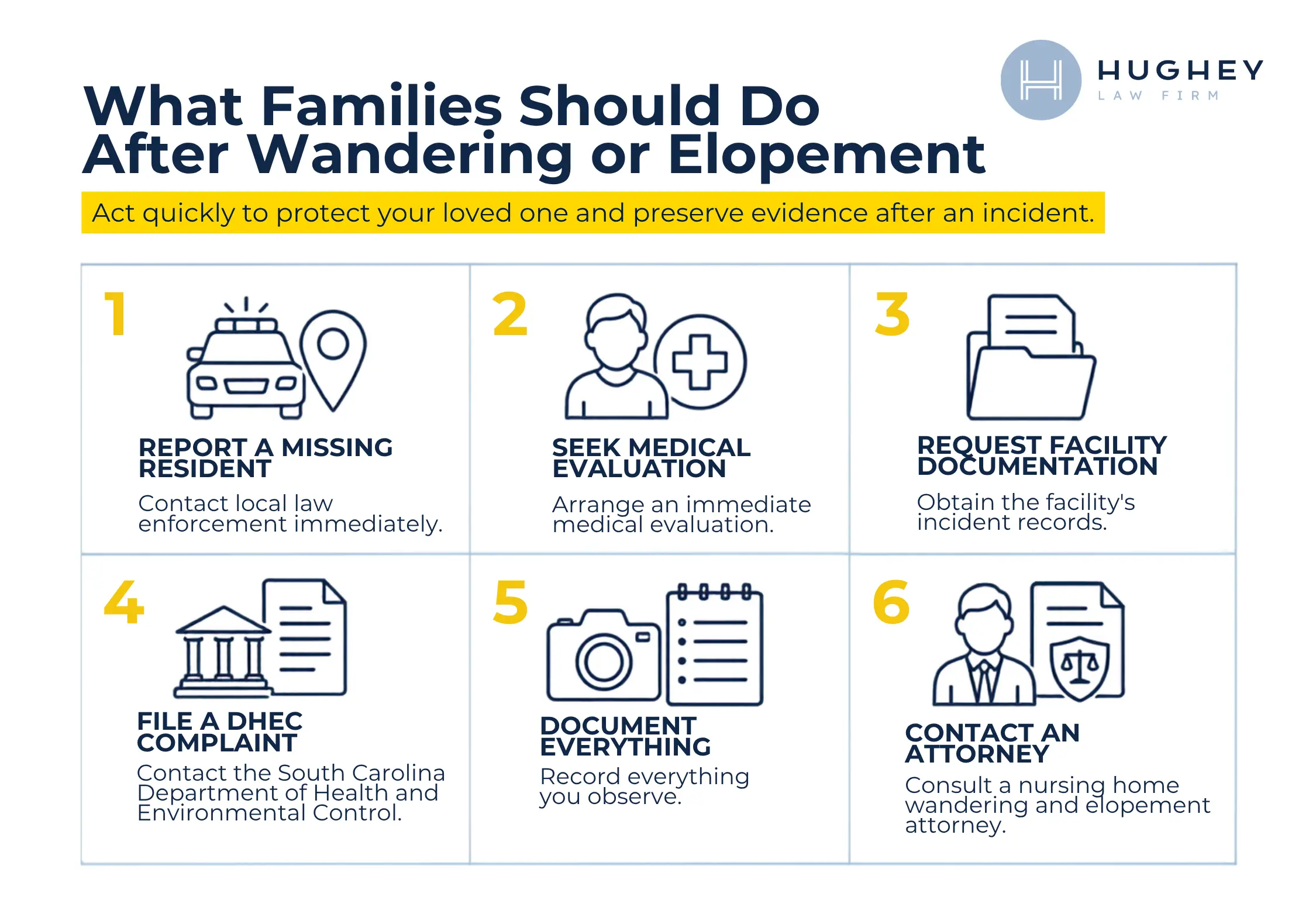
After a wandering or elopement incident at a Charleston nursing home or assisted living facility in the Charleston area, families must act quickly to protect the resident’s safety and lay the groundwork for a potential legal claim. Several critical actions must be taken in the immediate aftermath of the incident. After such an incident, families should act quickly to protect their loved one and preserve evidence.
- Report the incident to local law enforcement immediately if your loved one is missing.
- Seek immediate medical evaluation
- Request the facility’s documentation
- File a complaint with the South Carolina Department of Health and Environmental Control
- Document everything you observe
- Contact a nursing home wandering and elopement attorney
The facility’s documentation of an elopement event, including incident reports, care plans, and security system records, begins to take shape in the hours following the event. Having an attorney involved early on ensures that the legal record accurately reflects what happened rather than what the facility documents later. Call (843) 881-8644 to speak with Hughey Law Firm today.
Contact a Charleston Nursing Home Elopement Attorney Today
If your loved one has wandered away from or eloped from a nursing home or assisted living facility in Charleston, you do not have to face this alone. The Hughey Law Firm has represented families throughout the Charleston metropolitan area and across South Carolina. We handle every case with the urgency and seriousness it deserves.
We work on a contingency basis, so you will not pay any attorney fees until we win your case.
Call (843) 881-8644 for a free consultation, fill out our contact form, or use live chat to speak with our team now. We represent families throughout Charleston, the Lowcountry, and across South Carolina.
Disclaimer: The information on this page is intended for general informational purposes only and does not constitute legal advice. Every case is different. Past results do not guarantee future outcomes. Hiring a lawyer is an important decision that should not be based solely on advertisements. Ask us to send you free written information about our qualifications and experience before you decide. The Hughey Law Firm is located in Charleston, South Carolina.
Frequently Asked Questions
About Nursing Home Wandering and ElopementYes. Assisted living facilities carry the same basic duty to assess wandering risk and provide appropriate supervision as nursing homes, even though the two facility types operate under different licensing structures.
Contact local law enforcement immediately, notify the facility, and once your loved one is safe, request all documentation related to the incident and contact an attorney.
Evidence including the resident’s care plan, staffing schedules, security footage, supervision logs, and witness statements can show whether the facility identified the wandering risk and failed to act on it.
Yes. Families can pursue a negligence claim against the facility, and if the incident resulted in death, surviving family members may pursue a wrongful death claim.
Yes. Facilities are required to assess every resident for wandering risk, document that risk in the care plan, and provide supervision appropriate to the level of risk identified.
Yes. If a facility failed to properly assess a resident’s wandering risk, follow the resident’s care plan, or maintain adequate supervision and security, the facility can be held legally liable for resulting injuries.
Dementia and Alzheimer’s disease affect memory, judgment, and the ability to recognize danger, making residents with these conditions far more likely to wander or attempt to leave a facility without understanding the risk involved.