
 When a business dispute arises in Charleston, the stakes are high. Whether it’s a breach of contract, a partnership conflict, a commercial lease dispute, or a fraud claim, these issues can disrupt operations, damage relationships, and result in significant financial exposure. Resolving these disputes requires an attorney who understands the legal framework and business realities involved.
At Hughey Law Firm, we represent Charleston businesses, business owners, and commercial parties in disputes at every stage, from pre-litigation negotiation to trial, if necessary. We represent plaintiffs and defendants in commercial and business disputes in Charleston, Mount Pleasant, North Charleston, and across South Carolina.
Charleston Business Litigation Guide
- Common Types of Business Disputes We Handle
- Experienced Business and Commercial Litigation Services in Charleston, SC
- Do You Need a Business Litigation Attorney in Charleston?
- How Business Litigation Cases Are Resolved
- What Damages Can You Recover in Business Litigation?
- Frequently Asked Questions
Common Types of Business Disputes We Handle
The Hughey Law Firm handles commercial and business litigation involving a wide range of disputes in Charleston, SC. The most common cases we take on include the following:
- Contract disputes arising from breaches of service agreements, delivery contracts, promissory notes, buy-sell agreements, and employment and consulting contracts.
- Non-compete and restrictive covenant disputes involving the enforcement or defense of non-compete agreements, non-solicitation clauses, and trade secret protections.
- Partnership and shareholder disputes between business co-owners concerning profit distributions, management authority, fiduciary duties, and business dissolution under the South Carolina Business Corporation Act.
- Commercial lease disputes between landlords and tenants concerning lease terms, rent obligations, property conditions, and lease termination.
- Fraud and misrepresentation claims arising from deceptive business practices, misleading representations in commercial transactions, and fraudulent inducement into contracts.
- Unfair trade practices under South Carolina’s Unfair Trade Practices Act, including deceptive business conduct and unlawful competitive practices.
- Interference with contractual relations, which occurs when a third party intentionally disrupts an existing business relationship or contract.
- Real estate, mortgage, and commercial lending disputes involving commercial property transactions, loan agreements, and mortgage fraud.
- Construction litigation includes disputes over construction contracts, project delays, defective work, and payment obligations.
Experienced Business and Commercial Litigation Services in Charleston, SC
Hughey Law Firm handles commercial disputes at every stage of the resolution process. Many business disputes are resolved through negotiation or alternative dispute resolution before reaching trial. Others require full litigation. Our firm is prepared for both scenarios, which leads to better outcomes at every stage because opposing parties and their counsel recognize our willingness to take a case to verdict.
Our business litigation representation includes the following services:
- Pre-litigation assessment and strategy.
- Negotiation and demand letters.
- Alternative dispute resolution.
- We also provide commercial litigation and trial representation.
- We defend commercial claims.
Do You Need a Business Litigation Attorney in Charleston?
While not every business dispute requires immediate litigation, most benefit from early legal guidance. Decisions made during the initial days and weeks of a commercial dispute can significantly affect the outcome. These decisions include what to communicate in writing, whether to accept a settlement offer, and how to preserve evidence.
You should consult a Charleston business litigation attorney if any of the following applies to your situation:
- Another party has breached a contract and failed to perform or pay as agreed.
- A business partner or co-owner is acting against the company’s interests.
- A non-compete or confidentiality agreement has been violated.
- A commercial tenant or landlord has failed to meet their lease obligations.
- You have been accused of fraud, misrepresentation, or unfair trade practices.
- A competitor is engaging in unlawful conduct that is damaging your business.
Early legal involvement allows an attorney to evaluate the claim, send preservation demands for relevant documents and communications, and advise on the best course of action before the dispute escalates.
How Business Litigation Cases Are Resolved
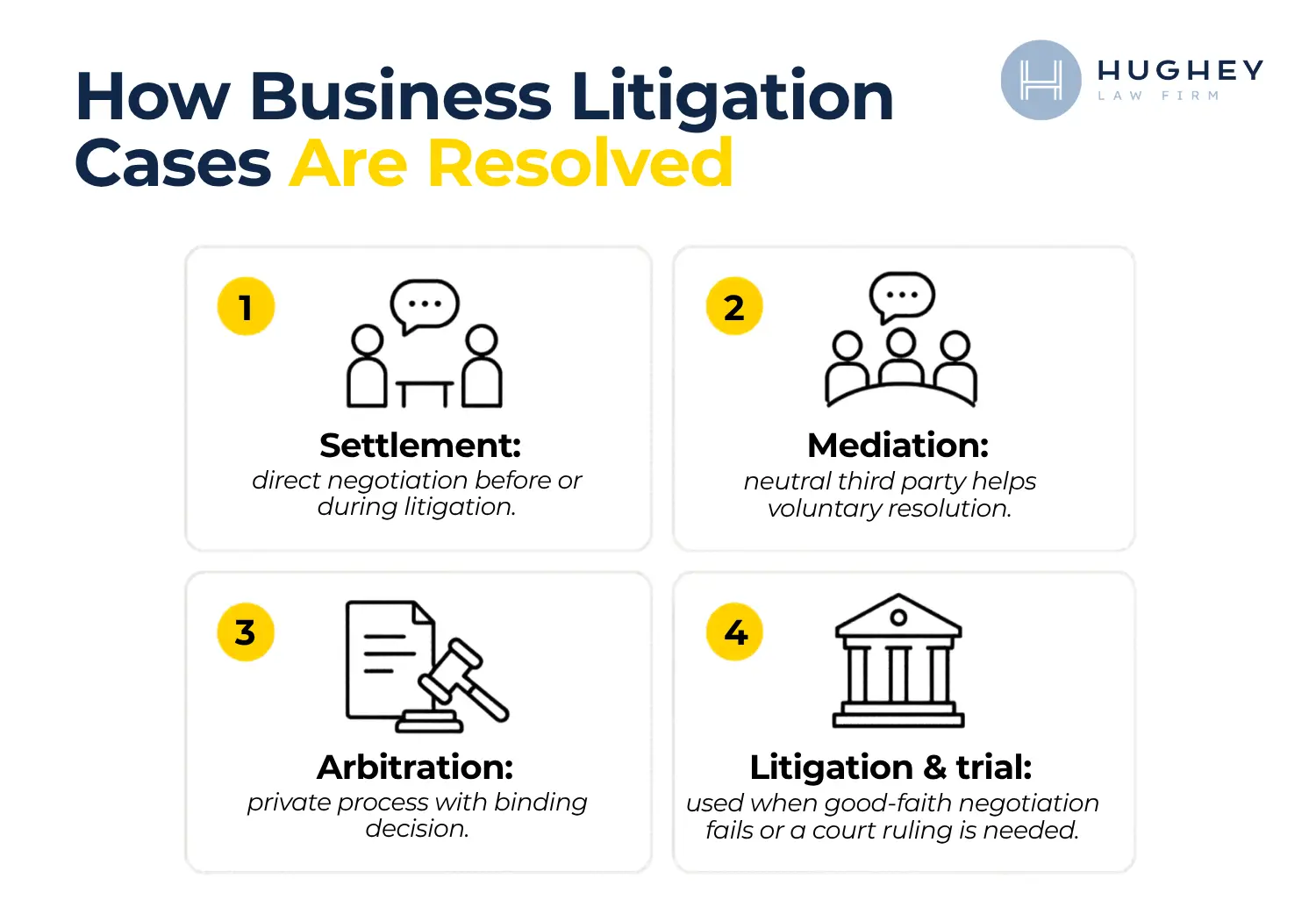
Depending on the nature of the claim, the relationship between the parties, and the terms of any governing contract, business disputes in Charleston are resolved through several different mechanisms:
- The most common outcome is a negotiated settlement. Most commercial disputes are resolved through direct negotiation between the parties and their attorneys before or during the litigation process.
- Mediation involves a neutral third party who helps both sides reach a voluntary resolution. Commercial mediations follow rules established by the South Carolina Supreme Court Commission on Alternative Dispute Resolution to maintain confidentiality.
- Arbitration is a private adjudication process that produces a binding decision. Commercial contracts often include arbitration clauses that require disputes to be resolved outside of court.
- Litigation and trial become necessary when the other party refuses to negotiate in good faith or when the stakes require a court ruling.
What Damages Can You Recover in Business Litigation?
The types of damages available in a business litigation case depend on the specific claims and the nature of the harm.
- Compensatory damages reimburse the injured party for actual financial losses, including lost profits, unpaid amounts owed under a contract, breach-related costs, and other direct economic harm.
- Consequential damages address losses that stem from the breach but are not the direct monetary value of the contract itself. Examples include lost business opportunities and financial harm caused by the other party’s failure.
- Specific performance is a remedy available in some contract cases where monetary damages are insufficient. It requires the breaching party to fulfill their contractual obligations.
- Injunctive relief may be available to stop ongoing harmful conduct, such as a competitor violating a non-compete agreement or continuing to engage in unfair trade practices.
- Punitive damages may be available in cases of fraud or intentional misconduct under South Carolina law if the defendant’s conduct was particularly egregious.
- Attorney fees and costs may be recoverable in certain types of commercial claims, including those involving unfair trade practices under South Carolina’s Unfair Trade Practices Act.
 Contact a Charleston Business Litigation Attorney Today
Are you involved in a business dispute in Charleston or anywhere in South Carolina? Hughey Law Firm is ready to evaluate your situation and advise you on the best way to resolve it. We represent plaintiffs and defendants in commercial and business disputes, offering flexible fee arrangements including contingency, flat fee, and hourly billing options, depending on the nature of the case.
We offer free initial consultations and are available for evening and weekend appointments. From our Mount Pleasant office, we represent clients throughout the Charleston metropolitan area and across South Carolina.
Call (843) 881-8644 for a free consultation, fill out our contact form, or use live chat to speak with our team now. We represent families throughout Charleston, the Lowcountry, and across South Carolina.
Disclaimer: The information on this page is for informational purposes only and does not constitute legal advice. Every case is different. Past results do not guarantee future outcomes. Hiring a lawyer is an important decision that should not be based solely on advertisements. Ask us to send you free written information about our qualifications and experience before you decide. The Hughey Law Firm is located in Charleston, South Carolina.
Frequently Asked Questions
About Business LitigationYou have the right to pursue legal action for breach of contract and seek compensatory damages for your losses, as well as specific performance, which would require the other party to fulfill their obligations. An attorney can evaluate your case and recommend the best course of action.
They are resolved through the terms of the lease agreement, applicable South Carolina landlord-tenant law, and negotiation or litigation when the parties cannot agree. Common issues include unpaid rent, lease termination, property condition obligations, and lease interpretation disputes.
According to South Carolina’s Unfair Trade Practices Act, deceptive and unlawful business practices that harm competition or consumers are prohibited. Successful claimants may recover actual damages and, in some cases, treble damages and attorney fees.
Yes. According to South Carolina law, a party can file a claim for fraud or misrepresentation if another party made a false statement of fact, knew it was false, intended for the other party to rely on it, and the other party suffered harm as a result. These claims can support both compensatory and punitive damages.
Negotiation involves direct resolution between the parties and their attorneys without court involvement. Litigation involves filing a formal lawsuit and proceeding through the court system. Most disputes begin with negotiation and only escalate to litigation when attempts at a good-faith resolution fail.
Document the breach in writing and preserve all relevant communications and records. Avoid making informal agreements that could complicate your legal position. Contact a business litigation attorney before taking further action or responding to the other party.
They are usually resolved through negotiation, mediation, or litigation, depending on the severity of the conflict and the terms of the governing partnership or shareholder agreement. In some cases, courts may order the dissolution of the business or the buyout of one party’s interest.
A breach of contract occurs when one party fails to fulfill their obligations under a legally binding agreement without valid legal justification. Examples include failure to pay, failure to deliver goods or services, and failure to meet agreed-upon deadlines or quality standards.
Yes. Most business disputes are resolved through negotiated settlements, mediations, or arbitrations before reaching trial. The most effective way to position a dispute for efficient resolution without litigation is through early legal involvement.