
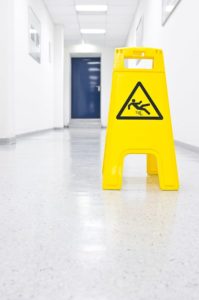
If you were injured on someone else’s property in Charleston or anywhere in South Carolina, the property owner or the party responsible for maintaining the property may be liable for your injuries. Premises liability is a broad legal concept that holds property owners and occupiers accountable when unsafe conditions on their property injure visitors, customers, or guests. This liability covers more than just slip and falls. It also covers negligent security that allows an assault to occur, defective building conditions, swimming pool accidents, elevator and escalator failures, animal attacks, and construction site hazards.
Charleston’s mix of historic downtown properties, active commercial corridors, high-density residential developments, and growing suburban communities creates a wide range of premises liability environments. Unaddressed property conditions in any of these settings can result in serious injuries with long-lasting physical, financial, and personal consequences.
Hughey Law Firm represents victims of premises liability throughout Charleston, North Charleston, Mount Pleasant, and South Carolina.
Charleston Premises Liability Guide
- What Is a Premises Liability Claim in Charleston?
- Common Causes of Premises Liability Accidents in Charleston
- Who Can Be Held Responsible?
- What Makes a Property Unsafe Under South Carolina Law?
- Steps to Take After a Premises Liability Accident
- What Damages Can You Recover?
- Charleston Premises Liability Attorneys Fighting for Injury Victims
- Why Choose Hughey Law Firm?
- Frequently Asked Questions
What Is a Premises Liability Claim in Charleston?
A premises liability claim arises when someone is injured by a defective, dangerous, or negligently maintained condition on another party’s property. The property owner or the party responsible for maintaining the property may be held liable for these injuries if they knew or should have known about the hazardous condition but failed to address it or warn people on the property about it.
In Charleston, premises liability cases are governed by the legal relationship between the injured person and the property owner. South Carolina law recognizes four classifications that affect the duty of care owed:
- Invitees are individuals who enter with the owner’s invitation, typically customers of a business. Property owners owe invitees the highest duty of care, including a duty to actively inspect and correct hazardous conditions.
- Licensees are individuals who enter with the owner’s consent, such as social guests. Owners must warn licensees of known dangers, but they are not required to actively inspect for hazards.
- Adult trespassers are owed no duty of care beyond avoiding willful or wanton injury.
- Children are generally owed a higher standard of care, including protection from attractive nuisances, regardless of whether they were invited onto the property.
Common Causes of Premises Liability Accidents in Charleston
Premises liability claims in Charleston arise from a variety of property types and hazard conditions. Common causes include:
- Slip and Fall Injuries
- Negligent security and assaults
- Swimming pool accidents
- Elevator and escalator failures stem from property managers failing to service equipment in strict accordance with national ASME safety codes.
- Parking lot injuries
- Construction site hazards
- Flooding and water damage
- Dog bites and animal attacks
- Stairwell and ramp accidents
- Amusement park accidents
- Dram shop and liquor liability
- Fires and toxic chemical exposure
Premises liability accidents in Charleston are often worsened by deteriorating walkways and road surfaces; data from national research groups like TRIP outline South Carolina’s surface transportation system gaps, calculating that nearly half of the major roads remain in poor or mediocre condition. Other contributing factors include the concentration of pedestrian traffic through historic downtown areas with uneven surfaces and aging infrastructure, as well as the continuous construction and high-risk pedestrian activity noted across major regional corridors, which have prompted targeted safety enforcement campaigns by the South Carolina Department of Transportation to reduce heavy commercial conflict zones.
Who Can Be Held Responsible?
Depending on the nature of the property and the circumstances of the injury, premises liability cases in Charleston can involve multiple potentially responsible parties.
- Business owners who invite customers onto their property have the highest duty of care and are often defendants in commercial premises liability claims.
- Homeowners who invite guests onto their property are responsible for maintaining safe conditions and warning guests of known hazards.
- Property management companies that are contractually responsible for maintaining a property are liable when their negligence creates or allows dangerous conditions.
- Stores, malls, and restaurants are responsible for the conditions within their premises and adjacent controlled areas.
- Parent companies and corporate ownership entities may share liability when their operational decisions, including staffing and maintenance budgets, create conditions that cause injury.
What Makes a Property Unsafe Under South Carolina Law?
A property condition is legally actionable if it poses an unreasonable risk of harm of which the responsible party was aware or should have been aware and failed to address or warn about in a timely manner. The duty does not require perfection. Rather, it requires reasonable care, taking into account the nature of the property, the foreseeable activity on it, and the class of visitor involved.
For example, a wet floor in a commercial grocery store that staff knew about but failed to mark is an actionable condition. Similarly, a broken stairwell railing in an apartment complex that management ignored for months is also an actionable condition. Inadequate security in a parking garage where prior incidents should have alerted the owner is also an actionable condition. These situations are connected by the gap between what a reasonably careful property owner would have done and what the defendant actually did.
Steps to Take After a Premises Liability Accident in Charleston
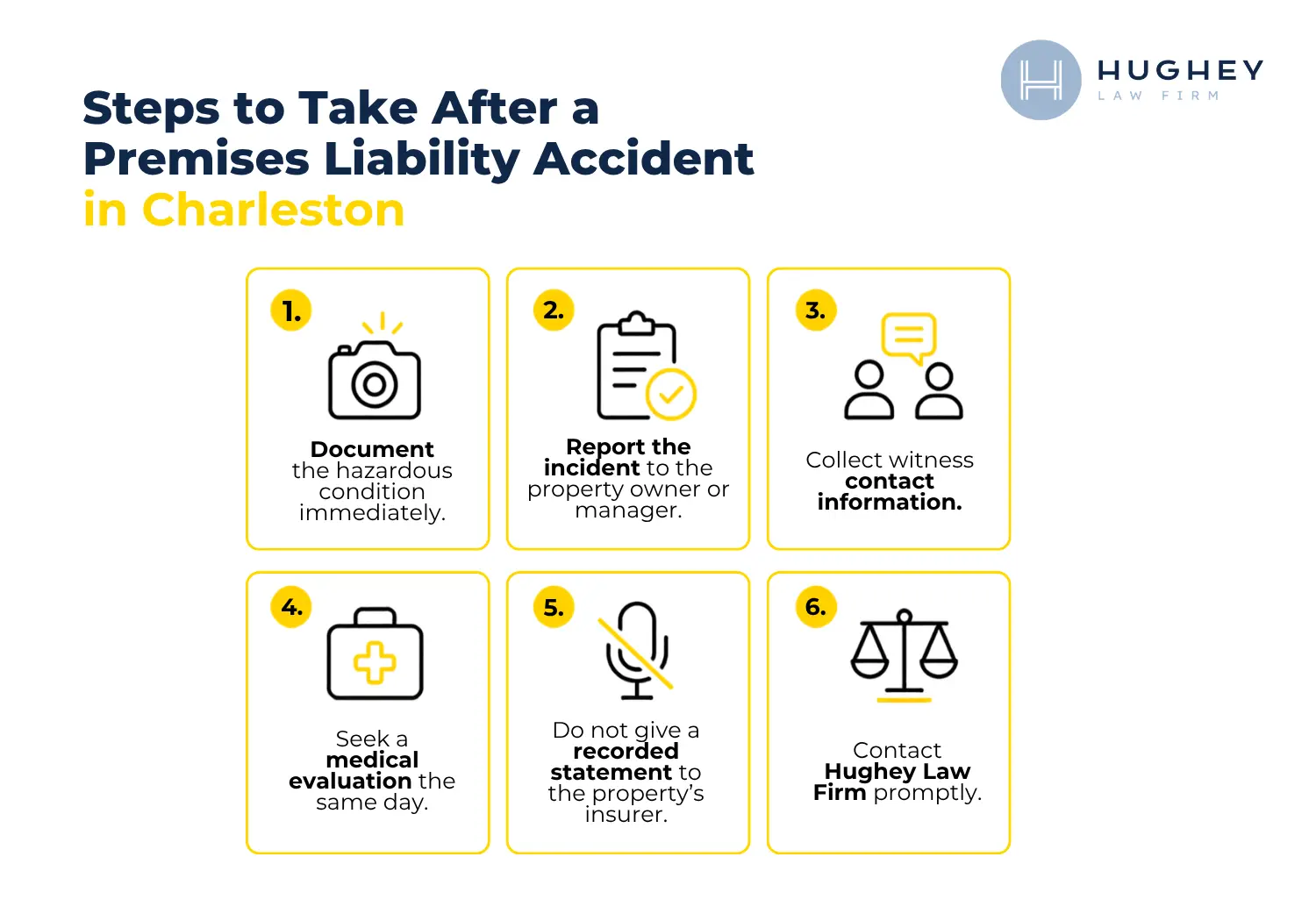
If you are involved in a premises liability accident in Charleston, you should document the scene, report the incident, seek medical attention, and contact an attorney before speaking with the property owner’s insurer. Here are the steps in detail:
- Step 1: Document the hazardous condition immediately.
- Step 2: Report the incident to the property owner or manager.
- Step 3: Collect witness contact information.
- Step 4: Seek a medical evaluation on the same day.
- Step 5: Do not give a recorded statement to the property’s insurer.
- Step 6: Contact Hughey Law Firm promptly.
What Damages Can You Recover?
According to South Carolina law, victims of premises liability can pursue compensation in the following categories.
- Economic damages cover tangible financial losses, such as medical bills, hospital stays, surgeries, prescription medications, rehabilitation and therapy, lost wages, reduced earning capacity, and the cost of ongoing care.
- Non-economic damages include pain and suffering, physical impairment or disfigurement, mental anguish, emotional distress, loss of enjoyment of life, and loss of consortium.
- Punitive damages may be available when there is clear and convincing evidence that the property owner acted recklessly, wantonly, or with malice.
Charleston Premises Liability Attorneys Fighting for Injury Victims
Hughey Law Firm represents injury victims in premises liability cases of all kinds in Charleston and throughout South Carolina. Our attorneys are experienced in identifying all liable parties, including insurers in complex, multiparty claims, as well as coverage under homeowners’ umbrella policies. We collaborate with a network of independent experts, including accident reconstructionists, building safety specialists, and medical professionals, to determine the nature of the hazardous condition and the extent of the resulting injuries.
Previously, Nathan Hughey obtained a $1,625,000 premises liability settlement for a client injured by a dangerous property condition. This result does not guarantee any future outcome. Every case is different and must be evaluated based on its unique facts and circumstances.
Why Choose Hughey Law Firm for Your Charleston Premises Liability Case?
- We provide full case management from start to finish. We handle every aspect of the claim, including the initial investigation, evidence preservation, expert retention, insurance negotiations, and litigation when necessary.
- We provide independent expert support. We collaborate with accident reconstructionists, flooring and building safety specialists, security experts, and medical professionals whose testimony supports the full scope of the claim.
- We have trial capability. When insurance companies decline to offer fair value, Hughey Law Firm takes premises liability cases to trial. This readiness influences how every case is valued and negotiated.
- There is no fee unless we recover. All premises liability cases are handled on a contingency fee basis. You pay no attorney fees unless we secure compensation for you.
- We serve all of South Carolina. From our Charleston office, we represent clients throughout the metro area, including North Charleston, Mount Pleasant, Summerville, Goose Creek, and other South Carolina communities.
Contact a Charleston Premises Liability Attorney Today
If you were injured on someone else’s property in Charleston or anywhere else in South Carolina, the Hughey Law Firm is ready to evaluate your situation and pursue the compensation your injuries warrant. The initial consultation is free and confidential.
Call (843) 881-8644 for a free consultation, fill out our contact form, or use live chat to speak with our team now. We represent families throughout Charleston, the Lowcountry, and across South Carolina.
Disclaimer: The information on this page is intended for general informational purposes only and does not constitute legal advice. Every case is different. Past results do not guarantee future outcomes. Hiring a lawyer is an important decision that should not be based solely on advertisements. Ask us to send you free written information about our qualifications and experience before you decide. The Hughey Law Firm is located in Charleston, South Carolina.
Frequently Asked Questions
About Premises LiabilityNot without consulting an attorney first. These offers are usually designed to resolve the claim quickly for less money than the injury deserves, especially before the full medical picture is known. An attorney can evaluate whether an offer reflects the true value of your claim.
In most cases, the statute of limitations is three years from the date of the injury. However, because evidence deteriorates quickly and insurance companies begin building their defense immediately, contacting an attorney as soon as possible after the incident provides the strongest possible foundation for the claim.
Yes, in most cases. South Carolina’s modified comparative fault system reduces your compensation proportionally by your percentage of fault, as long as it does not exceed 50%. However, if you are found to be fifty-one percent or more at fault, you will not receive any compensation. An attorney can investigate the specific facts of your case to ensure that fault is assessed accurately.
Property owners are liable not only for hazards they knew about, but also for those they should have known about. South Carolina law also holds them responsible for conditions they should have known about had they conducted reasonable inspections. If a hazard existed for a sufficient amount of time for a reasonable inspection to discover it, the owner is considered to have constructive knowledge of it.
The duty of care depends on how the visitor entered the property. Invitees, typically customers of a business, are owed the highest duty. Licensees, typically social guests, are owed a duty to warn of known hazards. Adult trespassers are generally owed no duty beyond protection from intentional harm. Children are generally owed a higher standard.
Premises liability covers a broad range of injuries, including those resulting from negligent security, assaults, swimming pool accidents, elevator and escalator failures, dog bites, construction site hazards, flooding and water damage, parking lot injuries, stairwell accidents, fires, and toxic chemical exposure.