

 If your loved one was harmed due to neglect or abuse in a Charleston assisted living facility, you have the right to pursue compensation and hold the responsible parties accountable. By state law, assisted living facilities across South Carolina are required to provide safe living conditions, adequate personal care, appropriate medical oversight, and an environment free from abuse. When these facilities fail to meet these standards, residents suffer preventable injuries that can permanently affect their health, independence, and quality of life.
South Carolina has over 190 licensed community residential care facilities operating throughout the state, ranging from small residential homes to large, corporate-owned assisted living communities. The South Carolina Department of Health and Environmental Control licenses and inspects these facilities. However, regulatory oversight does not always prevent the neglect and abuse that harms residents. When a facility’s failures injure your loved one, civil legal action is one of the most effective tools available to hold the facility accountable and recover the compensation your family deserves.
Hughey Law Firm represents families throughout Charleston and South Carolina whose loved ones have been harmed by assisted living facility negligence. With over thirty years of experience in elder abuse and care facility claims and over seventy percent of our caseload involving elder abuse, we bring focused and experienced advocacy to every assisted living case we handle.
Why Do Families Throughout South Carolina Trust Hughey Law Firm for Elder Abuse Cases?
Unlike most personal injury firms, which handle elder abuse as one practice area among many, Hughey Law Firm specializes in it. Hughey Law Firm is different, and our expertise is verifiable. Here’s what you need to know about us:
- Nathan Hughey, our founder, began his legal career defending nursing homes.
- Nathan Hughey teaches other attorneys about elder abuse law.
- Attorneys and law firms across South Carolina refer elder abuse cases to us.
- Over 70% of our caseload consists of elder abuse cases.
- Since 2007, we have resolved over 1,000 elder abuse cases in South Carolina.
Over 600 cases resolved for $100,000 or more.
- $1,000,000 recovered for elder abuse resulting in pressure sores in a nursing home
- $875,000 recovered for a client who suffered a broken neck and pelvis in a wheelchair accident
- $497,500 recovered for a client who fell and broke their hip in a nursing home
The results described above are specific to those cases and are not intended to predict or guarantee the outcome of any future case. Each case is unique, and outcomes depend on the particular facts and legal circumstances involved. Hiring a lawyer is an important decision that should not be based solely on advertisements.
Charleston Assisted Living Facility Guide
- Types of Assisted Living Facility Claims
- Signs an Assisted Living Facility Is Not Providing Proper Care
- Common Causes of Assisted Living Neglect
- Resident Rights in South Carolina Assisted Living Facilities
- What Families Should Do Immediately After Suspected Neglect
- How to Seek Compensation From a Charleston Assisted Living Facility
- Compensation Available in Assisted Living Facility Cases
- Assisted Living Facilities in the Area
- Frequently Asked Questions
Types of Assisted Living Facility Claims
Assisted living facilities in Charleston serve residents who need help with daily activities yet still maintain a degree of independence. Their legal duty of care is distinct from, yet equally serious as, that of higher-acuity facilities. The most common types of claims our Charleston assisted living attorneys handle are listed below:
Negligence and Inadequate Care
Negligence in an assisted living facility occurs when the staff fails to provide the level of care that the facility is licensed and required to provide. Examples of negligence include failing to assist with personal care tasks, inadequately managing medication, insufficiently monitoring residents with known health risks, and failing to maintain sanitary living conditions.
Specific examples include poor medication management leading to missed doses or adverse interactions for residents managing chronic conditions such as diabetes, heart disease, or respiratory illness. Negligence also includes chronic dehydration and malnutrition resulting from inadequate meal delivery and hydration monitoring, particularly for residents with dementia who cannot independently request food or water.
Slip and Fall Injuries
Slip and Falls are a leading cause of serious injury among elderly residents of assisted living facilities in Charleston. These facilities have a legal duty to maintain safe premises, assess residents for fall risk, and implement appropriate supervision and environmental safeguards.
Common causes of preventable falls in assisted living settings include:
- Inadequate supervision of residents at risk of falling
- Failure to use fall prevention protocols
- Poorly maintained flooring
- Unsecured rugs or carpets
- Obstructions in walkways
- Inadequate lighting in common areas and hallways
- Poorly maintained stairs, ramps, and handrails
Serious fall injuries sustained by assisted living residents often include hip fractures, traumatic brain injuries, spinal cord injuries, and severe soft tissue damage. These injuries can permanently alter a resident’s functional capacity and quality of life. The facility that failed to prevent the fall is responsible for all resulting consequences.
Pressure and Bed Sores
Pressure and bed sores develop when prolonged pressure cuts off blood flow to an area of the skin. For assisted living residents who require assistance with repositioning, the development of pressure ulcers is almost always evidence of inadequate care.
Facilities are required to assess residents for pressure ulcer risk and implement care plans to prevent them. If a facility fails to regularly reposition immobile residents, pressure ulcers can progress from surface-level redness to open wounds that affect deeper tissue. This creates significant pain and a risk of life-threatening infection. A stage 2 or higher pressure ulcer in a resident who did not arrive at the facility with skin breakdown is a serious red flag, warranting immediate medical attention and legal evaluation.
Abuse
Residents of assisted living facilities may experience physical, emotional, sexual, or financial elder abuse at the hands of staff members or other individuals in positions of trust.
- Physical abuse includes rough handling, improper use of restraints, and the intentional use of force that causes injury.
- Emotional abuse includes threats, humiliation, and isolation from family.
- Financial abuse involves the unauthorized use of a resident’s funds or assets.
Signs an Assisted Living Facility Is Not Providing Proper Care
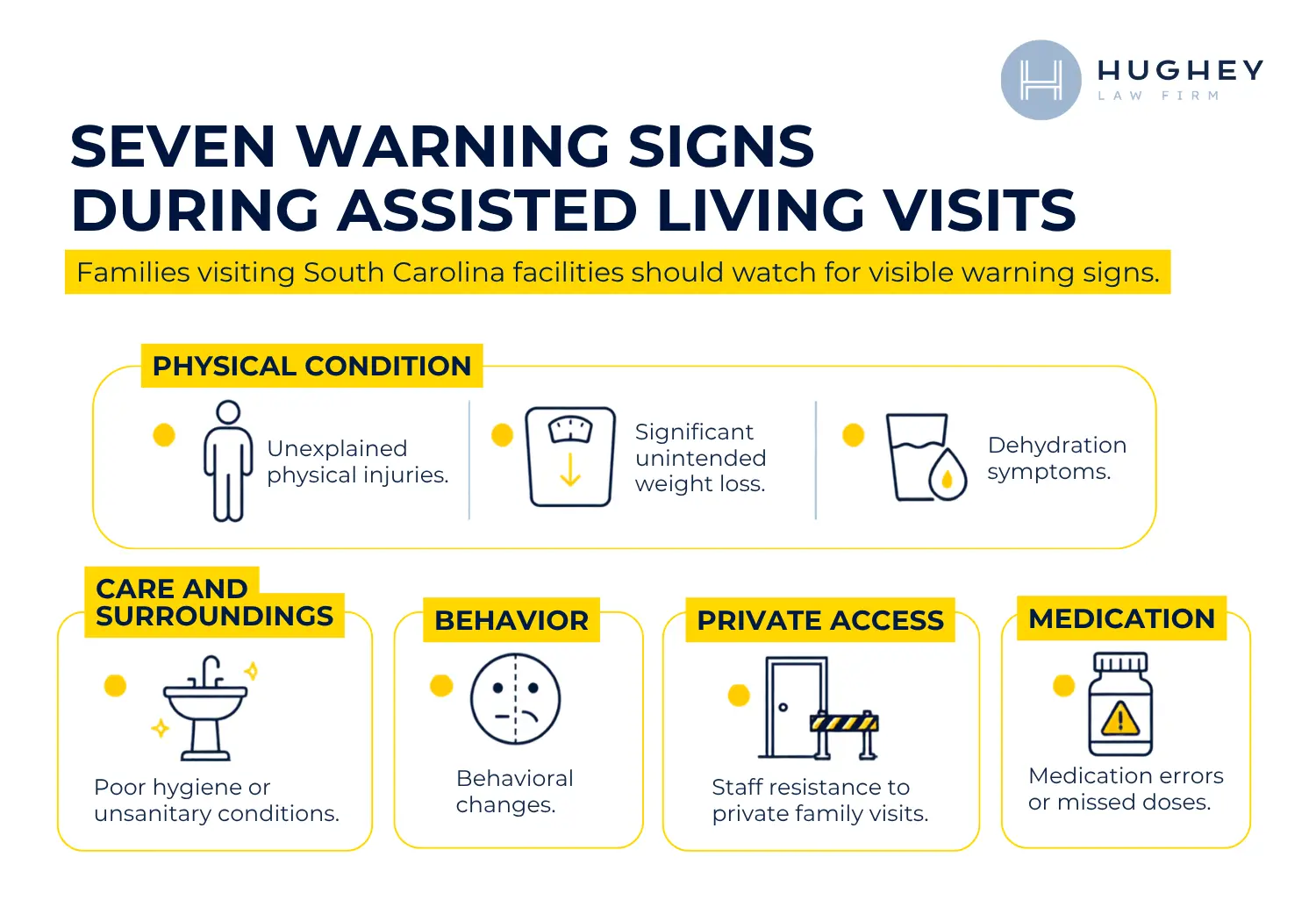
Warning signs of neglect in assisted living facilities are often visible during regular family visits, long before the resulting harm becomes medically acute. Recognizing these signs early creates an opportunity to intervene before a preventable condition worsens. Families visiting loved ones in Charleston assisted living facilities should watch for the following warning signs during every visit:
- Unexplained physical injuries.
- Significant unintended weight loss.
- Poor hygiene or unsanitary conditions.
- Dehydration symptoms.
- Behavioral changes.
- Staff resistance to private family visits is another sign.
- Medication errors or missed doses.
No warning sign on this list should be dismissed as an isolated incident. Each sign reflects an obligation of care that the facility is failing to meet or concealing. A pattern of these signs across multiple visits is grounds for immediate legal action. If you have observed any of these signs during visits to a loved one’s Charleston area facility, call Hughey Law Firm at (843) 881-8644 to speak with an assisted living facility lawyer.
Common Causes of Assisted Living Neglect
Neglect in assisted living facilities in Charleston is the predictable outcome of systemic facility decisions regarding staffing, training, and cost management. These decisions compound over time, creating patterns of care failure. Residents and their families are often the last to learn about these patterns. Most cases of assisted living neglect in Charleston result from systemic facility failures.
- The most consistent driver of neglect in Charleston assisted living facilities is chronic understaffing. When facilities do not maintain adequate staff-to-resident ratios, basic care tasks are often delayed, abbreviated, or skipped entirely.
- Neglect also occurs when employees are placed in direct care roles without the necessary knowledge or supervised experience to manage residents with complex needs due to inadequate staff training.
- High staff turnover disrupts continuity of care, meaning that individual residents’ specific needs, preferences, and documented risks are often unknown to the staff providing their care.
- Corporate cost-cutting at the ownership and management levels produces neglect when budget decisions reduce staffing, supplies, or facility maintenance below the levels required to deliver safe care.
- Failure to implement individual care plans occurs when a facility has documented a resident’s known risks but fails to follow the designed protocols to address them. This failure consistently appears in Charleston facility inspection deficiency reports.
Facilities are legally responsible for the harm they cause. Call (843) 881-8644 to speak with the Hughey Law Firm about which institutional failures may have contributed to your loved one’s situation.
Resident Rights in South Carolina Assisted Living Facilities
All residents of South Carolina assisted living facilities have legally protected rights under state and federal frameworks.
South Carolina’s Bill of Rights for Residents of Long-Term Care Facilities ensures that assisted living residents are treated with dignity and respect. It also guarantees them the right to be free from abuse and neglect, to have privacy and confidential communication, to manage their own financial affairs, and to voice grievances without fear of retaliation.
According to South Carolina Code of Regulations 61-84, which governs the licensing of community residential care facilities, assisted living facilities must provide residents with adequate nutrition, hydration, personal care, and a safe living environment. Facilities must also maintain adequate staffing levels to meet residents’ assessed needs and maintain current care plans for every resident.
The South Carolina Omnibus Adult Protection Act establishes civil and criminal consequences for the abuse and neglect of vulnerable adults in care settings and sets forth the mandatory reporting obligations that apply to facility staff.
If a facility violates a resident’s legally protected rights and the violation causes harm, there is a direct legal basis for a civil claim, in addition to the underlying negligence theories that govern most assisted living cases.
What Families Should Do Immediately After Suspected Neglect
In Charleston, when assisted living neglect is suspected, the actions taken in the first hours and days are crucial for ensuring the resident’s ongoing safety and for establishing a comprehensive evidentiary record for any subsequent investigation or legal claim. Several critical steps must be taken before the facility has the opportunity to shape its own account. If you suspect that your loved one is being neglected or abused in an assisted living facility in Charleston, take the following steps as soon as possible:
- Step 1: Address any immediate safety needs.
- Step 2: Document everything you observe.
- Step 3: Request care records immediately.
- Step 4: Speak privately with your loved one.
- Step 5: Notify the facility in writing.
- Step 6: Report to DHEC.
- Step 7: Report to Adult Protective Services.
- Step 8: Contact Hughey Law Firm before speaking with the facility’s insurer.
From the moment a family raises a concern, the facility’s account of what happened and why begins to take shape. An attorney involved at this stage can ensure the legal record reflects the actual contents of the care records and inspection history rather than the facility’s preferred version. Call (843) 881-8644 and allow Hughey Law Firm to get involved before it’s too late.
How to Seek Compensation From a Charleston Assisted Living Facility
Depending on the specific circumstances of the case, multiple parties may bear legal responsibility if your loved one was harmed due to assisted living facility negligence.
The operating facility is primarily liable for its staff’s conduct and systemic failures in care delivery. If a facility relies on outside staffing agencies, those agencies may share liability if they place workers with known deficiency histories or fail to verify credentials. Contractors and vendors whose negligence caused or contributed to harm on the premises of the facility may also be liable in specific circumstances.
At Hughey Law Firm, we investigate every element of the claim from the earliest stage of representation. This includes obtaining and analyzing all facility records, reviewing Department of Health and Environmental Control (DHEC) and Centers for Medicare & Medicaid Services (CMS) inspection history and deficiency citations, retaining appropriate expert witnesses, and sending preservation letters to prevent relevant documentation from being altered or lost.
From the moment we are retained, we handle all communications with the facility, its management, and its insurers, so families can focus on their loved ones rather than managing a complex legal process.
Compensation Available in Assisted Living Facility Cases
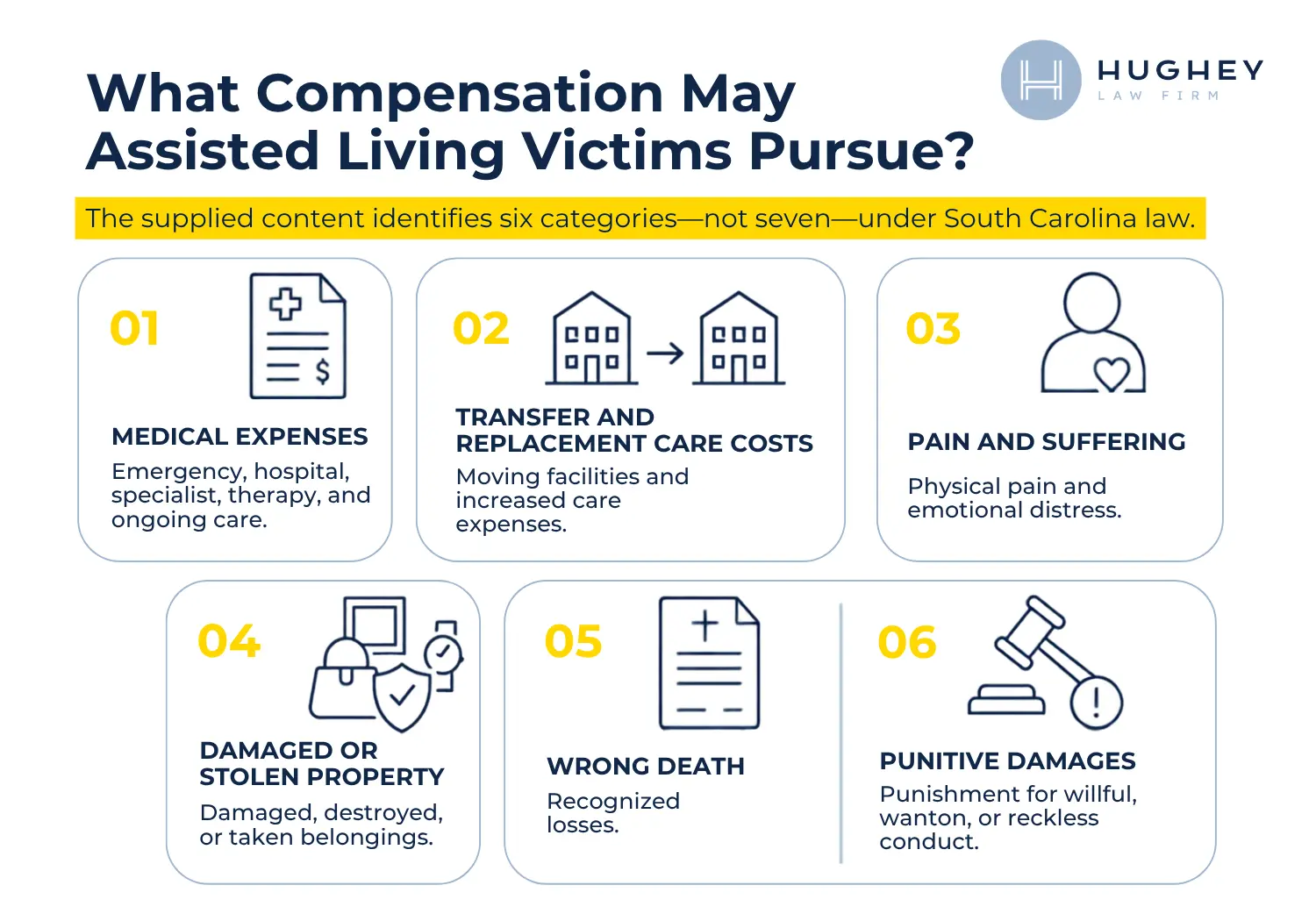
According to South Carolina law, victims of assisted living facility negligence and their families can pursue compensation in six categories. One of these categories, transfer and replacement care costs, is specific to assisted living cases and does not apply to other nursing home or premises liability contexts. According to South Carolina law, victims of assisted living facility negligence can pursue compensation in the following categories:
- Medical expenses may include emergency care, hospitalization, specialist treatment, wound care, physical therapy, and any other ongoing medical needs resulting from the facility’s failures.
- Transfer and replacement care costs include the expenses of moving a resident to a new facility due to neglect or abuse and the increased care costs resulting from injuries sustained at the prior facility.
- Pain and suffering compensation covers the physical pain and emotional distress experienced by the resident as a result of the facility’s failures. In most Charleston, South Carolina assisted living negligence cases, these non-economic damages are not subject to a statutory cap.
- Damages are available for damaged or stolen property when personal belongings are damaged, destroyed, or taken in connection with neglect or abuse.
- Wrongful death damages are available when a resident dies as a result of neglect or abuse at an assisted living facility, including funeral and burial expenses, loss of companionship, and other losses recognized under South Carolina’s wrongful death statute.
- Punitive damages may be available in cases where the facility’s conduct was willful, wanton, or reckless. These damages are designed to punish the facility and deter similar conduct.
At Hughey Law Firm, all assisted living facility cases are handled on a contingency fee basis. You will not be charged any legal fees unless we secure compensation for your family. Call (843) 881-8644 to schedule a free consultation with our assisted living facility abuse attorney and learn more about what your family’s claim may cover.
We’re Not Afraid to Take on the Biggest Assisted Living Facilities in the Area
If an assisted living facility injured you or your loved one, call us.
We’ve already won cases against all of these businesses:
- Anderson Oaks Assisted Living
- Ashley Gardens Alzheimer’s Special Care Center
- Ashley River Plantation
- Bayshore on Hilton Head Island
- Benton House of Aiken
- Benton House of Bluffton
- Benton House of West Ashley
- Blake at Carnes Crossroads
- Bloom at Belfair
- Bloom at Bluffton
- Bridge Assisted Living at Life Care Center of Charleston
- Brookdale Assisted Living Facilities
- Carolina Gardens Assisted Living Facilities
- East Cooper Medical Center
- Elmcroft of Florence
- Generations Assisted Living Facilities
- Heath Springs Residential Care Center
- Jolley Acres Healthcare Center
- Lakes at Litchfield Assisted Living
- Magnolias of Summerville
- Morningside Assisted Living Facility
- Myrtle Beach Manor Retirement Community
- Palmettos Assisted Living Facilities
- Pinewood Place
- Presbyterian Communities of South Carolina Assisted Living Facilities
- Rice Estate Rehabilitation and Nursing
- Savannah Hall Assisted Living Facilities
- Summit Place Assisted Living Facilities
- Sweetgrass Court Senior Living Community
- Sweetgrass Village Assisted Living Community
- Veterans Victory House
- Wellmore Assisted Living Facilities
- Wildewood Downs
- Windsor House
Even if you don’t see the facility that injured you or your loved one on that list, call us. We know what it takes to investigate allegations of neglect and build a successful case against those and other assisted living facilities that have injured our clients—and we want to help you no matter where the abuse or neglect took place.
 Speak With a Charleston Assisted Living Facility Attorney Today
If your loved one was harmed in a South Carolina assisted living facility, the Hughey Law Firm can help your family understand what happened and pursue the full compensation to which you are entitled under South Carolina law. You don’t have to navigate this process alone, and the initial consultation is free.
Call (843) 881-8644 for a free consultation, fill out our contact form, or use live chat to speak with our team now. We represent families throughout Charleston, the Lowcountry, and across South Carolina.
Disclaimer: The information on this page is for informational purposes only and does not constitute legal advice. Every case is different. Past results do not guarantee future outcomes. Hiring a lawyer is an important decision that should not be based solely on advertisements. Ask us to send you free written information about our qualifications and experience before you decide. The Hughey Law Firm is located in Charleston, South Carolina.
Frequently Asked Questions
About Assisted Living Facility AbuseMost assisted living facility claims are resolved through negotiated settlements before trial. However, Hughey Law Firm prepares every case as though it will go to trial, which produces better outcomes at every stage. If a fair resolution cannot be reached, we will take your case to trial.
In most cases, the statute of limitations for assisted living facility negligence claims is three years from the date of injury or discovery. Wrongful death claims arising from assisted living neglect have a three-year limitations period from the date of death. Contact an attorney promptly to ensure all applicable deadlines are identified.
Yes. If you have power of attorney for a loved one who was harmed, you can pursue a claim on their behalf. If a loved one died due to neglect in an assisted living facility, the personal representative of the estate may bring a wrongful death claim under South Carolina law.
The most common causes are chronic understaffing, inadequate staff training, high employee turnover, and management-level cost-cutting that reduces the quality of care below required standards. Regardless of the cause, the facility is legally responsible for any harm caused to residents by its staff’s failures.
No, not before consulting an attorney. Representatives and insurers often contact families quickly after an incident. They may attempt to gather statements that reduce the facility’s liability or offer early settlements that do not reflect the claim’s full value. Contact Hughey Law Firm before communicating with any facility representative or insurance adjuster.
Yes. Assisted living facilities in South Carolina must assess residents for fall risk, implement prevention protocols, and maintain safe premises. If a facility fails to do so and a resident is injured in a fall, the facility is liable for the resulting harm.
Assisted living facilities are licensed as community residential care facilities under the South Carolina Code of Regulations, 61-84. They serve residents who maintain a degree of independence and do not require the level of skilled nursing care provided in licensed nursing homes. While the regulatory frameworks differ, both types of facilities owe residents a duty of care and can be held civilly liable for neglect or abuse that causes harm.
The most consistent signs of assisted living neglect are unexplained weight loss, poor hygiene, pressure ulcers, dehydration, behavioral changes (including withdrawal or fearfulness), and unexplained injuries. Any injury that the facility cannot adequately explain warrants immediate attention and documentation.