

 When you enter a hospital in Charleston or anywhere in South Carolina, you are placing your health in the hands of healthcare professionals and institutions that are legally required to provide an acceptable standard of care. If a hospital, its staff, or its systems fail to meet this standard and you are harmed as a result, South Carolina law entitles you to pursue compensation.
Hospital negligence can manifest in various ways. One example is a medication error made by an overworked nurse. It could be a misread diagnostic result in a busy emergency room. It can also be a surgical mistake that causes permanent disability. An infection acquired during routine hospitalization because proper sterilization protocols were not followed. These failures can result in extended recovery time, permanent injury, or even wrongful death. They occur in Charleston-area hospitals and healthcare facilities every year.
The Charleston region is served by several major hospital systems, including Trident Medical Center in North Charleston, Summerville Medical Center in Dorchester County, and Roper St. Francis Healthcare facilities throughout the metro area. Patients treated at any of these facilities have the same legal rights if they are harmed due to negligence.
Nathan Hughey, founder of Hughey Law Firm, spent the early part of his career as an insurance defense attorney, defending hospitals and healthcare providers against malpractice claims. He knows how these institutions respond to allegations of negligence, what evidence they collect, and what arguments their defense teams use. He now uses that background to work exclusively for the patients and families those institutions harm.
Charleston Hospital Negligence & Malpractice Guide
- Legal Help for Hospital Negligence Victims in Charleston
- Common Types of Hospital Negligence Cases
- Who Can Be Held Liable for Hospital Negligence?
- Understanding Medical Malpractice Laws in South Carolina
- Warning Signs of Possible Hospital Negligence
- Compensation Available in Hospital Negligence Cases
- Proven Results in Hospital Negligence and Malpractice Cases
- Helping Injured Patients and Families in Charleston
- Frequently Asked Questions
Legal Help for Hospital Negligence Victims in Charleston
Hospital negligence occurs when a healthcare provider or institution fails to provide care that a reasonably competent provider would provide under the same circumstances, resulting in measurable harm to the patient. In Charleston, this standard applies to hospitals, hospital-employed staff, individual physicians and nurses, and contracted providers working within a facility.
To prove hospital negligence, one must establish that a standard of care existed, that it was breached, and that the breach caused the patient’s specific harm. Virtually every case requires independent medical expert testimony, as well as a thorough review of the patient’s complete medical records, the facility’s internal documentation, and, in many cases, the facility’s staffing and compliance history.
Hughey Law Firm works with independent medical experts in relevant clinical specialties to provide the necessary expert support for every hospital negligence case. We manage every aspect of the legal process, from obtaining and analyzing medical records to preparing and pursuing litigation. This allows our clients to focus on recovery rather than navigating a complex legal system against a well-resourced institutional defendant.
Common Types of Hospital Negligence Cases
The Hughey Law Firm handles hospital negligence claims in the following categories:
- Emergency Room Errors: Misdiagnosis, missed diagnoses of time-sensitive conditions such as stroke and heart attack, delays in treatment, and failures in the handoff between the ER and inpatient care can cause preventable patient harm.
- Surgical Mistakes: This includes wrong-site surgery, retained instruments, and anesthesia management failures that directly violate universal protocols, such as The Joint Commission’s National Patient Safety Goals designed to prevent wrong-patient or wrong-procedure catastrophes.
- Medication Errors: Incorrect medications, incorrect dosages, failure to screen for contraindications or drug interactions, and administration errors at any stage of the medication management process are preventable and legally actionable when they cause patient harm.
- Misdiagnosis and delayed diagnosis: A misdiagnosis or missed diagnosis that delays necessary treatment can allow a treatable condition to progress to the point of permanent harm or death. These cases require expert testimony to establish what a competent provider in the same specialty would have identified and when.
- Hospital-Acquired Infections: Infections contracted during a hospital stay resulting from inadequate hand hygiene or improper sterilization are a critical safety issue; national CDC healthcare-associated infection reports calculate that roughly 1 in 31 acute care patients suffers from at least one preventable infection on any given day.
- Birth Injuries: Errors during labor, delivery, and neonatal care can cause serious and permanent harm to both mother and infant.
- Failure to Monitor Patients: Patients recovering from surgery or managed in intensive care require monitoring appropriate to their clinical situation.
- Nursing Negligence: Nursing errors involving medication administration, patient monitoring, documentation, and communication with physicians can independently cause patient harm for which the hospital is responsible.
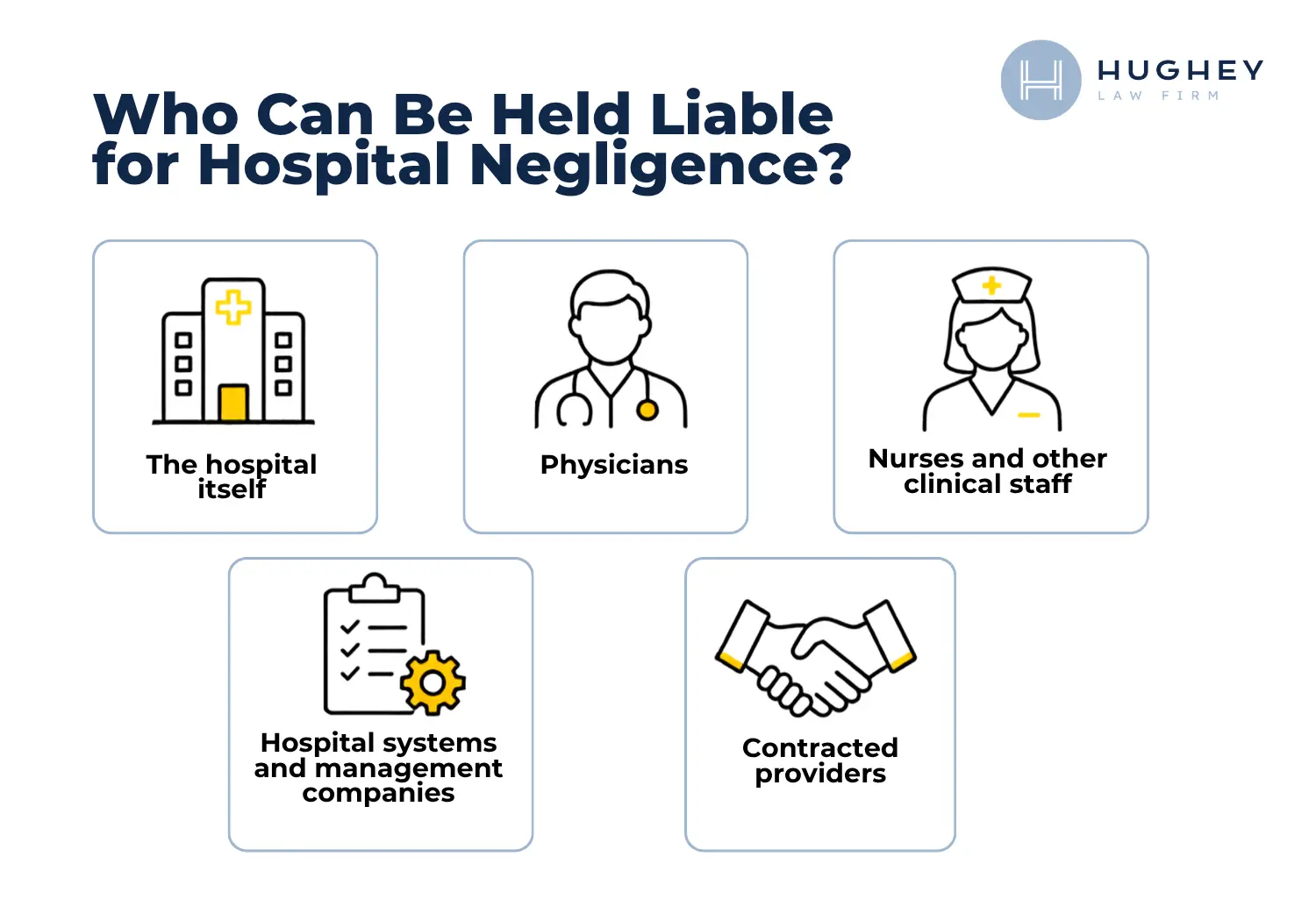
Who Can Be Held Liable for Hospital Negligence?
Depending on the specific circumstances, several parties can be legally responsible for hospital negligence.
- The hospital itself
- Physicians
- Nurses and other clinical staff
- Hospital systems and management companies
- Contracted providers
Understanding Medical Malpractice Laws in South Carolina
In South Carolina, hospital negligence claims are governed by the state’s medical malpractice framework. This includes specific procedural requirements that affect how and when a claim can be pursued.
According to South Carolina Code Section 15-79-125, claimants must provide written notice to all intended defendants at least ninety days before filing a lawsuit. Satisfying this pre-suit notice requirement is a prerequisite to beginning litigation. Failure to do so can jeopardize an otherwise valid claim.
The statute of limitations for medical malpractice claims in Charleston is generally three years from the date the negligence occurred or was discovered, though there are specific outer limits in some circumstances. South Carolina also requires expert testimony to establish the applicable standard of care and demonstrate how it was not met in virtually all medical malpractice cases. Identifying and retaining the appropriate expert is a critical step early in the litigation process.
Warning Signs of Possible Hospital Negligence
Families should consider consulting a hospital negligence attorney if any of the following occurred during a hospital stay:
- A patient’s condition unexpectedly worsened during or after treatment without a clear medical explanation.
- A treatment was administered without adequate informed consent.
- A diagnosis was missed or delayed and was later identified as the source of significant harm.
- A medication was administered incorrectly, or a drug interaction occurred that the treatment team should have anticipated.
- An infection developed during the hospital stay that required additional treatment.
- A patient fell or was injured inside the hospital.
- A surgical procedure was performed on the wrong site, or it produced complications that were not consistent with the known risks of the procedure.
The presence of any of these circumstances does not automatically establish negligence, but it warrants a legal evaluation to determine if the care delivered met the applicable standard.
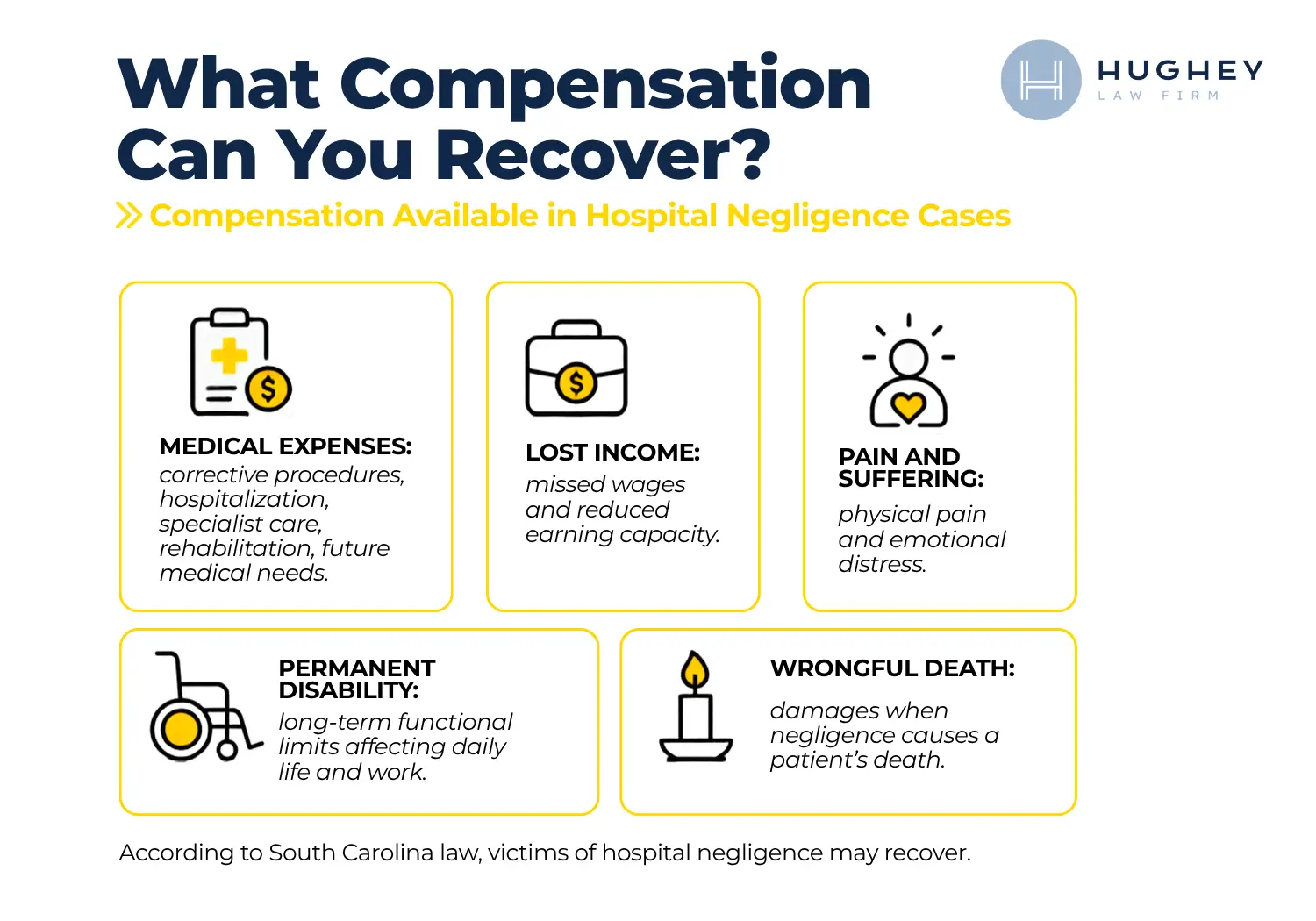
Compensation Available in Hospital Negligence Cases
According to South Carolina law, victims of hospital negligence may pursue compensation in the following categories.
- Medical expenses cover the full cost of corrective procedures, extended hospitalization, specialist care, rehabilitation, and future medical needs.
- Lost income compensates for missed wages during recovery and long-term loss of earning capacity due to permanent injuries.
- Pain and suffering compensation addresses the physical pain and emotional distress caused by negligent care and its consequences.
- Permanent disability damages address functional limitations that affect daily activities, employment, and quality of life in the long term.
- Damages for wrongful death are available when hospital negligence causes a patient’s death.
Proven Results in Hospital Negligence and Malpractice Cases
Hughey Law Firm has achieved proven case results for clients who have experienced serious harm due to failures in hospital and medical care throughout Charleston, South Carolina. The cases below reflect the firm’s commitment to pursuing the full cost of negligent medical care to patients and their families, including not only immediate treatment expenses, but also the cumulative harm that results from unaddressed preventable failures.
- $350,000 for Hospital Neglect/Nursing Home Neglect: A client developed numerous pressure sores while hospitalized. Following discharge, the client was transferred to a nursing home, where the pressure sores deteriorated to stage IV and became severely infected. Hughey Law Firm held accountable those across the full chain of care failures that allowed a preventable condition to reach a life-threatening state.
- $650,000 for Dental Malpractice: A client developed a serious infection after dental surgery because the treating provider failed to prescribe antibiotics before the procedure. Hughey Law Firm recovered $650,000 for the harm caused by departing from the standard of care that should have been followed before the patient left.
These results reflect cases in which the standard of care required by South Carolina law was not met, resulting in serious harm to our clients. Every medical negligence case is different, and past results cannot guarantee a specific outcome in your case. What these results demonstrate is our consistent willingness to thoroughly investigate, build the evidence a claim requires, and pursue meaningful accountability for the people and families we represent.
Past results do not guarantee future outcomes. Every case is unique and must be evaluated based on its specific facts and circumstances. Hiring a lawyer is an important decision that should not be based solely on advertisements.
Helping Injured Patients and Families in Charleston
Hughey Law Firm represents victims of hospital negligence throughout the Charleston metropolitan area. Our clients include patients treated at Trident Medical Center, Summerville Medical Center, Grand Strand Medical Center, Roper St. Francis Healthcare facilities, and other South Carolina hospitals and healthcare systems.
We understand that many of our clients are still recovering from a serious hospital negligence event, are hospitalized, or have permanent disabilities that make travel difficult or impossible. We accommodate these circumstances. We can meet with you wherever is most convenient, whether it’s your home, a rehabilitation facility, or our office. We handle all aspects of the claim, so our clients are not burdened by the legal process during recovery.
We handle all hospital negligence cases on a contingency fee basis. You pay no attorney fees unless we recover compensation for you.
 Contact a Charleston Medical Malpractice Attorney Today
Cases involving hospital negligence require specific medical knowledge, qualified expert testimony, strict compliance with South Carolina’s pre-suit notice requirements, and litigation capabilities sufficient to take on a well-resourced institutional defendant. The Hughey Law Firm handles all of this on behalf of our clients.
Our team has a direct understanding of how these institutions approach negligence claims and how to counter their defense strategies with the evidence that establishes what actually happened.
Call (843) 881-8644 for a free consultation, fill out our contact form, or use live chat to speak with our team now. We represent families throughout Charleston, the Lowcountry, and across South Carolina.
Disclaimer: The information on this page is intended for general informational purposes only and does not constitute legal advice. Every case is different. Past results do not guarantee future outcomes. Hiring a lawyer is an important decision that should not be based solely on advertisements. Ask us to send you free written information about our qualifications and experience before you decide. The Hughey Law Firm is located in Charleston, South Carolina.
Learn More About Your Healthcare Facility:
Frequently Asked Questions
About Hospital Negligence & MalpracticeThe personal representative of the deceased patient’s estate may file a wrongful death claim under South Carolina law on behalf of eligible survivors. These claims are subject to specific procedural requirements and deadlines. Contact an attorney as soon as possible after experiencing a loss to ensure that your claim is evaluated within the applicable timeframes.
Yes. South Carolina law requires expert testimony that establishes the standard of care and departure from it in virtually all hospital negligence cases. The Hughey Law Firm works with independent medical experts in the relevant clinical specialty to develop this testimony.
Yes. Both delayed diagnoses and emergency room errors are actionable if they represent a departure from the applicable standard of care that caused measurable harm to the patient.
Request complete copies of your medical records, document your observations and the timeline of events, and contact a hospital negligence attorney before speaking with the hospital or its insurance representatives further.
Generally, you have three years from the date of the negligence or its discovery. However, South Carolina also requires written pre-suit notice to all defendants at least ninety days before filing. Contact an attorney promptly to ensure that all applicable deadlines are identified for your specific situation.
It depends on the relationship between the doctor and the hospital. If a physician is a hospital employee, the hospital is generally liable for their conduct. When a physician is an independent contractor, however, the analysis is more complex. Still, the hospital may share liability depending on the circumstances.
The most reliable way is to have an attorney review your medical records and the circumstances of your treatment. The core requirement is a departure from the standard of care that caused measurable harm, and determining whether both elements are present requires a detailed clinical and legal evaluation.
It occurs when a hospital, its staff, or contracted providers fail to deliver care that a reasonably competent provider would deliver under the same circumstances, causing measurable harm to the patient. This can apply to surgical errors, medication errors, misdiagnosis, infection control failures, and many other clinical contexts.