

When you or a family member seeks medical care at Summerville Medical Center, you trust the hospital’s physicians, nurses, and staff to provide competent and attentive care. This trust is reasonable, and patients have the right to expect treatment that meets accepted medical standards. If a healthcare provider makes a mistake, is careless, or fails to follow proper protocols, causing preventable harm, the patient and their family have the right to pursue compensation.
The Hughey Law Firm represents patients and families in Dorchester County, Berkeley County, and the surrounding Summerville and Lowcountry communities who have been harmed by negligent care at Summerville Medical Center. We investigate adverse outcomes and review medical records to determine if the care provided fell below accepted standards. We then pursue the full compensation our clients are owed under South Carolina law.
Summerville Medical Center Guide
- About Summerville Medical Center
- Understanding Hospital Negligence at Summerville Medical Center
- Medical Errors and Negligence Cases We Handle
- Recovering Compensation After Hospital Negligence
- How Hughey Law Firm Supports Injured Patients and Families
About Summerville Medical Center
HCA Healthcare’s Summerville Hospital is a 174-bed acute care hospital that has served families in Dorchester, Berkeley, and surrounding communities for over thirty years. Located in Summerville, South Carolina, the hospital is part of Trident Health, an HCA Healthcare affiliate that operates Trident Medical Center in North Charleston and several freestanding emergency departments throughout the Lowcountry. The hospital offers a 24-hour emergency room, a dedicated pediatric emergency room, a wide range of surgical procedures, and comprehensive medical services. Summerville Medical Center is recognized for its emergency, women’s, children’s, cardiac, imaging, orthopedic, and stroke services for the growing Lowcountry community. The hospital also features a women’s and neonatal tower that offers labor and delivery services, prenatal care, postpartum treatment, high-risk obstetric care, and a Level III NICU. Summerville and the surrounding Tri-County area have experienced significant population growth in recent years, making Summerville Medical Center an increasingly important healthcare resource for a large and growing patient community. The hospital has invested substantially in expanding its capacity to meet this growth. This includes a recent $66.8 million inpatient project that increased the number of licensed beds at the hospital to its current level.
The scale of the hospital and the volume of patients it serves each year creates an obligation of care that applies to every patient, regardless of which department or service line is involved. If this obligation is not met and a patient is harmed, the hospital and the responsible providers may face legal accountability under South Carolina law.
Understanding Hospital Negligence at Summerville Medical Center
Hospital negligence is not the same as an unfavorable outcome. Medicine involves inherent risks, and even with excellent, attentive care, some complications occur; but hospital negligence occurs when the care a patient receives falls below what a reasonably competent healthcare provider would deliver under the same circumstances, resulting in measurable harm to the patient.
At a full-service facility like Summerville Medical Center, which handles a high volume of emergency cases, surgical procedures, obstetric and neonatal care, and pediatric treatment across multiple departments, there are many opportunities for negligence. The most common patterns of hospital negligence arise wherever the systems, staffing, training, and individual conduct of healthcare providers fail to meet the standard that patients have the right to expect:
- The knew or should have known standard applies: Both South Carolina premises liability law and medical negligence law apply the standard of what a reasonably competent provider in the same circumstances would have known and done. A provider who claims they were unaware of a developing complication is not automatically exempt from liability if the clinical signs of that complication were present, and a competent provider would have recognized and addressed them.
- The role of medical records is important: In any hospital negligence case, medical records are among the most important evidence available. They document the care ordered and delivered, the medications administered, the monitoring performed, and the clinical decisions made at each stage of treatment. Gaps, inconsistencies, or inaccuracies in a patient’s medical records can be as significant as the information they contain. Thoroughly reviewing them is one of the first steps in evaluating whether a negligence claim exists.
- Pre-suit requirements in South Carolina: Claims involving medical malpractice, including hospital negligence, carry specific procedural requirements before a lawsuit can be filed. According to South Carolina Code Section 15-79-125, claimants must provide written notice to all intended defendants at least ninety days before filing a lawsuit. Failure to do so can jeopardize an otherwise valid claim. Given these procedural steps and the applicable statute of limitations, early legal involvement is particularly important in potential hospital negligence cases.

Medical Errors and Negligence Cases We Handle
The Hughey Law Firm represents patients of Summerville Medical Center who have been harmed in a variety of clinical settings due to various types of negligence. The following are among the most common cases we handle:
- Misdiagnosis and missed diagnosis
A misdiagnosis occurs when a healthcare provider incorrectly identifies a condition. A missed diagnosis occurs when a condition that should have been identified is overlooked entirely. Both can delay necessary treatment and allow a serious condition to progress unchecked. In emergency and urgent care settings, where providers work quickly under pressure, missed diagnoses of conditions such as stroke, heart attack, pulmonary embolism, and sepsis are among the most litigated forms of hospital negligence.
- Surgical Errors and Procedural Mistakes
Summerville Medical Center performs a wide range of surgical procedures, including orthopedic, spinal, gynecological, robotic, and general surgeries. When a surgical error results from a departure from accepted techniques, miscommunication among the operating team, or a failure to follow preoperative protocols, the consequences can be permanent and life-altering.
- Obstetric and Neonatal Negligence
Summerville Medical Center provides labor and delivery services and a Level III NICU, caring for a significant number of families in Dorchester and Berkeley counties. Errors during labor and delivery, including failure to respond to fetal distress, improper use of delivery instruments, and mismanagement of high-risk pregnancies, can cause serious harm to both mother and infant. Neonatal negligence in the NICU setting has its own specific standard of care obligations and pattern of preventable errors.
- Pediatric Negligence
The hospital’s dedicated pediatric emergency room, inpatient unit, and intensive care unit serve a substantial number of children from across the Lowcountry. Pediatric patients require age-specific clinical judgment regarding medication dosing, diagnostic interpretation, and monitoring. When providers apply adult-oriented standards to pediatric patients without making the appropriate adjustments, the results can be serious.
- Emergency Room Errors
Summerville Medical Center’s emergency department treats a large number of patients with varying levels of severity. ER errors, including mistriage, delayed evaluation of time-sensitive conditions, failure to act on diagnostic results, and miscommunication between providers, can cause preventable harm in the high-pressure environment of emergency medicine.
- Medication Errors
Incorrect medications, incorrect dosages, failure to screen for contraindications or drug interactions, and errors in medication administration at any stage of a hospital stay are preventable and legally actionable when they cause patient harm.
- Hospital-Acquired Infections
Poor sanitation, inadequate sterilization of surgical instruments, failure to follow infection control protocols, and improper wound care can lead to infections that patients did not have when they entered the hospital. Hospital-acquired infections, including MRSA, C. difficile, and surgical site infections, are among the most common and preventable complications of hospital care.
- Patient Falls and Neglect
Patients identified as being at risk of falling are entitled to care that implements appropriate fall prevention protocols, including bed alarms, assistive devices, and adequate supervision. If facilities fail to follow their own protocols and a patient is injured as a result, the hospital may be liable. Similarly, patients who depend on staff for basic needs, such as nutrition, hydration, repositioning, and hygiene, are entitled to have these needs met. Failure to provide this basic care constitutes neglect and can result in a negligence claim.
- Failure to Monitor and Delayed Treatment Response
Patients whose conditions deteriorate and whose clinical signs indicate a need for intervention are entitled to have that need recognized and addressed in a timely manner. Failure to adequately monitor, failure to escalate care when clinical signs warrant it, and failure to communicate a change in condition among treating providers are all forms of negligence that can transform a manageable complication into a catastrophic outcome.
Recovering Compensation After Hospital Negligence
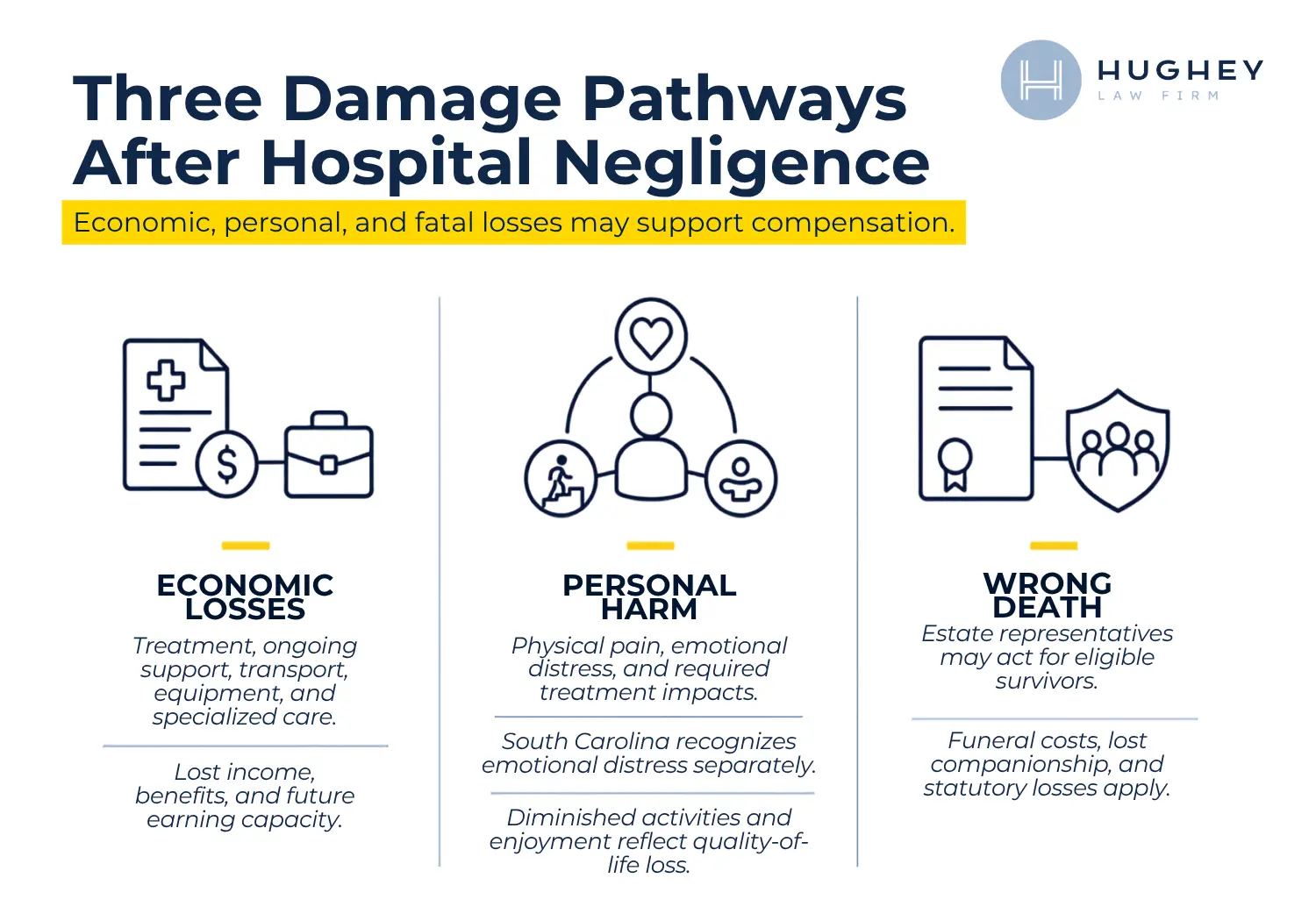
According to South Carolina law, patients who are harmed by negligence at Summerville Medical Center may pursue compensation for several categories of recoverable damages.
- Medical expenses cover the full cost of treating injuries, illnesses, or health complications caused or worsened by negligent care. This includes emergency treatment, hospitalization, corrective surgery, specialist care, rehabilitation, and any ongoing medical needs resulting from the harm sustained.
- Additional costs resulting from the adverse health outcome are also covered, including home care services, transportation for ongoing treatment, adaptive equipment, and the expense of obtaining specialized care not available locally.
- Patients can also seek compensation for lost income and benefits for the time they were unable to work due to the harm caused by the negligent care. Patients with permanent injuries affecting their earning capacity can also recover future economic losses.
- Pain and suffering compensation covers the physical pain, discomfort, and emotional distress caused by the negligent care and the treatment required to address the resulting harm.
- Emotional distress reflects the specific psychological impact of being harmed by care intended to help. South Carolina law recognizes emotional distress as a distinct, compensable category, separate from physical pain.
- Diminished quality of life compensates for the broader impact of the injury on the patient’s ability to engage in daily activities and enjoy life as they did before the negligent care occurred.
- Wrongful death damages are available when hospital negligence results in a patient’s death. The personal representative of the deceased patient’s estate may bring a wrongful death claim on behalf of eligible survivors. This claim may include compensation for funeral expenses, loss of companionship, and other losses recognized under South Carolina’s wrongful death statutes. For a detailed overview of wrongful death claims in South Carolina, visit our South Carolina wrongful death lawyer page.
The amount recoverable in a given case depends on the severity of the harm, the extent to which the provider departed from the standard of care, and the facts and evidence revealed during the legal process. Hughey Law Firm thoroughly reviews every client’s situation to identify all applicable categories of damages.
How Hughey Law Firm Supports Injured Patients and Families
Hospital negligence claims are among the most procedurally complex personal injury cases in South Carolina. These claims require an in-depth knowledge of medical standards, access to qualified expert witnesses, strict adherence to South Carolina’s pre-suit notification requirements, and the litigation capability to take on a well-resourced hospital and its defense team. The Hughey Law Firm handles every aspect of this process on behalf of our clients.
- Medical Record Review and Investigation: We obtain and analyze the patient’s complete medical record from their treatment at Summerville Medical Center. This includes nursing notes, physician orders, medication administration records, operative reports, and diagnostic results. We then review the timeline of care to identify where the standard was breached and what the consequences of that breach were.
- Expert witness coordination: South Carolina’s medical malpractice framework requires expert testimony to prove that the care provided was substandard and caused the patient harm. We work with qualified medical experts in the relevant specialty to develop the expert support required by applicable legal standards.
- Pre-suit compliance: Before filing any lawsuit, we ensure full compliance with South Carolina Code Section 15-79-125’s pre-suit notice requirements, so the claim is not jeopardized on procedural grounds. This step requires specific timing and documentation, which our team manages carefully.
- Damages assessment: We evaluate the full scope of past and future losses that our client has suffered, including medical expenses, income loss, and the personal impact of the injury. This ensures that any legal action pursues the maximum possible compensation.
- Insurance and defense counsel communication: We handle all communications with the hospital’s insurance carrier and defense attorneys. Our clients are never put in the position of negotiating with institutional defendants on their own.
- Negotiation backed by trial capability: We negotiate with Summerville Medical Center’s insurer and defense team from a position of thorough preparation and demonstrated willingness to take cases to trial. If a fair resolution cannot be reached through negotiation, Hughey Law Firm will pursue the case in a South Carolina civil court.
- Ongoing communication with our clients: Every client of the Hughey Law Firm receives personalized attention and regular updates on the status of their case. Questions are answered by attorneys and staff who are familiar with the case, not by an automated system.
All hospital negligence cases at Hughey Law Firm are handled on a contingency fee basis. You pay no legal fees unless we secure compensation for you. The initial consultation is free.
Speak With a Summerville Medical Center Negligence Lawyer Today

If you or a family member has been harmed due to negligence at Summerville Medical Center, the Hughey Law Firm is prepared to review your case and explain your legal options. We serve patients in Dorchester County, Berkeley County, and the surrounding Lowcountry communities. We are prepared to use our experience to help you.
Call (843) 881-8644 for a free consultation, fill out our contact form, or use live chat to speak with our team now. The consultation is free, confidential, and carries no obligation.
Disclaimer: The information on this page is intended for general informational purposes only and does not constitute legal advice. Every case is different. Past results do not guarantee future outcomes. Hiring a lawyer is an important decision that should not be based solely on advertisements. Ask us to send you free written information about our qualifications and experience before you decide. The Hughey Law Firm is located in Charleston, South Carolina.