

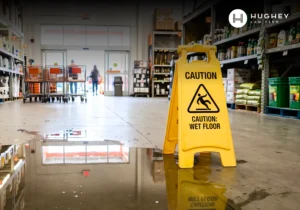
If you were injured in a slip-and-fall accident at Walmart, Home Depot, Costco, Dollar General, or another large retail store in South Carolina, you may be entitled to compensation. These big-box retailers have a legal duty to maintain safe conditions throughout their premises and promptly address any hazards that could injure customers. If they fail to do so and a customer is injured as a result, the store is responsible for the harm caused.
South Carolina’s premises liability law requires business owners to exercise reasonable care to ensure their properties are safe for customers. For large retailers, this obligation extends to every part of the store. When a wet floor, fallen product, broken cart corral, or poorly maintained surface causes a serious injury, the retailer’s size and resources do not protect them from accountability. However, they can make pursuing a claim significantly more difficult without experienced legal representation on your side.
Hughey Law Firm represents slip-and-fall victims throughout Charleston and South Carolina who have been injured in retail store incidents. We understand how large retailers approach these claims and how their legal and insurance teams respond to injury demands. We also know what evidence is required to build a case that holds them accountable.
South Carolina Big Box Retailer Slip and Fall Guide
- What Is a Big Box Retailer Slip and Fall Case?
- Common Causes of Slip and Fall Accidents in South Carolina Retail Stores
- Which Retailers Commonly Face Slip and Fall Claims in South Carolina?
- Why Big Box Retailers Are Difficult to Sue
- How to Prove Liability in a Retail Slip and Fall Case
- Common Injuries in South Carolina Retail Slip and Fall Accidents
- What Compensation Can Be Recovered in a South Carolina Retail Slip and Fall Case?
- What to Do After a Slip and Fall at a Big Box Store in South Carolina
- How Hughey Law Firm Helps Retail Slip and Fall Victims
- Frequently Asked Questions
What Is a Big Box Retailer Slip and Fall Case?
A slip-and-fall case involving a big-box retailer is a premises liability claim arising from an injury that occurred on the property of a large retail store due to a hazardous condition that the store created, knew about, or should have known about, but failed to address. South Carolina’s premises liability law governs these cases and requires business owners to exercise reasonable care to keep their properties safe for customers and to warn of known hazards that customers would not reasonably anticipate.
Big-box retailers, including Walmart, Home Depot, Costco, Lowe’s, Target, Dollar General, Dollar Tree, and Food Lion, collectively serve millions of South Carolina customers each year. Their large floor plans, high inventory turnover, frequent restocking, and heavy customer traffic create consistent opportunities for hazardous conditions to develop. If those conditions are not promptly identified and addressed, and a customer is injured, the retailer faces civil liability for the resulting harm.
Common Causes of Slip and Fall Accidents in South Carolina Retail Stores
In South Carolina, establishing a big-box retailer’s liability begins with identifying the specific hazard that caused the fall because the nature of the hazard directly determines the necessary evidence and how to build the legal claim. The following are some of the most common sources of slip-and-fall injuries at big-box retailers in South Carolina.
- Wet Floors
- Spilled Liquids and Product Leakage
- Poor Maintenance and Deteriorated Flooring
- Falling Merchandise
- Unsafe Entrances and Exits
- Parking Lot Hazards
These hazard categories are predictable and recurring. They are also entirely within a retailer’s control to identify and address through reasonable inspection and maintenance practices. Call (843) 881-8644 to speak with the Hughey Law Firm about the circumstances of your fall and how they may affect your claim.
Which Retailers Commonly Face Slip and Fall Claims in South Carolina?
Several large retail chains operating throughout Charleston and South Carolina frequently face premises liability and slip-and-fall claims. The Hughey Law Firm has experience handling claims against major retailers and understands the specific legal and insurance strategies each uses to defend against injury claims.
Walmart
Walmart operates dozens of locations throughout South Carolina and is one of the most frequently named defendants in national retail slip-and-fall litigation. The high volume of customer traffic, frequent restocking during open hours, and large size of individual stores all contribute to hazardous conditions that generate these claims.
Dollar General
Dollar General’s rapid expansion throughout South Carolina, including in smaller communities where it is often the only retail option available, has resulted in a consistent pattern of premises liability claims. Understaffing at individual locations often means spills, fallen products, and floor hazards go unaddressed for extended periods.
Dollar Tree
Dollar Tree stores throughout South Carolina generate slip and fall claims arising from inadequate staffing, cluttered aisles, and merchandise placement that creates tripping hazards and an increased risk of falling products.
Food Lion
Food Lion’s grocery retail operations in South Carolina result in slip-and-fall claims due to the inherent hazards of a food retail environment. These hazards include produce section floor moisture, refrigeration unit condensation, and spills in high-traffic areas such as checkout aisles.
Home Depot
Home improvement retailers present a distinct slip-and-fall hazard profile that includes liquid product spills in the garden and paint departments, warehouse-style shelving that poses a risk of falling merchandise, outdoor garden center surfaces, and loading area conditions.
Costco
Costco’s warehouse retail model creates specific hazards, including large product displays that may shift or fall, food sample areas with hazardous floor conditions, and high-traffic refrigerated sections.
Why Big Box Retailers Are Difficult to Sue
Large retailers are not passive participants in slip-and-fall litigation. They are sophisticated defendants with substantial resources dedicated to minimizing their liability exposure. Understanding this informs how a claim must be built and pursued.
Dedicated Corporate Legal Teams
Every major big-box retailer operating in South Carolina maintains relationships with law firms that specialize in premises liability defense. From the moment an incident report is filed, the retailer’s legal and insurance teams begin working to document the incident in a manner favorable to the defense.
Surveillance Systems and Evidence Control
Big box retailers operate comprehensive surveillance systems that record activity throughout their stores and parking lots. The retailer controls this footage and will preserve it if it supports their defense.
Incident Report Framing
When a customer reports an injury, store employees complete an incident report prepared by the retailer’s staff. These reports are often written in a way that minimizes the store’s apparent knowledge of or responsibility for the hazardous condition.
Comparative Negligence Defenses
South Carolina’s modified comparative fault system offers retailers a structural defense in slip-and-fall cases. According to South Carolina Code Section 15-38-15, claimants who are found to be fifty-one percent or more at fault are barred from recovery.
Delayed Reporting Tactics
Large retailers and their insurers sometimes use early post-incident contact with injured customers to:
- Gather recorded statements before the customer has spoken with a big box retailer slip and fall attorney
- Establish facts favorable to the defense
- Create pressure to accept early settlement offers that do not reflect the full value of the claim. The period immediately following a retail slip-and-fall accident is one of the most legally consequential, and it is when claimants are most vulnerable to these tactics.
How to Prove Liability in a Retail Slip and Fall Case
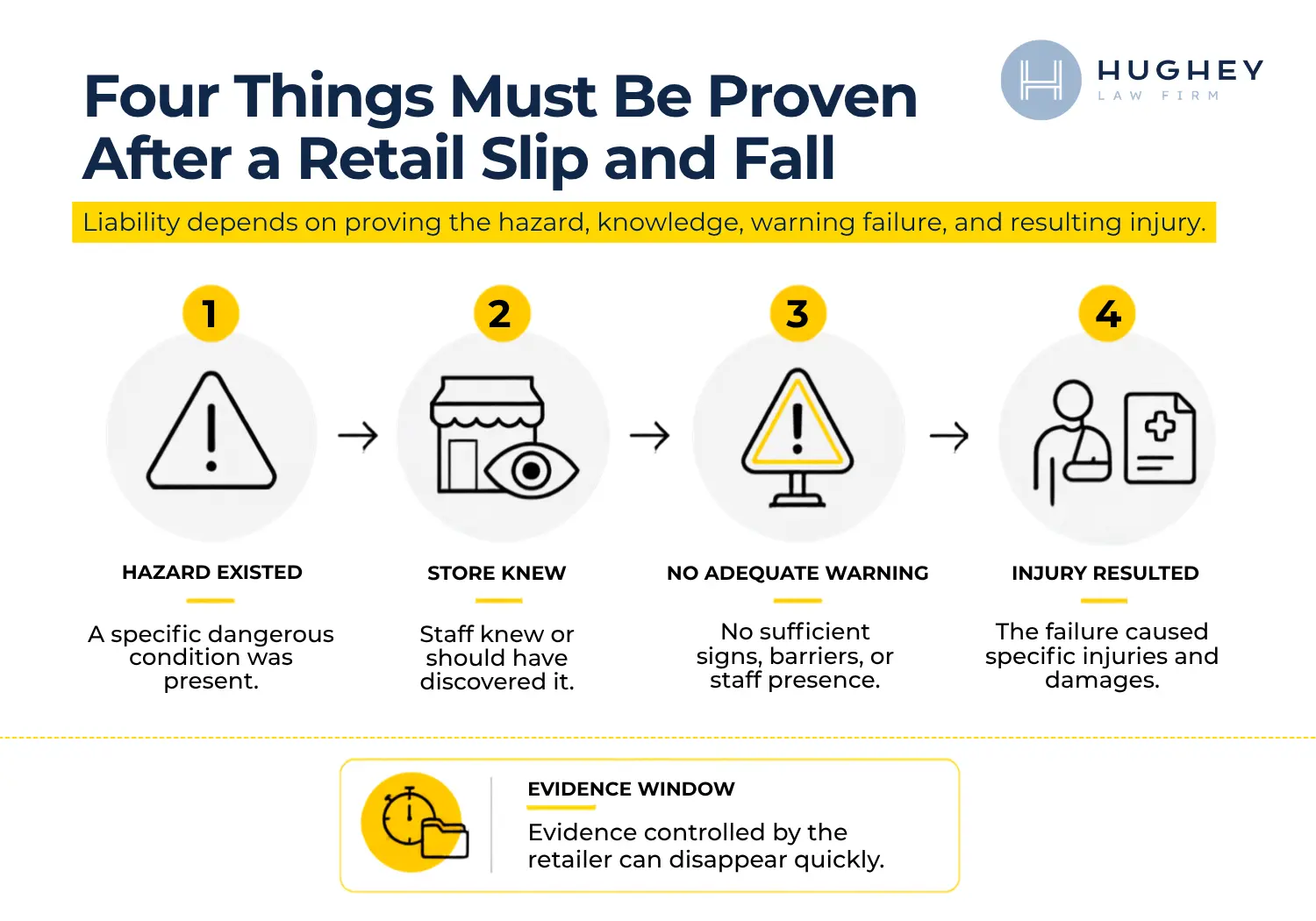
In South Carolina, proving that a big-box retailer is legally responsible for a slip-and-fall injury requires establishing four specific elements with concrete evidence. The window to collect that evidence closes the moment the incident is reported.
- The dangerous condition must have existed. The claimant must demonstrate that a specific hazardous condition was present on the store’s premises at the time of the injury.
- The store knew or should have known about the condition. According to South Carolina Code Section 15-78-60 and established premises liability case law, the claimant must demonstrate that either a staff member was aware of the hazardous condition or the condition had existed long enough for a reasonable inspection program to discover it.
- The store failed to warn customers. Retailers cannot always prevent temporary hazards, such as an active spill cleanup, but they are obligated to warn customers of the danger through adequate signage, barriers, or staff presence.
- The failure to do so caused the injury and resulting damages. To establish liability, the connection between the store’s failure to address the hazard and the specific injuries sustained must be demonstrated with medical documentation and testimony.
Each of these elements relies on evidence that the retailer controls and which disappears quickly. Call (843) 881-8644 so the Hughey Law Firm can start preserving the evidence before it’s gone.
Common Injuries in South Carolina Retail Slip and Fall Accidents
Slip-and-fall incidents in retail settings can result in injuries ranging from soft tissue sprains to catastrophic, permanently disabling conditions. Elderly customers are disproportionately represented among those with serious injuries because the consequences of a fall worsen significantly with age.
- Hip fractures
- Traumatic brain injuries
- Spinal cord injuries caused
- Knee and shoulder injuries
- Soft tissue injuries
- Wrist and arm fractures
The above injuries are among the most serious and costly in personal injury law. Medical expenses, rehabilitation costs, and lost income can accumulate for years after a fall. When a retail store’s negligence results in this level of harm, the pursued compensation must reflect the full long-term impact, not just the immediate medical bills.
What Compensation Can Be Recovered in a South Carolina Retail Slip and Fall Case?
According to South Carolina premises liability law, injured retail store customers can pursue six categories of compensation if a big-box retailer’s negligence caused their injuries. In serious cases, the total value reflects the full extent of the harm, not just the immediate medical expenses. According to this law, injured retail store customers can pursue the following categories of compensation.
- Medical expenses, including emergency transport, emergency room evaluation, hospitalization, surgery, specialist care, diagnostic imaging, physical therapy, prescription medication, and medical devices.
- Lost wages compensate for income missed during the recovery period when injuries prevented the claimant from working.
- Pain and suffering compensation covers the physical pain and emotional distress experienced as a result of the injuries.
- Future medical care addresses anticipated ongoing treatment needs, including follow-up surgical procedures, long-term physical therapy, assistive devices, and home modification costs for injuries that permanently affect mobility or function.
- Permanent disability damages compensate for lasting physical limitations that affect the claimant’s daily life, occupational capacity, and quality of life beyond the immediate recovery period.
- Punitive damages may be available in cases where the retailer demonstrated a conscious and reckless disregard for customer safety.
Understanding what South Carolina law permits is the key to recovering the full cost of your injury rather than settling for what the insurer offers. Call (843) 881-8644 for a free consultation with Hughey Law Firm to discuss the specifics of your case.
What to Do After a Slip and Fall at a Big Box Store in South Carolina
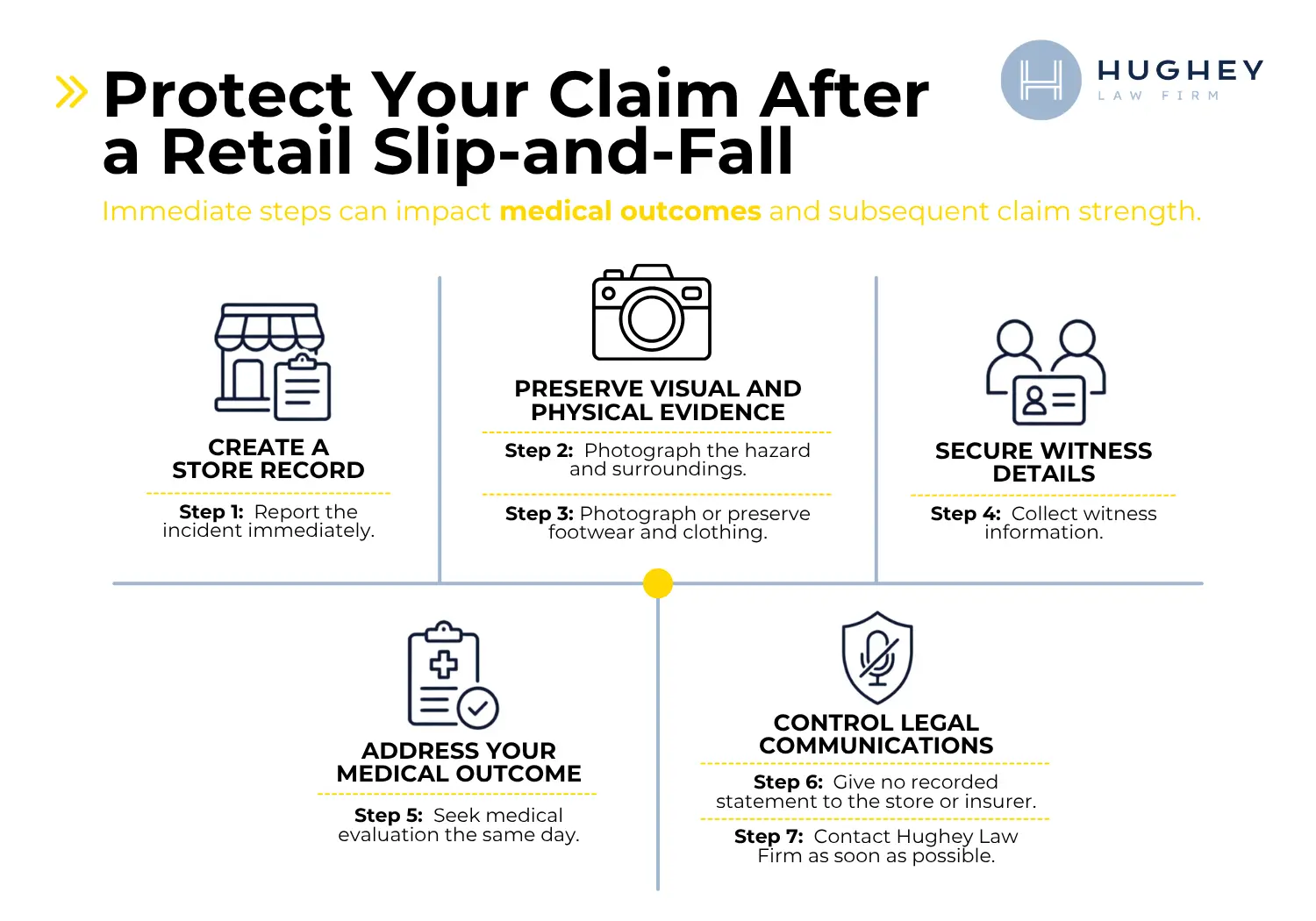
Big-box retailers act swiftly to control the narrative when a customer is injured. This means that the steps taken at the scene and in the hours immediately following are crucial not only for safety but also for building a strong legal case. These steps can significantly impact the medical outcome and the strength of any subsequent legal claim.
- Step 1: Report the incident to the store immediately.
- Step 2: Photograph the hazard and your surroundings.
- Step 3: Photograph or preserve your footwear and clothing.
- Step 4: Collect witness information.
- Step 5: Seek medical evaluation the same day.
- Step 6: Do not give a recorded statement to the store or its insurer.
- Step 7: Contact Hughey Law Firm as soon as possible.
The most effective way to ensure that evidence proving your case doesn’t disappear is to involve an attorney as early as possible. Call (843) 881-8644 to let Hughey Law Firm get ahead of the retailer’s defense team from day one.
How Hughey Law Firm Helps Retail Slip and Fall Victims

Hughey Law Firm has more than thirty years of experience with South Carolina personal injury cases. Our approach to retail slip-and-fall cases is the same, regardless of which major retailer is on the other side. We thoroughly prepare, conduct independent investigations, and are genuinely ready to take the case to trial if necessary. This is what we do for our clients:
- Immediate evidence preservation. We issue legal preservation demands to the retailer, their property management company, and any third-party vendors for all surveillance footage and documentation relevant to the incident.
- Independent investigation. We conduct a thorough, independent investigation of the incident and the specific hazardous condition.
- Medical record review and expert coordination. We obtain and analyze all medical records related to the sustained injuries and work with medical experts who can document the nature, severity, and long-term consequences of the injuries.
- Liability analysis under South Carolina law. We evaluate all applicable legal theories, including premises liability and negligence per se when regulatory violations are involved.
- Aggressive negotiation. We negotiate with retailers’ insurance carriers and legal teams from a position of thorough preparation and demonstrated willingness to litigate.
- Trial representation when necessary. When a fair settlement cannot be reached, Hughey Law Firm takes retail slip-and-fall cases to trial.
We handle all retail slip-and-fall cases on a contingency fee basis. You will not be charged any legal fees unless we secure compensation for you. Contact a Big Box Retailer Slip and Fall Lawyer as soon as possible.

Speak With a Big Box Retailer Slip and Fall Attorney Today
If you were injured in a slip-and-fall accident at Walmart, Home Depot, Costco, Dollar General, Dollar Tree, Food Lion, or another large retail store in South Carolina, the Hughey Law Firm can help your family understand your legal options and pursue the compensation your injuries warrant. The initial consultation is free, confidential, and carries no obligation to proceed.
Call (843) 881-8644 for a free consultation, fill out our contact form, or use live chat to speak with our team now. We represent families throughout Charleston, the Lowcountry, and across South Carolina.
Disclaimer: The information on this page is intended for general informational purposes only and does not constitute legal advice. Every case is different. Past results do not guarantee future outcomes. Hiring a lawyer is an important decision that should not be based solely on advertisements. Ask us to send you free written information about our qualifications and experience before you decide. The Hughey Law Firm is located in Charleston, South Carolina.
Frequently Asked Questions
About Big Box Retailer Slip and Fall AccidentsCleaning up a hazard before you can photograph it does not eliminate your claim. Witness accounts, surveillance footage from before the cleanup, the store’s inspection and cleaning logs, and your contemporaneous account of what you observed are all potential sources of evidence showing that the hazard existed.
A gap in treatment between the incident and your first medical evaluation could allow the retailer’s insurer to claim that your injuries were not caused by the fall or were not serious. If you delayed treatment, contact an attorney as soon as possible.
In most premises liability cases in South Carolina, the statute of limitations is three years from the date of the incident. Missing this deadline almost always permanently eliminates the right to pursue compensation.
Comparative fault arguments are a standard defense tactic in retail slip-and-fall cases. Under South Carolina’s modified comparative fault system, your recovery is reduced proportionally by your percentage of fault, as long as it does not exceed fifty percent. Retailers often claim that customers were inattentive, were wearing inappropriate footwear, or had prior notice of the hazard.
Retention practices vary by retailer and are not always publicly disclosed. In litigation, however, incident reports are subject to discovery and must be produced. Outside of litigation, there is no guarantee that a store will retain an incident report indefinitely.
Yes. Under South Carolina law, a retailer’s premises liability extends to the parking lot and surrounding property.
The absence of warning signs is directly relevant to proving liability. Retailers who create or are aware of hazardous conditions have an obligation to warn customers through adequate signage, barriers, or staff presence.
Yes, and it happens regularly. Most big-box retailers keep surveillance footage for thirty to ninety days before it is automatically overwritten. Without a formal legal preservation demand, footage documenting the hazard, how long it existed, and the absence of warning measures may disappear before a claim is initiated.