

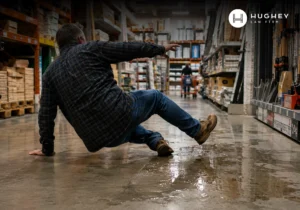
 A slip-and-fall accident at Home Depot can result in serious injuries, significant medical expenses, lost income, and long-term uncertainty regarding recovery. According to South Carolina premises liability law, customers injured due to hazardous conditions at a Home Depot store may be entitled to compensation from the company.
Home Depot operates two primary locations that serve the Charleston market:
- The West Ashley store, located at 2008 Magwood Drive, serves consumers and businesses traveling the US-17 and I-526 corridors across the western half of the market.
- The North Charleston store is located at 7554 Northwood Boulevard, just east of I-26 at Exit 209, where Northwood Boulevard and Ashley Phosphate Road intersect. It serves customers from North Charleston, Hanahan, and surrounding communities.
Both locations have a high-density warehouse retail format, which creates elevated safety obligations. If Home Depot’s inspection protocols fall short of South Carolina’s legal standard and a customer is seriously injured, the corporation is fully liable.
Hughey Law Firm provides representation for slip-and-fall victims in Charleston, North Charleston, and the wider South Carolina Lowcountry area. We examine forklift operational logs, zone-clearance records, internal security footage, and employee sweep sheets to build an unassailable case that recovers the true long-term value of your recovery.
Charleston Home Depot Slip and Fall Guide
- Conditions That Frequently Lead to Falls at Home Depot
- Common Injuries Caused by Home Depot Falls
- When Does a Home Depot Accident Become a Legal Claim?
- Evidence That Can Support a Home Depot Injury Claim
- Seeking Compensation After a Home Depot Accident
- What to Do After a Home Depot Slip and Fall in Charleston
- Challenges Victims Face in Home Depot Injury Claims
- How Hughey Law Firm Investigates Home Depot Injury Claims
- Frequently Asked Questions
Conditions That Frequently Lead to Falls at Home Depot
Home Depot’s warehouse retail format creates a unique set of hazards that differ from those in grocery stores, discount retailers, and general merchandise stores. The combination of industrial-scale shelving, heavy building materials, and continuous restocking during business hours violates OSHA materials handling and storage standards if paths are left unguarded, creating an environment requiring active hazard management than most retail settings:
- Water and mud tracked from the garden center
- Spilled Liquids and Cleaning Product Hazards
- Lumber, Pipes and Building Materials in Walkways
- Loose Cords, Hoses, and Extension Cables
- Forklift and Restocking Activity During Customer Hours
- Uneven Flooring and Damaged Concrete
- Falling Merchandise from High Shelves
- Parking Lot and Loading Zone Hazards
Several of these conditions, such as forklift activity during customer hours and merchandise falling from warehouse-height shelving, are unique to Home Depot’s warehouse format and do not occur in any other retail environment discussed on this site. Call (843) 881-8644 to speak with a representative from Hughey Law Firm about which of these conditions caused your injury and how it affects your claim.
Common Injuries Caused by Home Depot Falls
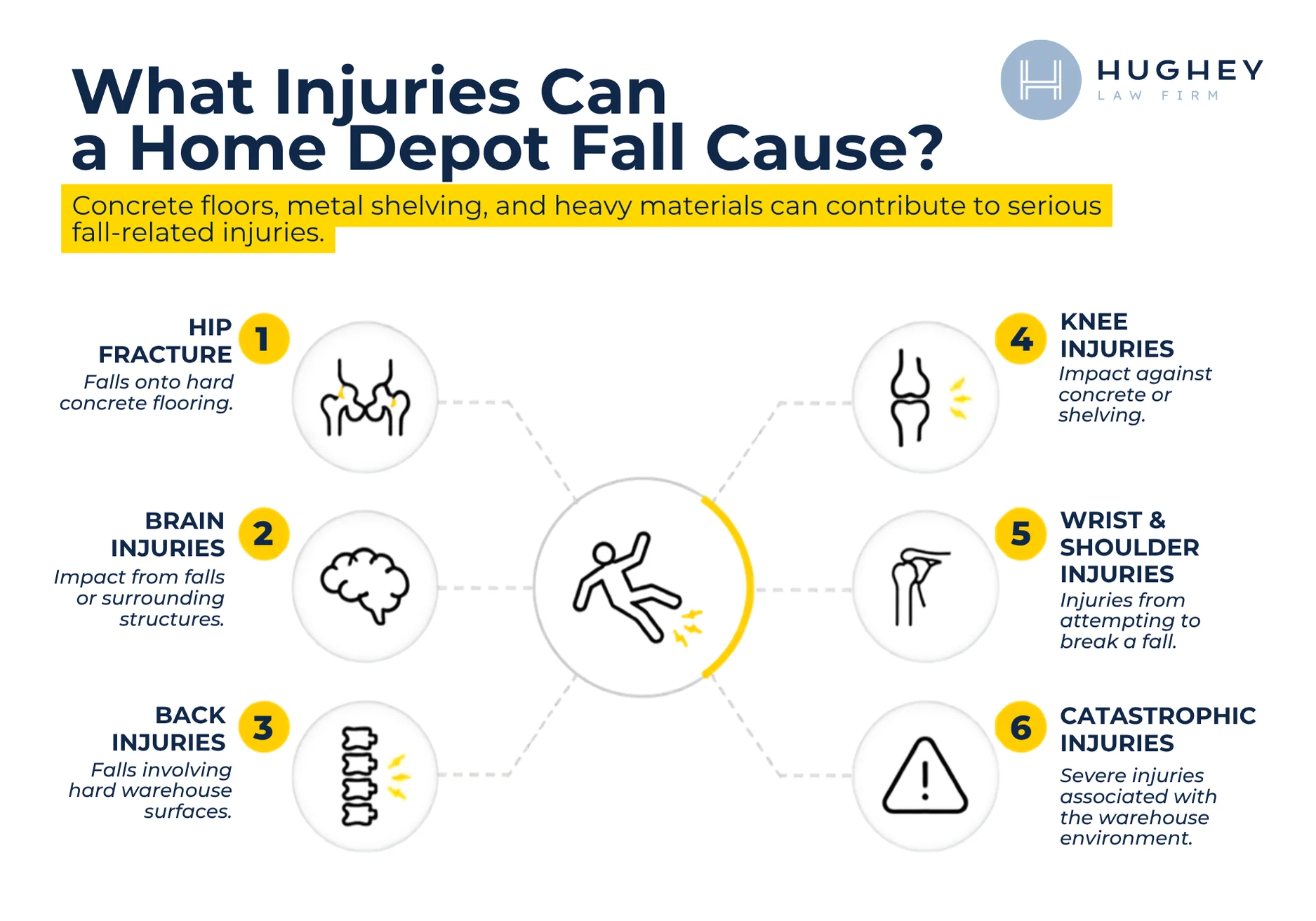
The warehouse retail environment at Home Depot produces a more severe injury profile than conventional retail settings. This is due to the hardness of its concrete flooring, the height of its shelving, and the weight of the building materials customers encounter throughout the store. The following characteristic injuries result from falls on concrete flooring, against metal shelving, or from contact with heavy building materials at Home Depot.
- Hip fracture
- Brain injuries
- Back injuries
- Knee injuries
- Catastrophic injuries
- Wrist and shoulder injuries
The lacerations and crushing injuries on this list are specific to the warehouse environment of Home Depot. Call (843) 881-8644 to discuss how your injuries reveal the cause of the fall and what South Carolina premises liability law allows you to pursue.
When Does a Home Depot Accident Become a Legal Claim?
A Home Depot accident becomes a legal claim when the company fails to meet its obligations under South Carolina premises liability law and that failure causes or contributes to a customer’s injuries. Several legal principles determine when liability exists:
- Duty of care: Home Depot is required to exercise reasonable care to keep its premises safe and to address or warn of known hazards.
- Actual vs. constructive notice: Liability can arise through actual notice, an employee was aware of the hazard, or constructive notice, meaning the condition existed long enough for a reasonable inspection program to discover it.
- Failure to inspect: Home Depot must implement comprehensive inspection protocols, as the National Safety Council documents preventable falls as one of the leading causes of severe, long-term emergency room injuries in commercial spaces.
- Failure to remediate: When Home Depot identifies a hazard and fails to address it within a reasonable timeframe, or does so inadequately, that response itself constitutes a breach of duty.
- Failure to warn: When a hazard cannot be immediately remedied, the company is obligated to warn customers through adequate signage, barriers, or active staff management of the affected area.
South Carolina courts assess liability by evaluating the duration of the hazard, whether Home Depot’s own operations created it, whether similar incidents have occurred at the same location, whether inspection records show compliance with the company’s own safety protocols, and whether warning measures were adequate relative to the actual hazard.
Evidence That Can Support a Home Depot Injury Claim
Building a successful Home Depot slip-and-fall claim requires early access to evidence the company controls, and the warehouse-specific documentation categories unique to Home Depot, including forklift operation logs and building material placement records, make the evidence picture in these cases broader and more complex than in any other retail premises liability context. The following evidence is central to a Home Depot slip and fall claim in South Carolina.
- Store surveillance footage
- Incident and accident reports
- Inspection and maintenance records
- Employee reports and internal communications
- Witness statements
- Medical records and treatment documentation
- Photographs and videos of the hazard
- Proof of lost wages and other damages
Home Depot’s thirty-day surveillance retention policy means that the footage documenting the hazard and fall could be deleted automatically before a formal preservation demand is received.
Visit our South Carolina Big Box Retailer Slip and Fall Lawyer page, which explains these in more detail. Call (843) 881-8644 so that the Hughey Law Firm can issue the demand before the window closes and the warehouse-specific operational records that are key to these cases begin to disappear.
Seeking Compensation After a Home Depot Accident
According to South Carolina premises liability law, victims of Home Depot slip-and-fall accidents can pursue two broad categories of recoverable damages. The combined value of these damages in serious warehouse injury cases often reflects a more extensive and expensive recovery process than the initial circumstances suggest. According to this law, victims of Home Depot slip-and-fall accidents can pursue the following categories of compensation:
Economic Damages
- Emergency medical expenses
- Ongoing medical treatment
- Rehabilitation and therapy costs
- Lost income
- Loss of future earning capacity
Non-Economic Damages
- Pain and suffering
- Emotional distress
- Permanent disability
- Loss of enjoyment of life
- Scarring or disfigurement
Crushing and laceration injuries specific to Home Depot’s warehouse environment can result in scarring and disfigurement that are not common in other retail slip-and-fall cases. This makes a thorough damages assessment particularly important in these claims. Call (843) 881-8644 for a free consultation with Hughey Law Firm to learn more about what your Home Depot claim may entail.
What to Do After a Home Depot Slip and Fall in Charleston
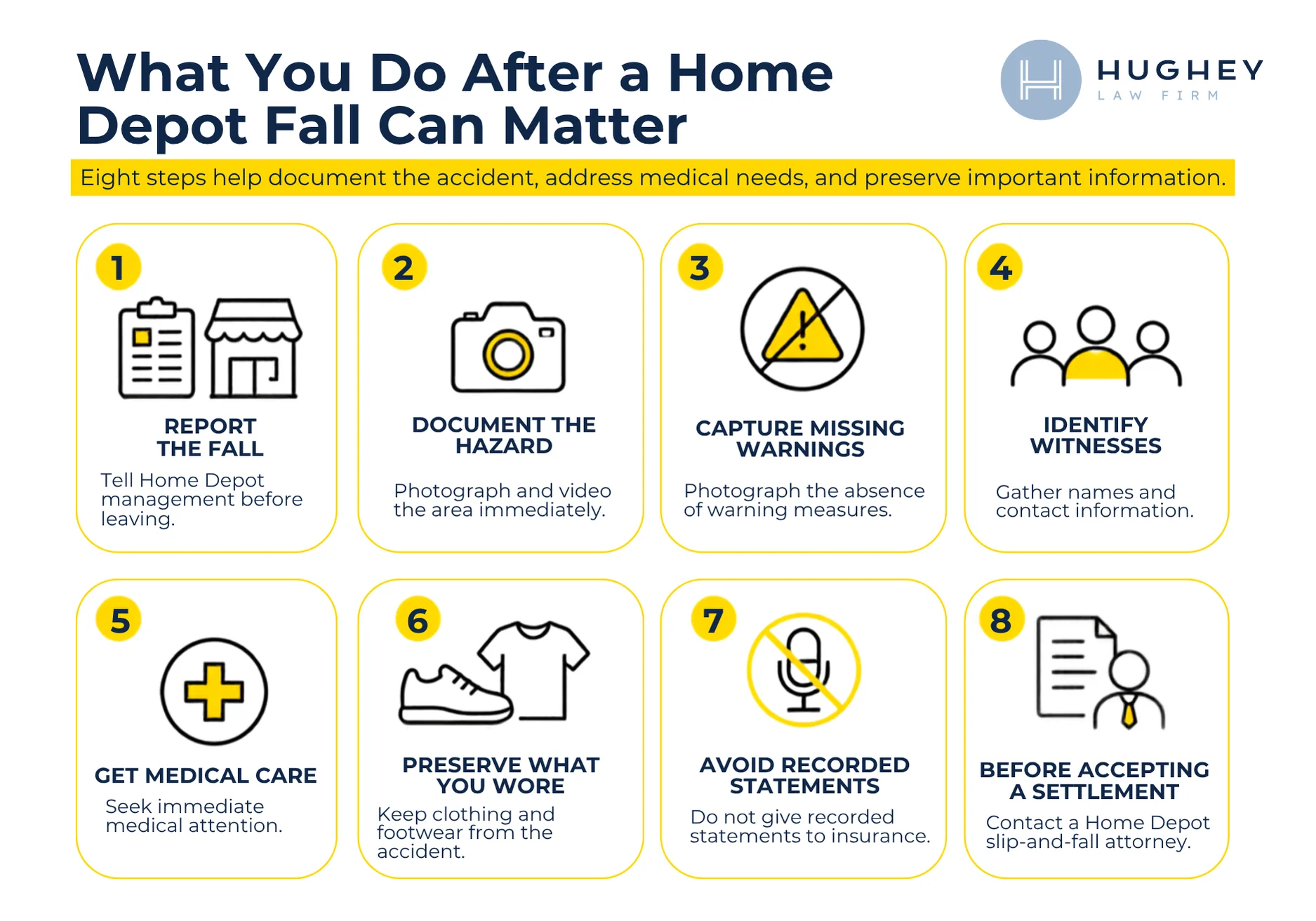
Eight specific steps are required after a fall at Home Depot in Charleston, and the three most critical to the legal claim and most commonly missed by injured customers are those taken at the scene: reporting the incident, photographing the hazard, and documenting the absence of adequate warning measures. The steps taken immediately after a slip-and-fall accident at Home Depot can significantly impact the medical outcome and the strength of any subsequent legal claim.
- Step 1: Report the accident to Home Depot management before leaving the store.
- Step 2: Immediately photograph and video the hazard and surrounding area.
- Step 3: Specifically photograph the absence of adequate warning measures.
- Step 4: Gather witness names and contact information.
- Step 5: Seek immediate medical attention.
- Step 6: Preserve the clothing and footwear worn during the accident.
- Step 7: Do not give recorded statements to Home Depot’s insurance representative.
- Step 8: Contact a Home Depot Slip and Fall Attorney before accepting any settlement offer.
Even if you left the store without completing all these steps, don’t assume your claim is unworkable. Call (843) 881-8644, and the Hughey Law Firm will assess the available evidence and determine the best course of action.
How Hughey Law Firm Investigates Home Depot Injury Claims
The Hughey Law Firm approaches every Home Depot slip-and-fall case with the same thorough investigation and litigation preparation that we bring to all retail premises liability matters.
- We provide immediate evidence preservation.
- Warehouse-specific investigation.
- Medical and damages development.
- We conduct liability analyses under South Carolina law.
- We provide negotiation and trial representation.
All Home Depot slip and fall cases at Hughey Law Firm are handled on a contingency fee basis. You pay no legal fees unless we recover compensation for you. Contact our Charleston Home Depot Slip and Fall Lawyer today.
Challenges Victims Face in Home Depot Injury Claims
Home Depot injury claims present a unique set of corporate defense resources and warehouse-specific evidentiary challenges that surpass those encountered in other retail premises liability contexts. Identifying these challenges in advance enables attorneys to prepare specifically rather than respond reactively. The following are the most common challenges encountered in Home Depot premises liability claims in South Carolina.
- Corporate defense infrastructure: Home Depot maintains a sophisticated claims management operation and ongoing relationships with premises liability defense firms throughout South Carolina.
- Disputes over hazard duration: The defense will often argue the hazard was recently created and the company had no reasonable time to address it. Surveillance footage, inspection logs, and employee testimony are the primary tools for rebutting this argument.
- Comparative negligence: Home Depot will attempt to assign a percentage of fault to the injured customer, claiming they were distracted, not watching where they were walking, or failed to avoid a hazard that was open and obvious.
- Open and obvious defense: Home Depot frequently asserts that the condition causing the fall was visible and that a reasonably careful customer would have noticed and avoided it.
- Missing or overwritten surveillance footage: The company’s thirty-day retention policy means footage documenting the hazard and the fall may be automatically deleted before a formal preservation demand is received.
- Pressure to settle early: Home Depot’s insurer may present early settlement offers before the full scope of injuries and future medical needs is known, structured to minimize the company’s exposure rather than fairly compensate the victim.
Each of these defenses is predictable, and that predictability allows for thorough preparation to counter them. Call (843) 881-8644 to start building your defense with Hughey Law Firm from day one.

Contact Our Charleston Home Depot Slip and Fall Injury Lawyer Today
If you were injured in a slip-and-fall accident at a Home Depot in Charleston or anywhere else in South Carolina, the Hughey Law Firm is ready to evaluate your situation and pursue the full compensation your injuries warrant. The initial consultation is free, confidential, and carries no obligation to proceed.
Call (843) 881-8644 for a free consultation, fill out our contact form, or use live chat to speak with our team now. We represent families throughout Charleston, the Lowcountry, and across South Carolina.
Disclaimer: The information on this page is intended for general informational purposes only and does not constitute legal advice. Every case is different. Past results do not guarantee future outcomes. Hiring a lawyer is an important decision that should not be based solely on advertisements. Ask us to send you free written information about our qualifications and experience before you decide. The Hughey Law Firm is located in Charleston, South Carolina.
Frequently Asked Questions
About Home Depot Slip and Fall AccidentsUnder South Carolina’s modified comparative fault system, your recovery is reduced proportionally by your percentage of fault as long as it does not exceed fifty percent. Home Depot’s defense team routinely attempts to assign fault to injured customers to reduce the company’s liability.
Approximately thirty days before it is automatically overwritten. Without a formal legal preservation demand issued before that window closes, footage documenting the hazard and the circumstances of your fall may be permanently lost. This is one of the primary reasons to contact an attorney as soon as possible after the incident.
The absence of a warning sign is direct evidence that Home Depot failed to fulfill its duty to warn customers of known hazards. Photograph the absence of signs specifically at the scene. Documenting the lack of adequate warnings significantly strengthens the liability argument.
Yes. The company is responsible for ensuring that merchandise is stored and displayed in a way that does not pose an unreasonable risk to customers. Improperly secured products on elevated warehouse shelving, overloaded sections, and merchandise destabilized can all support a premises liability claim and a product liability claim.
Not automatically, but the company is liable if the wet condition existed long enough for a reasonable inspection program to discover it, if Home Depot’s own operations created it, or if the company failed to provide adequate warning once the condition was known.
Yes. According to South Carolina premises liability law, Home Depot can be held liable if they failed to maintain safe premises, which resulted in your injury. To win your case, you must prove that a hazardous condition existed, that Home Depot knew or should have known about it, and that the company failed to address or warn you about the danger in a timely manner.