

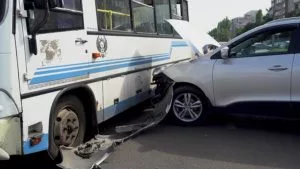
 If you were injured in a bus crash in Charleston, South Carolina, you may be dealing with serious injuries and mounting medical bills. The claims process is also significantly more complicated than that of a standard vehicle collision. Buses carry dozens of passengers, weigh tens of thousands of pounds, and often operate under government or corporate ownership structures that add layers of legal complexity to injury claims.
Charleston’s public transportation system moves millions of passengers through the city each year. This system includes CARTA buses, the Downtown Area Shuttle, school buses, and private charter carriers. When these vehicles crash, the injuries are often catastrophic, and liability questions involve multiple parties across the government, insurance, and private sectors.
Hughey Law Firm represents bus accident victims throughout Charleston, North Charleston, Mount Pleasant, and South Carolina.
Charleston Bus Accident Guide
- Why You Need a Charleston Bus Accident Attorney After a Crash
- Definition of a Bus Under South Carolina Law
- Types of Bus Accidents
- The Dangers Buses Create on Charleston Roads
- Common Injuries Caused by Bus Accidents
- Who Can Be Held Liable in a Bus Accident?
- Challenges Associated With Bus Accident Claims
- What to Do After a Bus Accident in Charleston
- Compensation Available in Bus Accident Claims
- Frequently Asked Questions
Why You Need a Charleston Bus Accident Attorney After a Crash
Claims involving bus accidents are more legally and procedurally complex than standard vehicle collision claims. In these cases, the right legal representation is not optional. It determines whether you receive fair compensation or nothing at all.
When a bus is owned or operated by a government entity, such as a municipal transit authority, the South Carolina Tort Claims Act imposes special notice requirements and damage caps that do not apply to private party claims. Missing a government notice deadline can permanently eliminate your right to recover, regardless of how serious your injuries are.
When multiple passengers are injured in the same crash, competing claims may reduce the available insurance coverage. When a private carrier or charter company is involved, corporate structures can complicate the identification of the correct defendants. If driver error, vehicle maintenance failures, or inadequate training contributed to the crash, then the liability investigation will require resources and legal knowledge that most injured people lack.
Hughey Law Firm handles investigations, evidence preservation, government notice requirements, insurance negotiations, and litigation for bus accident victims throughout Charleston, allowing clients to focus on recovery.
Definition of a Bus Under South Carolina Law
It matters to understand what qualifies as a bus under South Carolina law because the classification determines which liability rules and insurance requirements apply to an injury claim.
According to South Carolina Code Section 56-5-180, a bus is defined as any motor vehicle designed to carry more than ten passengers for transportation, or any motor vehicle that transports people for compensation other than a taxicab.
The following vehicle types fall within this definition and may be involved in bus accident claims:
- Public transit buses operated by government agencies
- School buses used to transport children to or from public school or school activities
- Shuttles, such as Charleston’s Downtown Area Shuttle
- Private charter and carrier buses
- Large passenger vans
Types of Bus Accidents
There are several distinct scenarios in which bus accidents occur in Charleston, each involving different potential defendants and liability theories. The most common types include the following:
- Passenger injury accidents
- Vehicle collision accidents
- Pedestrian and cyclist accidents
- Rear-end and intersection collisions
- Maintenance and equipment failure accidents
The Dangers Buses Create on Charleston Roads
The physical characteristics of buses result in a higher degree of liability exposure than that of ordinary vehicles. In the United States, transit buses are usually forty feet long, weigh between 30,000 and 44,000 pounds when loaded, and lack the passenger safety features that are standard in personal vehicles. Fully loaded, larger three-axle buses can weigh up to 65,000 pounds.
Most buses do not have seat belts or passenger restraints. According to the Insurance Institute for Highway Safety, the airbag systems available in passenger vehicles have not been widely adopted for transit buses. These safety gaps directly affect the severity of injuries and the scope of damages in the event of a crash.
Buses also operate under conditions that increase crash risk on Charleston roads. Peak-hour crowding on vehicles such as CARTA buses on the Meeting Street and King Street corridors adds weight and creates driver distraction. Large turning radii make navigating intersections more difficult, particularly in downtown Charleston’s historic grid, where streets were not designed for vehicles of this size.
Common Injuries Caused by Bus Accidents
Due to the significant weight difference between buses and other vehicles, as well as the lack of passenger restraints on most buses, injuries from bus accidents are often more severe than those from collisions involving standard vehicles. The following injuries are most commonly seen in bus accident claims:
- Traumatic brain injuries
- Spinal cord injuries and paralysis
- Broken bones and fractures
- Soft tissue and internal injuries
- Head and neck trauma
- Organ damage and internal hemorrhaging
- Lacerations and road rash
- Fatal injuries
Long-term disability is a common outcome in serious bus accident cases. Its effect on future earning capacity and ongoing care needs significantly affects the total value of a claim.
Who Can Be Held Liable in a Bus Accident?
Depending on who owned the vehicle, who operated it, and what caused the collision, multiple parties may share legal responsibility for a bus crash.
- The bus driver
- The transit authority or operating company
- Vehicle maintenance contractors
- Government entities that operate public transit buses
- Equipment manufacturers
Challenges Associated With Bus Accident Claims
There are several specific challenges that distinguish bus accident claims from ordinary vehicle collision cases.
- Government notice requirements. Claims against government-operated transit authorities require written notice within the timeframe specified by the South Carolina Tort Claims Act before a lawsuit can be filed.
- Damage caps against government defendants. South Carolina law limits the damages recoverable in claims against government entities.
- Statute of limitations. In most cases, the statute of limitations is three years from the date of the crash.
- Evidence preservation. Bus operators maintain maintenance records, driver logs, and surveillance footage that are critical evidence in crash investigations.
What to Do After a Bus Accident in Charleston
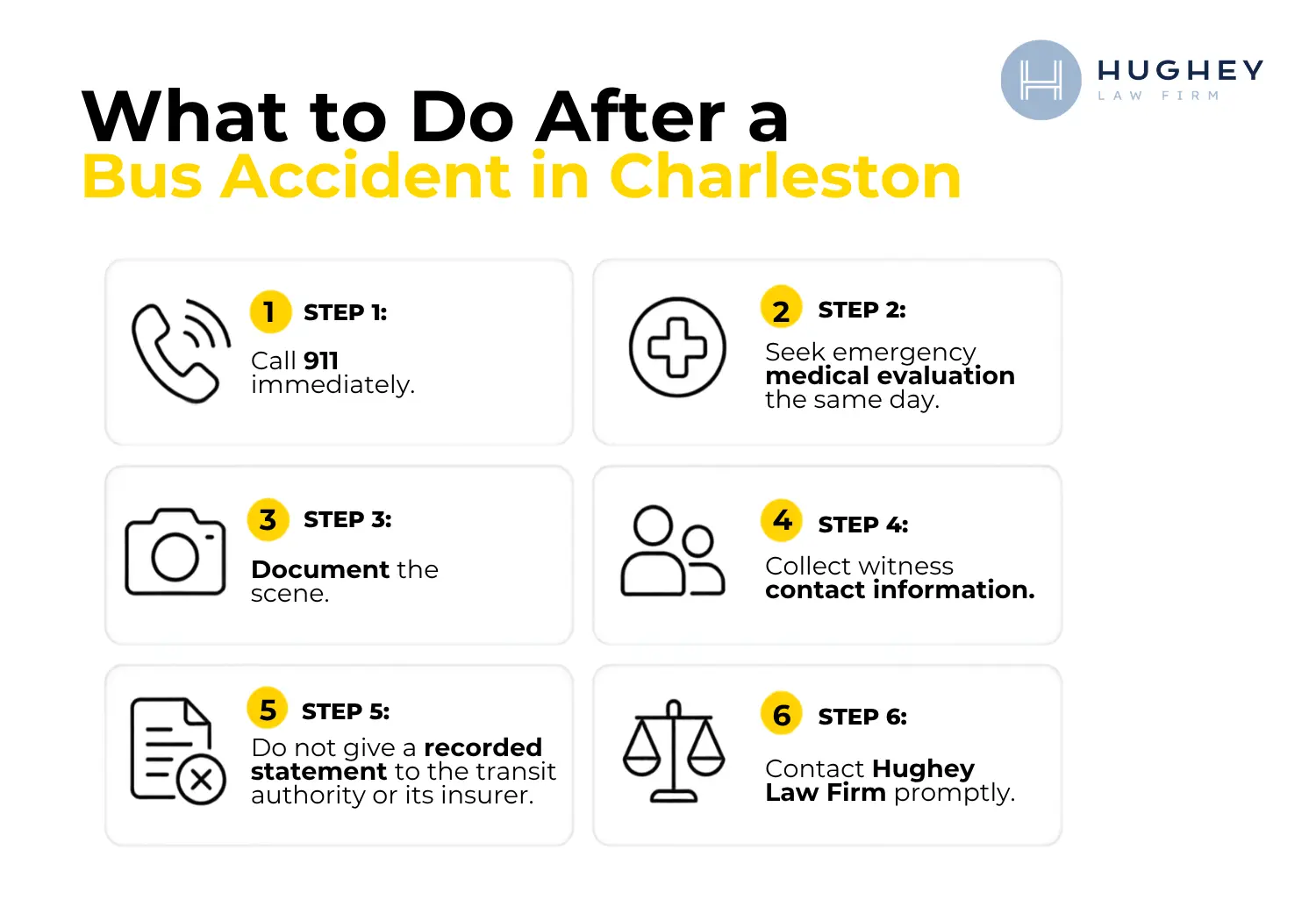
Here are the steps in detail:
- Step 1: Call 911 immediately.
- Step 2: Seek emergency medical evaluation the same day.
- Step 3: Document the scene.
- Step 4: Collect witness contact information.
- Step 5: Do not give a recorded statement to the transit authority or its insurer.
- Step 6: Contact Hughey Law Firm promptly.
Compensation Available in Bus Accident Claims
According to South Carolina law, bus accident victims can pursue compensation in the following categories.
- Medical expenses, including emergency treatment, hospitalization, surgery, specialist care, rehabilitation, and future medical needs resulting from the crash.
- Lost wages for income missed during recovery and long-term loss of earning capacity when permanent injuries affect the ability to work.
- Pain and suffering, which can be severe and lasting in serious bus crash cases.
- Permanent disability damages for lasting functional limitations affecting daily life, employment, and quality of life.
- Property damage compensation is available for the repair or replacement of a vehicle or other property damaged in the crash.
- Wrongful death damages are available when a bus crash causes a fatality. This allows surviving family members to recover funeral expenses and loss of companionship, among other damages recognized under South Carolina’s wrongful death statute.
Note that claims against government entities are subject to damage caps under the South Carolina Tort Claims Act. This makes it important to identify all available private defendants alongside any government claim.
 Get in Touch With a Charleston Bus Accident Lawyer Today
If you or a family member was injured in a bus crash in Charleston or anywhere else in South Carolina, the Hughey Law Firm is ready to investigate what happened, manage the claims process, handle government notice requirements, and pursue the full compensation your injuries warrant.
Call (843) 881-8644 for a free consultation, fill out our contact form, or use live chat to speak with our team now. We represent families throughout Charleston, the Lowcountry, and across South Carolina.
Disclaimer: The information on this page is intended for general informational purposes only and does not constitute legal advice. Every case is different. Past results do not guarantee future outcomes. Hiring a lawyer is an important decision that should not be based solely on advertisements. Ask us to send you free written information about our qualifications and experience before you decide. The Hughey Law Firm is located in Charleston, South Carolina.
Frequently Asked Questions
About Bus AccidentsDriver negligence is one of the most common causes of bus crashes. In such cases, both the driver and the employing company can be held responsible.
Yes. Depending on the cause of the crash, the bus driver, the transit authority or operating company, maintenance contractors, and equipment manufacturers can all share liability.
You have the right to pursue a personal injury claim against the bus operator, the transit authority, and any other liable parties. These claims follow the same legal framework as other vehicle collision cases, but they are more complex when government entities are involved.
Yes. Passengers injured on a bus can file claims against the transit authority, the operating company, or both. The applicable legal framework depends on whether the operator is a government entity or a private carrier.
Yes, but claims against government-operated transit authorities are subject to the South Carolina Tort Claims Act. This act imposes written notice requirements and damage caps. Failing to meet the notice deadline can permanently eliminate your right to recover.