

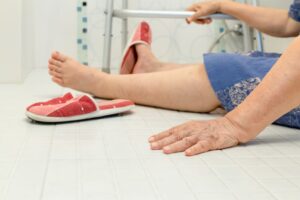
If you were injured in a slip-and-fall accident on someone else’s property in Charleston, the property or business owner may be legally responsible for your injuries and losses. According to South Carolina premises liability law, property owners and businesses must maintain reasonably safe conditions for visitors and address or warn them about known or foreseeable hazards. If they breach this duty and someone is seriously hurt, the injured person has the right to pursue compensation.
Charleston’s mix of grocery stores, big-box retailers, restaurants, apartment complexes, parking lots, and historic downtown properties creates a wide range of premises liability environments, each with its own common hazards and legal considerations. For example, a fall on a wet grocery store floor raises different questions of evidence and liability than a fall on an uneven sidewalk outside a downtown restaurant or a poorly lit stairwell in an apartment complex. They all share a legal framework that holds the property owner accountable when their failure to maintain safe conditions causes injury.
At Hughey Law Firm, we represent slip-and-fall victims throughout Charleston and South Carolina. We have the experience to investigate what caused your fall, establish the property owner’s liability, and pursue the full compensation your injuries warrant.
Charleston Slip and Fall Accident Guide
- Common Causes of Slip and Fall Accidents
- Common Injuries in Slip and Fall Accidents
- Who Is Liable for a Slip and Fall Accident?
- High-Risk Locations for Slip and Fall Accidents
- Damages You Can Recover After a Slip and Fall
- What to Do After a Slip and Fall Accident in Charleston
- Proven Results in Charleston Slip-and-Fall Cases
- Frequently Asked Questions
Common Causes of Slip and Fall Accidents
Slip-and-fall accidents in Charleston usually result from a few common hazardous conditions that property owners and businesses are legally obligated to identify and address:
- Wet or recently mopped floors without adequate warning signage.
- Spilled liquids and debris left unattended for long periods.
- Uneven flooring, sidewalks, and walkways, including cracked pavement, raised transitions between flooring types, and deteriorated surfaces.
- Poor lighting in stairwells, parking lots, hallways, and walkways
- Broken or missing handrails on stairs and ramps.
- Torn or worn carpeting and floor mats.
These are among the most frequently documented hazardous conditions in Charleston premises liability cases. However, they represent only a portion of what can give rise to a valid claim. The Hughey Law Firm has represented clients injured by a wide range of unsafe property conditions. If your situation is not on this list, it does not mean that you do not have a case worth evaluating.
Common Injuries in Slip and Fall Accidents
Depending on how the fall occurred, the surface struck, and the victim’s age and physical condition, slip and fall accidents can produce a wide range of injuries. The following categories cover the most frequently seen injuries in Charleston slip-and-fall cases.
- Head injuries
- Spinal and Back Injuries
- Fractures
- Soft tissue injuries
- Bruised or fractured tailbones and pelvic injuries
- Sprains and tears to knee ligaments and tendons
Regardless of the type of injury, prompt medical evaluation is critical. Some of the most serious slip-and-fall injuries, including concussions and certain fractures, are not immediately obvious at the scene. A doctor’s evaluation establishes the appropriate treatment plan and medical documentation connecting your injuries to the incident. Contact a Charleston Slip and Fall Lawyer as soon as possible.
Who Is Liable for a Slip and Fall Accident?
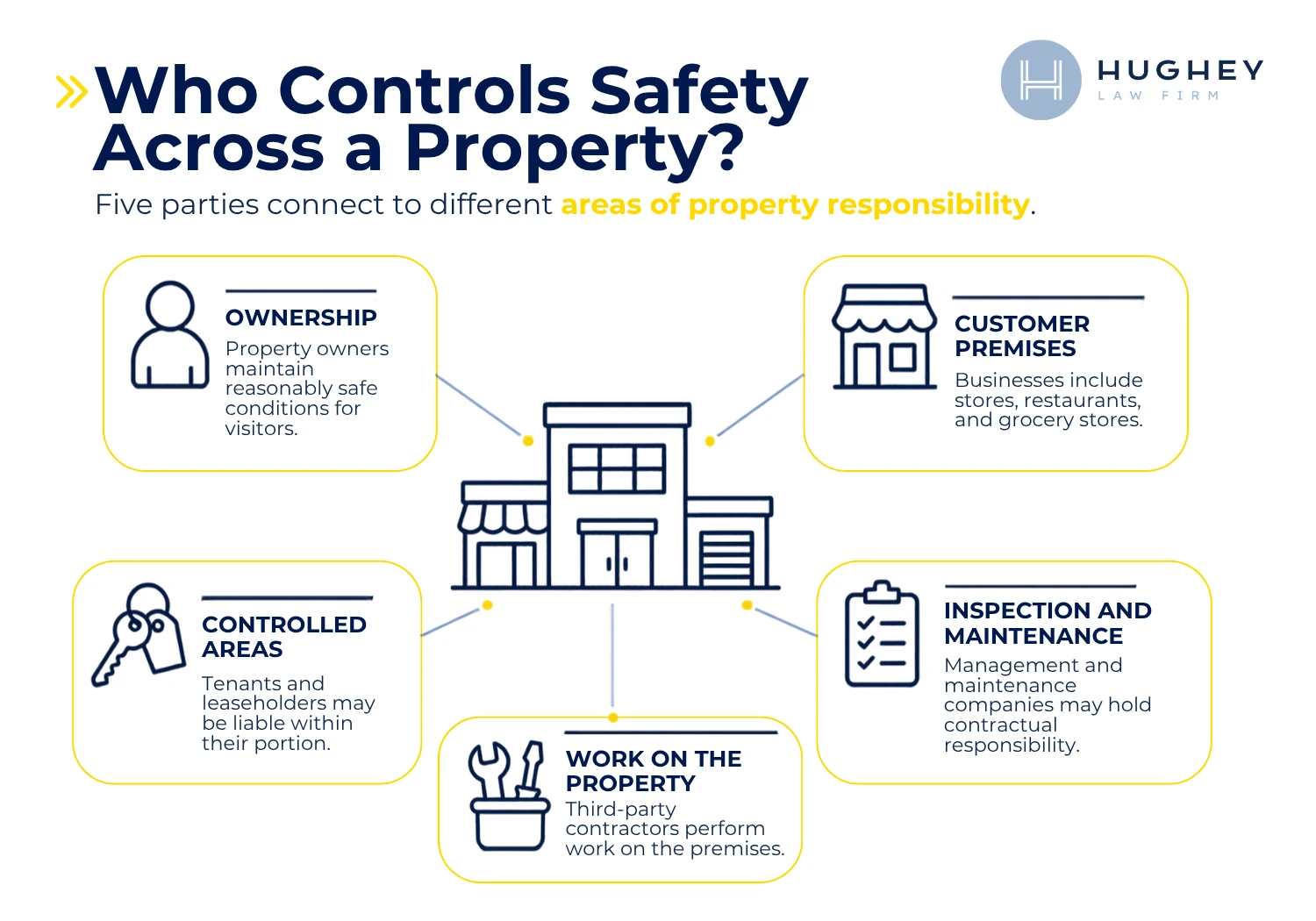
In a Charleston slip-and-fall case, liability depends on who controlled the property or the specific condition that caused the fall. Depending on how the property is owned, managed, and maintained, more than one party can be legally responsible. The liable party in a Charleston slip and fall accident is determined by who controlled the property or condition that caused the fall and whether that party failed to meet their legal duty of care.
- Property owners are primarily responsible for maintaining their property in a reasonably safe condition for visitors.
- Businesses that invite customers onto their premises, including stores, restaurants, and grocery stores.
- Tenants and leaseholders may be liable for conditions within the portion of a property they control.
- Property management and maintenance companies that are contractually responsible for inspecting and maintaining a property.
- Third-party contractors performing work on a property.
Identifying every party that bears legal responsibility from the beginning of a claim ensures that every available source of compensation is pursued. Call (843) 881-8644 to discuss who is responsible for what happened to you with Hughey Law Firm.
How Fault Is Proven
In a Charleston slip-and-fall case, proving liability requires demonstrating that the responsible party knew or should have known about the hazardous condition and failed to address it promptly. This standard is firmly anchored in South Carolina jurisprudence. Under the landmark Garvin v. Bi-Lo, Inc. ruling, 343 S.C. 625, 541 S.E.2d 831 (2001), the state Supreme Court ruled that an injured plaintiff must show that the merchant created the hazard or had actual or constructive knowledge of it.
Therefore, a business that claims it was unaware of a floor hazard is not automatically exempt from liability. According to South Carolina law, businesses owe customers the highest duty of care. This means that they must conduct regular, proactive inspections of their premises to identify and remedy hazards before they cause injury. If a hazardous condition existed long enough to be discovered by a reasonable inspection schedule, the business is legally considered to have constructive knowledge of the hazard, regardless of whether a specific employee ever saw it.
High-Risk Locations for Slip and Fall Accidents
The mix of retail centers, restaurants, entertainment venues, and residential properties in Charleston creates specific premises liability risks across multiple property types. The legal considerations differ depending on where the accident occurred and what duty of care the property owner owed. Slip-and-fall accidents occur across a wide range of property types in Charleston, including the following high-risk environments.
- Grocery stores
- Big-box retail stores
- Apartment complexes
- Parking lots
- Restaurants
- Entertainment venues
Each location has its own hazard profile and requires a different approach to investigate who knew about the dangerous condition and when. Call (843) 881-8644 to discuss your case and learn about your legal options.
Damages You Can Recover After a Slip and Fall
According to South Carolina law, slip and fall victims can pursue compensation across three broad categories of damages. In serious injury cases, the combined value reflects not just the immediate medical bills, but also the full physical, financial, and personal costs caused by the property owner’s negligence.
- Medical costs cover all expenses related to treating the injuries sustained in the fall, including emergency care, hospitalization, surgery, diagnostic imaging, physical therapy, prescription medication, and any future medical care made necessary by the injuries.
- Lost wages compensate for income missed during recovery.
- Non-economic damages compensate for losses that cannot be quantified, including pain and suffering, permanent disability or disfigurement, and loss of enjoyment of life.
The total value of a slip-and-fall claim depends on several factors, including the severity of the injuries, the length of recovery, the necessary medical treatment, and the long-term impact on the victim’s life and ability to work. There is no standard settlement amount, and no two cases are alike. Call (843) 881-8644 to speak with the Hughey Law Firm and receive an honest assessment of your case’s value.
What to Do After a Slip and Fall Accident in Charleston
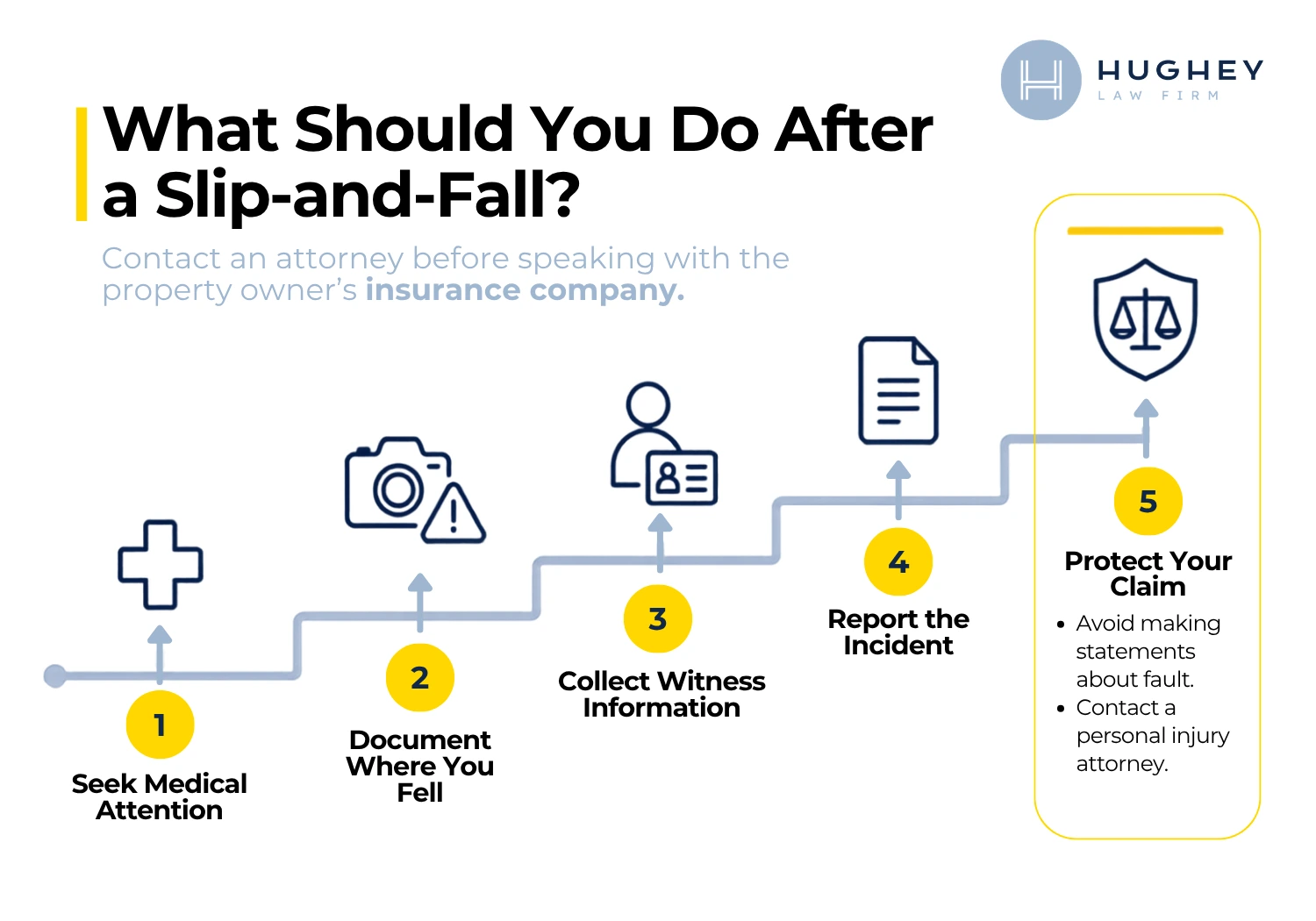
If you are involved in a slip-and-fall accident in Charleston, you should seek medical attention, document the scene, collect witness information, and contact an attorney before speaking with the property owner’s insurance company. Here are the steps in detail:
- Step 1: Seek medical attention.
- Step 2: Document the area where you fell.
- Step 3: Collect witness information.
- Step 4: Report the incident.
- Step 5: Avoid making statements about fault.
- Step 6: Contact a slip and fall accident attorney.
The sooner you take these steps, the stronger your position will be. Surveillance footage disappears, witnesses become harder to locate, and property owners quickly correct hazardous conditions after an incident. If you are ready to take that last step, Hughey Law Firm is available now for a free consultation.
Proven Results in Charleston Slip-and-Fall Cases

Hughey Law Firm has achieved significant results for slip-and-fall victims throughout Charleston and South Carolina. These results include a $1,000,500 settlement for a 93-year-old woman injured in a premises liability fall. This outcome demonstrates the firm’s dedication to maximizing the value of a claim, regardless of the defendant’s size or resources.
Every slip-and-fall case is unique, and previous results do not guarantee a specific outcome in your case. However, past results reflect a consistent willingness to thoroughly investigate, build the evidence a claim requires, and pursue meaningful accountability for the people and families we represent.
Past results do not guarantee future outcomes. Every case is unique and must be evaluated based on its specific facts and circumstances.

Get Help After a Slip and Fall Injury in Charleston
At Hughey Law Firm, our Charleston slip and fall attorneys have seen firsthand the serious injuries that can result from these accidents. We know how to pursue the full compensation our clients deserve as efficiently as possible. We handle insurance claims and premises liability lawsuits and manage every aspect of your legal claim, from investigation to resolution.
Call (843) 881-8644 for a free consultation, fill out our contact form, or use live chat to speak with our team now. Consultations are free, so do not wait to reach out.
Disclaimer: The information on this page is intended for general informational purposes only and does not constitute legal advice. Every case is different. Past results do not guarantee future outcomes. Hiring a lawyer is an important decision that should not be based solely on advertisements. Before making a decision, ask us to send you free written information about our qualifications and experience. The Hughey Law Firm is located in Charleston, South Carolina.
Frequently Asked Questions
About Slip & Fall AccidentsThere is no set value. Compensation depends on the severity of the injuries, the necessary medical treatment, time missed from work, and the long-term impact on the victim’s life. An attorney can evaluate your case’s specific facts to provide a realistic assessment.
Yes. In most cases, South Carolina’s statute of limitations for slip-and-fall claims is three years from the date of the accident. Missing this deadline generally eliminates your right to pursue compensation, so it is important to contact an attorney promptly.
You must show that a hazardous condition existed, that the property owner or business knew or should have known about it, and that they failed to address or adequately warn you about it in a timely manner. Establishing how long the hazard existed before your fall often becomes the central issue in these cases.
Depending on who was responsible for the condition that caused the fall, liability may fall on the property owner, a business owner, a tenant, a property management company, or a maintenance contractor. An experienced attorney can identify all potentially liable parties in your specific situation.
Settlement timelines vary based on the severity of the injuries, the complexity of the liability investigation, and how much negotiation is required. Cases involving serious injuries often take longer because your attorney may recommend waiting until your medical prognosis is clear before finalizing a claim.
In the immediate aftermath, your health insurance or the property’s medical payments coverage may cover initial treatment. Ultimately, if the property owner or business is found liable for your injuries, their insurance carrier is responsible for reimbursing your medical expenses as part of your settlement or verdict.
Yes. Initial settlement offers from insurance companies are often lower than a claim’s actual value, especially before the full extent of your injuries and future medical needs is known. An attorney can evaluate whether an offer reflects the true value of your claim before you accept it.
You suffered injuries in a Charleston slip and fall accident. What next? The steps you take in the immediate aftermath of a slip and fall accident can go a long way toward providing both physical and financial protection following your injury.
Report your injury to the premises owner. If you suffered injuries at a business, the business may have a specific procedure it needs to go through to create a record of the accident. The record will serve as evidence of when the accident took place, which can later make it easy for you to pursue compensation through a personal injury claim.
Create your own record of the accident. As soon as possible after your accident, take the time to sit down and create a record of the accident. You may want to take photos of the accident scene, including any clear signs of what led to your fall. If, for example, you suffered injuries when the stairs down to the beach collapsed beneath you, you might want to snap photos of the stairs. Ask for contact information from any witnesses to the accident.
As soon as you can, write down or record your account of what happened. Your memory may prove clearer in the immediate aftermath of the accident, which can make it easier for you to create an accurate view of exactly what led to your accident and your injuries.
Seek medical attention. Charleston offers several opportunities to seek medical attention, including MEDcare Urgent Care, Health First Urgent Care, and Access Urgent as well as Roper Hospital, MUSC Health University Medical Center, and a Children’s Hospital, where children can receive treatment for serious injuries. If you feel any pain or see any sign of injury after a fall, or if you have underlying health conditions that could make a fall more dangerous to you, always seek medical attention immediately.
Your doctor may uncover injuries that you did not even recognize in the immediate aftermath of the accident, including injuries like broken bones or even traumatic brain injury. Failure to seek treatment for those injuries could worsen your symptoms and leave you with more severe long-term impacts than you initially anticipated.
Contact an attorney. Do not try to handle a Charleston slip and fall accident claim on your own. Instead, get in touch with an experienced Charleston premises liability attorney. An attorney can help you decide on your next steps, give you vital advice, and make it easier for you to recover the compensation you deserve.
Yes. Homeowners owe a duty of care to visitors on their property. If a dangerous condition on a residential property caused your fall, you may be able to pursue a claim against the homeowner through their insurance policy.
They commonly occur in grocery stores, big-box retail stores, restaurants, apartment complexes, and parking lots, where wet floors, cluttered aisles, poor lighting, and uneven surfaces are common hazards.