
 Sexual assault in a nursing home is one of the most serious forms of elder abuse and is almost always preventable. Failure to supervise staff, screen employees, or protect residents from one another can result in violations that leave lasting physical and psychological harm. Residents with dementia, cognitive impairment, or limited mobility are at the greatest risk because they often cannot report the assault or defend themselves.
The Hughey Law Firm represents victims of nursing home sexual assault in Charleston, North Charleston, Mount Pleasant, and throughout South Carolina. We hold facilities accountable when their failure to protect a resident allows abuse to occur.
Why Do Families Throughout South Carolina Trust Hughey Law Firm for Elder Abuse Cases?
Unlike most personal injury firms, which handle elder abuse as one practice area among many, Hughey Law Firm specializes in it. Hughey Law Firm is different, and our expertise is verifiable. Here’s what you need to know about us:
- Nathan Hughey, our founder, began his legal career defending nursing homes.
- Nathan Hughey teaches other attorneys about elder abuse law.
- Attorneys and law firms across South Carolina refer elder abuse cases to us.
- Over 70% of our caseload consists of elder abuse cases.
- Since 2007, we have resolved over 1,000 elder abuse cases in South Carolina.
Over 600 cases resolved for $100,000 or more.
- $1,000,000 recovered for elder abuse resulting in pressure sores in a nursing home
- $875,000 recovered for a client who suffered a broken neck and pelvis in a wheelchair accident
- $497,500 recovered for a client who fell and broke their hip in a nursing home
The results described above are specific to those cases and are not intended to predict or guarantee the outcome of any future case. Each case is unique, and outcomes depend on the particular facts and legal circumstances involved. Hiring a lawyer is an important decision that should not be based solely on advertisements.
Charleston Nursing Home Sexual Assault Guide
- What Is Nursing Home Sexual Assault?
- Warning Signs of Nursing Home Sexual Abuse
- When Negligence Leads to Sexual Abuse in Charleston Nursing Homes
- Who Can Be Held Liable for Nursing Home Sexual Assault?
- Compensation Available in Charleston Nursing Home Sexual Abuse Cases
- What Families Should Do If They Suspect Sexual Abuse
- Can a Nursing Home Successfully Defend a Sexual Assault Case?
- Frequently Asked Questions
What Is Nursing Home Sexual Assault?
Sexual assault in a nursing home is any non-consensual sexual contact involving a resident. Examples include unwanted touching, indecent exposure, forced nudity, and rape. Those responsible may be staff members, other residents, contractors working in the facility, or visitors.
Consent is a central legal issue in these cases. A resident with dementia or significant cognitive impairment is often unable to legally consent to sexual activity, even if they do not resist or verbally object. Both South Carolina law and federal nursing home regulations recognize this. A facility cannot defend an assault by claiming the resident did not object when their medical condition made real consent impossible.
Charleston and the surrounding Lowcountry are home to dozens of nursing homes and assisted living facilities, ranging from large, corporate-run campuses to smaller, privately owned homes. Each has a legal duty to protect residents from this kind of harm, regardless of size or ownership structure.
Warning Signs of Nursing Home Sexual Abuse
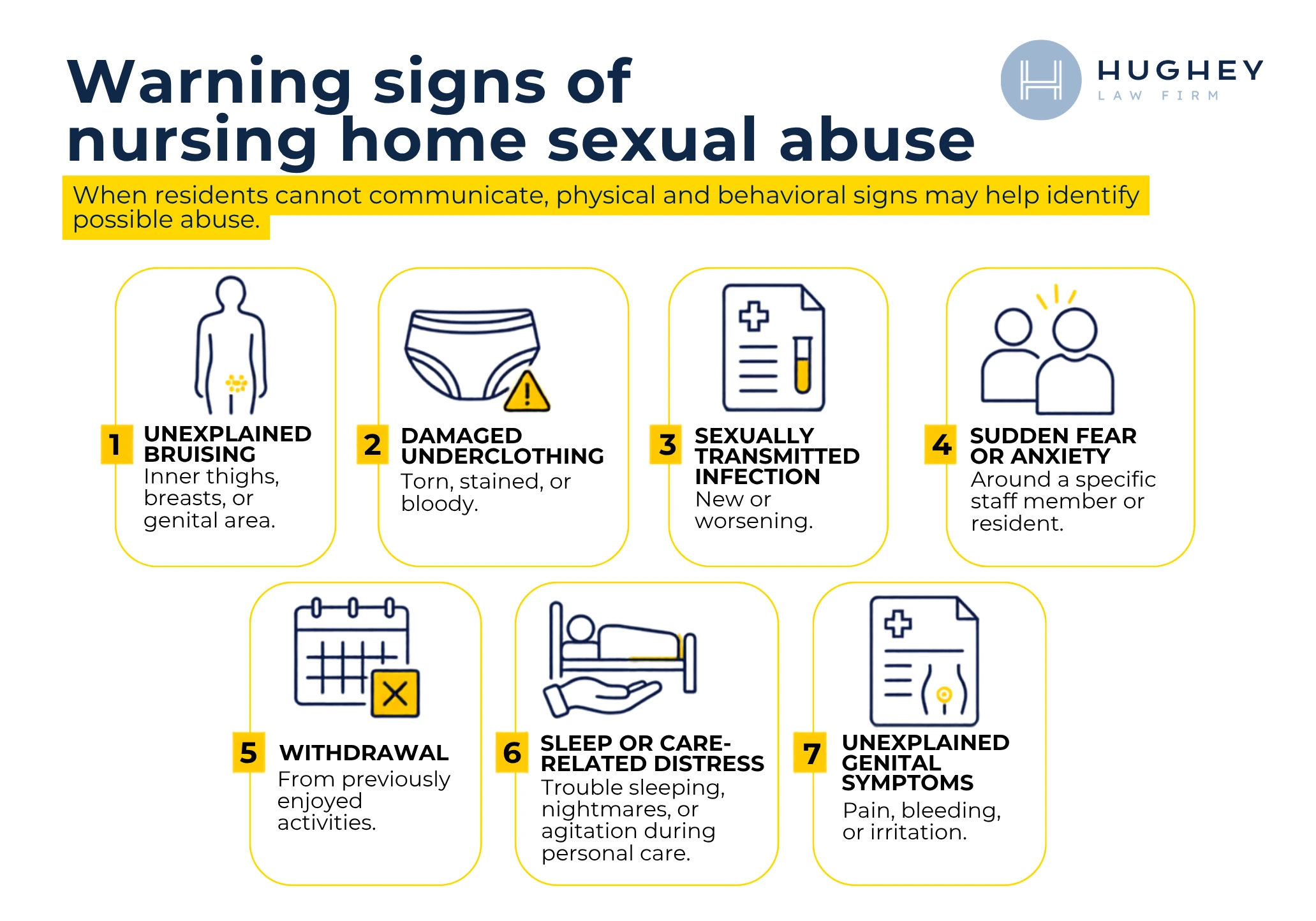
Sexual abuse in nursing home settings is frequently concealed, underreported, and difficult for victims to communicate, particularly when cognitive impairment limits a resident’s ability to describe what happened, making physical and behavioral warning signs the primary means by which families and attorneys identify that an assault has occurred. Families should watch for the following warning signs, especially when a loved one is unable to easily communicate what happened:
- Unexplained bruising, particularly around the inner thighs, breasts, or genital area
- Torn, stained, or bloody underclothing
- A new or worsening sexually transmitted infection
- Sudden fear or anxiety around a specific staff member or resident
- Withdrawal from activities the resident previously enjoyed
- Trouble sleeping, nightmares, or agitation during personal care routines
- Unexplained genital pain, bleeding, or irritation
Each sign on this list deserves immediate attention. Together, they reveal a pattern that families and attorneys can use to investigate what happened and establish that the facility ignored warning signs before an assault occurred or escalated. If you have observed any of these signs in a loved one residing at a Charleston area nursing home, call (843) 881-8644 to speak with Hughey Law Firm.
When Negligence Leads to Sexual Abuse in Charleston Nursing Homes
Sexual abuse in a nursing home almost always occurs due to some failure on the part of the facility. One of the most common root causes is understaffing. When a facility does not have enough staff on duty, residents are left unsupervised for extended periods of time, creating opportunities for abuse.
Inadequate care plans are another contributing factor. Every resident should have a plan that addresses their specific risks, including supervision needs for those who cannot protect themselves.
Poor employee screening is a third major cause. Facilities are required to conduct background checks on staff who will have direct contact with residents. When a facility skips this step, rushes it, or hires someone with a history of misconduct, the facility bears direct responsibility for that employee’s actions.
Failing to separate at-risk residents from those who have exhibited aggressive or inappropriate behavior toward others is also a common factor in cases of resident-on-resident assault. Facilities know, or should know, when a resident has a history of acting out sexually toward others.
Who Can Be Held Liable for Nursing Home Sexual Assault?
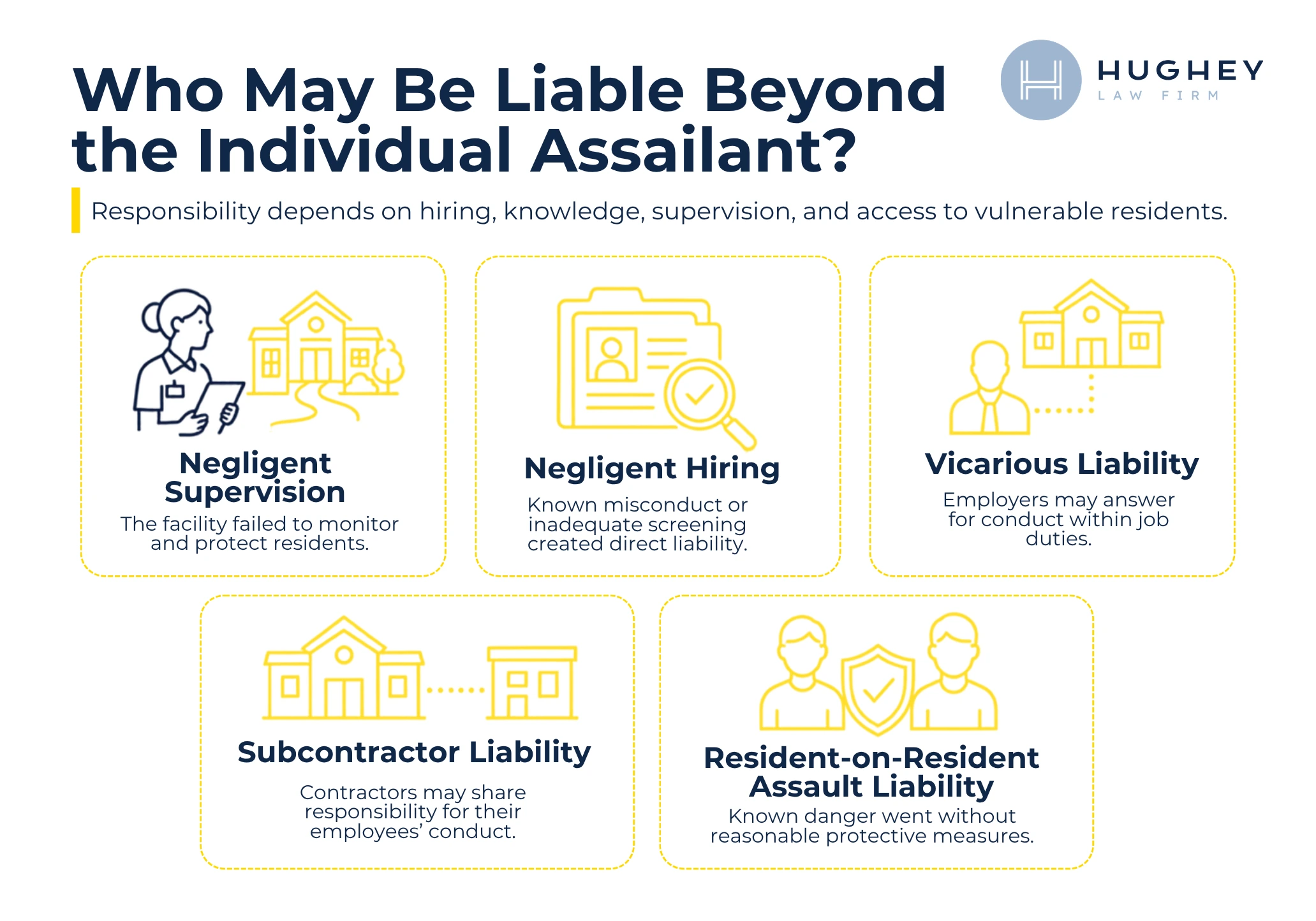
In Charleston, liability for nursing home sexual assault extends beyond the individual who committed the act. It can also include the facility itself, as well as outside contractors and staffing agencies. This depends on what the facility knew, who it hired, and how it supervised those who had access to vulnerable residents. Depending on the specific facts of the case, the following parties can be held legally responsible:
- One example is negligent supervision. Nursing homes have a duty to monitor and protect their residents. If a staff member or another resident assaults a resident because the facility failed to adequately supervise, then the facility is negligent.
- Negligent hiring: If an employee has a history of sexual misconduct, the facility is responsible for discovering that information during a proper background check. Hiring someone with a known history of misconduct, or failing to screen at all, creates direct liability.
- There is vicarious liability for employee conduct. Generally, an employer is responsible for an employee’s actions taken within the scope of their job. However, the employee remains personally responsible for their own criminal conduct.
- Subcontractor liability: Therapy providers, staffing agencies, and other contractors working inside a facility may share responsibility for their employees’ conduct. A nursing home cannot avoid liability by hiring outside contractors to provide care.
- Liability for resident-on-resident assault: A nursing home can be held liable even when an assault is committed by another resident, not a staff member. If the facility knew or should have known about a dangerous resident and failed to take reasonable steps to protect others, that failure constitutes negligence.
Charleston nursing homes are subject to criminal penalties under the South Carolina Omnibus Adult Protection Act, and they risk losing federal funding for failing to comply with federal nursing home regulations. Staff or residents who commit sexual acts against a resident also face criminal charges under South Carolina law.
Compensation Available in Charleston Nursing Home Sexual Abuse Cases
Nursing home sexual assault claims in Charleston support three categories of compensation, with general damages frequently representing the largest portion because the psychological and dignitary harm of sexual trauma in elderly victims extends far beyond the physical injuries and often requires long-term counseling that is itself a recoverable component of the claim. Families pursuing a nursing home sexual assault claim can recover compensation in the following categories:
- Economic damages cover the direct financial costs of the assault, including medical bills, hospital treatment, physical therapy, psychological counseling, and transportation to medical appointments.
- General damages address the more difficult to quantify, yet very real, impact of the assault. This includes pain and suffering, post-traumatic stress disorder, depression, anxiety, damaged family relationships, loss of dignity, and humiliation. These damages often comprise the largest portion of a sexual assault claim because the trauma extends far beyond physical injury.
- Punitive damages may be available under South Carolina Code Section 15-32-510 if there is clear and convincing evidence that the responsible party acted with willful, wanton, or reckless disregard. Direct sexual assault often meets this high legal standard.
Long-term counseling is a significant part of many of these claims, and the cost of future psychological treatment is a recoverable component of damages that must be calculated before considering a settlement. Call (843) 881-8644 for a free consultation with our Charleston nursing home sexual assault lawyer to learn more about what your family’s nursing home sexual assault claim may cover.
What Families Should Do If They Suspect Sexual Abuse
If you suspect sexual abuse in a Charleston-area nursing home, the steps you take in the first hours will determine the quality of medical care your loved one receives, as well as the strength of the evidence for any subsequent legal claims or criminal investigations. If you suspect your loved one was sexually assaulted in a Charleston-area nursing home, act quickly following these steps:
- Seek immediate medical attention. A medical exam will document any injuries and preserve evidence.
- Report the incident to local law enforcement. Sexual assault is a crime, and a police report creates an official record.
- Notify South Carolina Adult Protective Services. You can reach APS at 1-888-CARE-211 to begin a formal state investigation.
- Document everything you observe. Write down dates, times, behavioral changes, and conversations with facility staff.
- Request your loved one’s medical and care records. These records may reveal supervision gaps or prior warning signs.
- Before speaking further with the facility, contact a nursing home sexual assault attorney. An attorney can preserve evidence and protect your loved one’s legal rights from the outset.
The facility’s documentation and response to an incident begin taking shape in the hours after a report is made, and this documentation directly affects the subsequent legal claim. Call (843) 881-8644 and allow the Hughey Law Firm to get involved before the facility has the opportunity to further shape the record.
Can a Nursing Home Successfully Defend a Sexual Assault Case?
Nursing homes have significant advantages when defending these types of claims, and families should be aware of them.
HIPAA privacy rules limit access to resident records by outside parties, and workplace privacy protections limit access to employee files. This makes taking early legal action important since an elder abuse attorney can use a formal legal process to obtain records that a family cannot get on their own.
Facilities commonly raise two defenses. The first is a denial of negligence, arguing that the facility could not have reasonably prevented the assault. The second defense is comparative negligence, which argues that the resident bears some fault.
Thorough investigations that include staffing records, prior incident reports, and background check documentation usually expose the negligence behind the assault. Thorough preparation is key to overcoming a nursing home’s defense strategy, regardless of the facility’s size or corporate backing.
Contact Our Charleston Nursing Home Sexual Assault Lawyers
If your loved one has been sexually assaulted in a nursing home or assisted living facility in the Charleston area, you do not have to face it alone. For years, Hughey Law Firm has represented victims of nursing home abuse throughout the Charleston metro region and across South Carolina, handling every case with the seriousness and compassion it deserves.
We work on a contingency basis, so you will not pay any attorney fees until we win your case.
Call (843) 881-8644 for a free consultation, fill out our contact form, or use live chat to speak with our team now. We represent families throughout Charleston, the Lowcountry, and across South Carolina.
Disclaimer: The information on this page is for informational purposes only and does not constitute legal advice. Every case is different. Past results do not guarantee future outcomes. Hiring a lawyer is an important decision that should not be based solely on advertisements. Ask us to send you free written information about our qualifications and experience before you decide. The Hughey Law Firm is located in Charleston, South Carolina.
Frequently Asked Questions
About Nursing Home Sexual AssaultIn most cases, the deadline is three years from the date of the incident or its discovery. Since evidence can disappear quickly, you should contact an attorney as soon as possible to protect your family’s rights.
Important evidence includes medical exam records, staffing schedules, employee background check files, prior incident reports, witness statements, and the facility’s own internal investigation documents.
Often not. A resident with significant cognitive impairment may lack the legal capacity to consent, even if they do not resist. This is a critical issue in many nursing home sexual assault cases.
Report it to local law enforcement and to South Carolina Adult Protective Services at 1-888-CARE-211. You can also file a complaint with the South Carolina Department of Health and Environmental Control.
It can include payment of medical bills, reimbursement for psychological counseling, compensation for pain and suffering, and payment for post-traumatic stress disorder, anxiety, and loss of dignity. In some cases, punitive damages may be awarded under South Carolina Code Section 15-32-510.
Yes. If the facility knew or should have known that a resident posed a danger but failed to take reasonable steps to protect others, the facility can be held liable for a resident-on-resident assault.
Seek immediate medical attention, report the incident to law enforcement, and notify South Carolina Adult Protective Services at 1-888-CARE-211. Document everything, request medical and care records, and contact an attorney before speaking further with the facility.
Yes. Facilities can be held liable for negligent hiring if they failed to properly screen an employee and for negligent supervision if inadequate staffing or oversight allowed the assault to occur.
The facility may be held liable for negligent supervision or hiring, or for failing to protect residents from a known dangerous individual. Depending on the facts, individual staff members and outside contractors may also bear responsibility.
Warning signs include unexplained bruising near the genitals or inner thighs, torn or bloody underclothing, new sexually transmitted infections, sudden fear of a specific person, withdrawal, and agitation during personal care. These signs require immediate attention.