
 Spinal cord injuries in Charleston, SC nursing homes frequently result from falls, improper resident transfers, inadequate supervision, or a failure to provide necessary safety equipment. These injuries can have devastating and life-altering consequences, so nursing homes may be held legally responsible when their negligence harms a resident.
Spinal cord injuries are especially serious for elderly residents. Reduced bone density, underlying health conditions, and a diminished ability to recover from trauma mean that an injury survivable for a younger person could lead to permanent disability, severe complications, or even death for an elderly resident. Families of residents who have suffered spinal cord injuries in Charleston or other South Carolina nursing homes should know that these incidents are often preventable and may warrant legal action against the responsible facility.
The Hughey Law Firm represents nursing home residents and families throughout Charleston and South Carolina who have been affected by preventable spinal cord injuries. Firm founder Nathan Hughey began his legal career defending nursing homes before dedicating his practice to advocating for injured residents and their families. This background gives him valuable insight into how these injuries occur, the standards facilities are expected to follow, and the strategies nursing homes often use when facing liability claims.
Why Do Families Throughout South Carolina Trust Hughey Law Firm for Elder Abuse Cases?

Unlike most personal injury firms, which handle elder abuse as one practice area among many, Hughey Law Firm specializes in it. Hughey Law Firm is different, and our expertise is verifiable. Here’s what you need to know about us:
- Nathan Hughey, our founder, began his legal career defending nursing homes.
- Nathan Hughey teaches other attorneys about elder abuse law.
- Attorneys and law firms across South Carolina refer elder abuse cases to us.
- Over 70% of our caseload consists of elder abuse cases.
- Since 2007, we have resolved over 1,000 elder abuse cases in South Carolina.
Over 600 cases resolved for $100,000 or more.
- $1,000,000 recovered for elder abuse resulting in pressure sores in a nursing home
- $875,000 recovered for a client who suffered a broken neck and pelvis in a wheelchair accident
- $497,500 recovered for a client who fell and broke their hip in a nursing home
The results described above are specific to those cases and are not intended to predict or guarantee the outcome of any future case. Each case is unique, and outcomes depend on the particular facts and legal circumstances involved. Hiring a lawyer is an important decision that should not be based solely on advertisements.
Charleston Nursing Home Spinal Cord Injury Guide
- How Neglect and Abuse Can Lead to Nursing Home Spinal Cord Injuries
- What Is a Spinal Cord Injury?
- Signs and Symptoms of a Spinal Cord Injury
- Long-Term Effects on Elderly Residents
- When a Charleston Nursing Home Can Be Held Liable for a Spinal Cord Injury
- Important Evidence in Nursing Home Spinal Cord Injury Lawsuits
- Compensation Available to Injured Residents and Families
- Steps to Take After a Charleston Nursing Home Spinal Cord Injury
- How Hughey Law Firm Advocates for Residents Suffering Catastrophic Injuries
- Frequently Asked Questions
How Neglect and Abuse Can Lead to Nursing Home Spinal Cord Injuries
Spinal cord injuries in nursing home residents are almost never accidental. They result from failures in supervision, transfer protocols, fall risk planning, and staffing that Charleston facilities are legally required to prevent. Understanding how elder abuse and neglect cause these injuries helps explain why the facility is usually legally responsible, not the resident. The following are the most common causes identified in spinal cord injury cases in nursing homes in Charleston and across South Carolina.
- Inadequate supervision. Falls are the leading cause of spinal cord injuries in adults over 65, according to the National Spinal Cord Injury Statistical Center. In a nursing home, these falls are almost always preventable when staff follow each resident’s required fall prevention plan.
- Unsafe Transfers. Transferring a resident from a bed to a wheelchair or shower chair is one of the most physically demanding and highest-risk tasks in nursing home care.
- Failure to plan for fall risk. Charleston nursing homes must assess every resident for fall risk upon admission and after any significant change in their condition. Then, they must create a care plan to address those risks.
- Understaffing: When staff-to-resident ratios are too low, caregivers cannot give each resident the attention they need. High-risk residents are often left unattended for long periods of time, which creates serious danger.
- Physical abuse. In some cases, rough handling, forceful repositioning, or direct assault by staff can cause spinal trauma, which elderly residents are especially vulnerable to due to their fragile bones and connective tissue.
The distinction between a preventable fall and an unavoidable medical event is at the heart of every legal question in a nursing home spinal cord injury case. Call (843) 881-8644 to speak with Hughey Law Firm about whether your loved one’s injury reflects a failure that the facility was required to prevent.
What Is a Spinal Cord Injury?
A spinal cord injury involves damage to the spinal cord itself or the surrounding structures, such as the vertebrae, intervertebral discs, and ligaments. This damage disrupts the transmission of signals between the brain and the body. According to the Mayo Clinic, the spinal cord is the primary communication pathway between the brain and the rest of the body. Damage to the spinal cord at any level can result in permanent loss of function below the injury site.
In a nursing home context, spinal cord injuries most commonly occur in one of four ways.
- Falls from beds
- Falls from wheelchairs
- Unsafe transfers
- Direct falls during ambulation
Elderly residents are at dramatically higher risk for serious spinal cord injuries from these mechanisms than younger patients. Additionally, pre-existing degenerative changes in the cervical and lumbar spine reduce the spinal canal’s tolerance for additional compression or displacement. Spinal cord trauma has more severe physiological consequences, progresses more rapidly, and is less amenable to recovery in elderly patients than in younger patients.
Signs and Symptoms of a Spinal Cord Injury
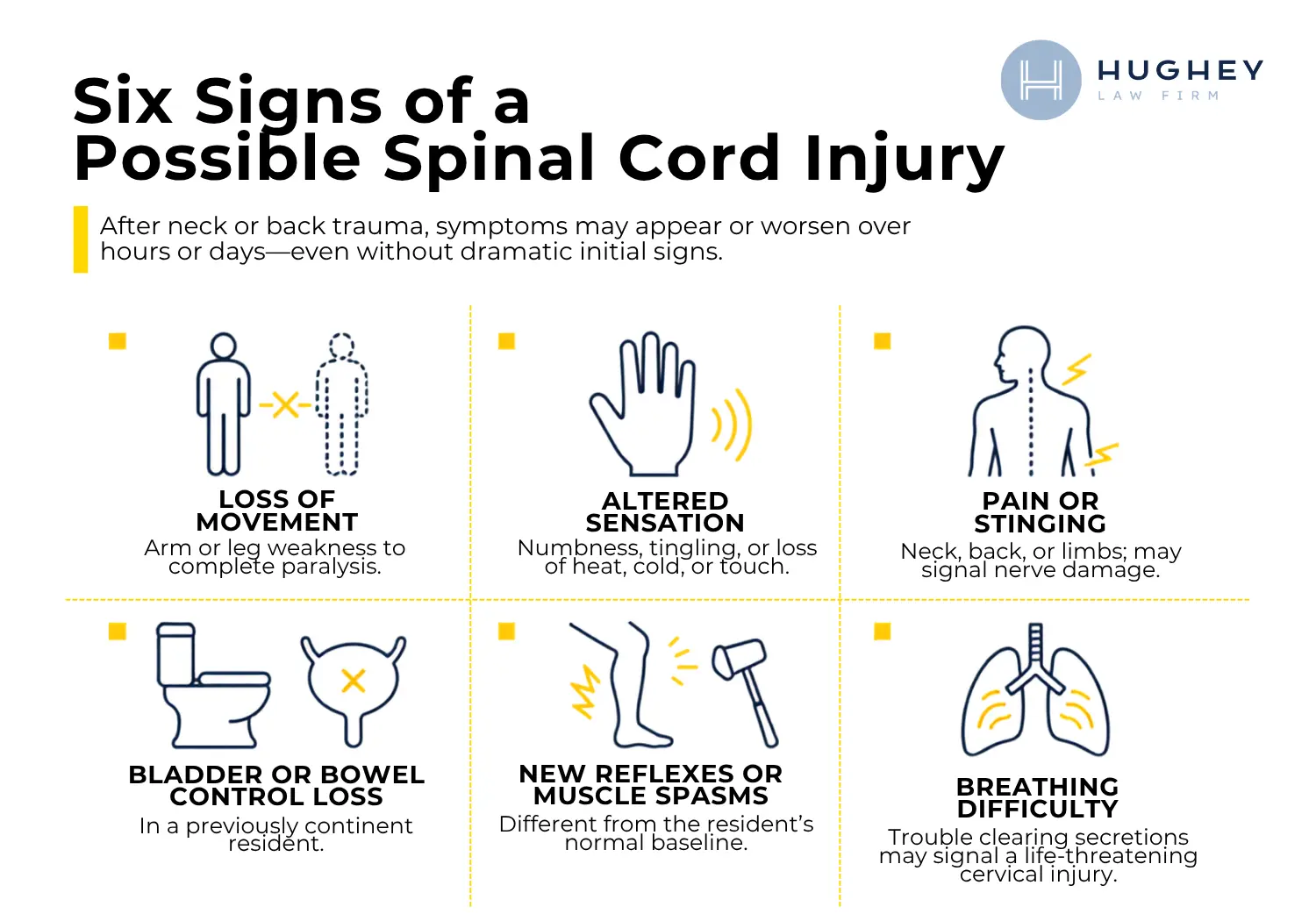
Spinal cord injuries may not show obvious symptoms right away, especially in elderly residents with cognitive impairment who may have difficulty describing their symptoms. A lack of dramatic symptoms after a fall doesn’t mean that spinal trauma didn’t occur. Swelling in the spinal canal can develop over hours or days, and neurological symptoms may appear or worsen gradually rather than suddenly.
After any fall, difficult transfer, or incident involving force to the neck or back, families and staff should watch for the following:
- Loss of movement in the arms or legs ranging from weakness to complete paralysis
- Altered sensation including numbness, tingling, or an inability to feel heat, cold, or touch
- Pain or stinging in the neck, back, or limbs which may signal nerve damage
- Loss of bladder or bowel control in a previously continent resident
- New or unusual reflexes or muscle spasms differing from the resident’s normal baseline
- Breathing difficulty or trouble clearing secretions which can signal a life-threatening cervical spinal cord injury
If any of these signs appear, seek emergency medical evaluation immediately. Don’t let the facility simply “monitor” the resident, insist on an independent medical assessment. Early, aggressive treatment is critical to limiting permanent damage from spinal cord trauma.
Long-Term Effects on Elderly Resident
Spinal cord injuries sustained in nursing homes have long-term consequences for elderly residents that are profound and usually permanent. These consequences are also far more costly than the initial medical emergency suggests. The compensation pursued in these cases must reflect the full lifetime impact, not just the costs already incurred. Understanding these consequences is essential to appreciating the full scope of damages available in spinal cord injury claims involving nursing homes.
- Permanent paralysis or motor deficits
- Elevated care requirements and costs result
- Secondary health complications
- Psychological consequences
- The impact on surviving family members
These consequences do not diminish over time for elderly residents the way they might for younger patients with spinal cord injuries. They compound, so an accurate damages analysis must account for this trajectory from the beginning. Call (843) 881-8644 for a free consultation with our spinal cord injury lawyer to learn how the long-term consequences of your loved one’s injury affect the available compensation.
When a Charleston Nursing Home Can Be Held Liable for a Spinal Cord Injury
A Charleston nursing home can be held liable for a resident’s spinal cord injury if the facility failed to meet the legally required standard of care, causing or contributing to the injury. Liability may extend beyond the facility to its management company and third-party contractors. Depending on the specific facts of the case, several legal theories may apply.
- Duty of care. Under South Carolina law and federal regulations, nursing homes must provide care that meets the highest practical standard for each resident’s physical, mental, and emotional well-being.
- Negligent supervision. A facility breaches this duty when it leaves a resident with a known fall risk or who needs help transferring unattended in a potentially injurious situation, regardless of why staff were absent.
- Failure to follow care plans. If a resident’s care plan identifies a fall risk and outlines protective steps that the facility failed to take, this documentation is direct evidence of negligence.
- Unsafe facility conditions. The facility must maintain its physical environment and can be held liable when conditions such as poor lighting or broken equipment contribute to an injury.
- Who can be held responsible. Liability may extend beyond the facility itself to the management company that controls staffing and budget decisions, as well as to third-party contractors that provide therapy or staffing services.
One of the first and most important steps in a nursing home spinal cord injury case is identifying every party that bears legal responsibility. Call (843) 881-8644 to have the Hughey Law Firm determine the full scope of accountability for what happened to your loved one.
Important Evidence in Nursing Home Spinal Cord Injury Lawsuits
Building a claim for a spinal cord injury in a nursing home requires access to the facility’s records. Those records become less complete and reliable with each passing day after the incident. Therefore, early legal involvement is the most critical protective step a family can take after an injury occurs. The following evidence is central to a successful claim:
- Resident medical records and care plans
- Incident reports
- Staffing records
- Surveillance footage
- Facility inspection records
- Expert medical testimony
In nursing home spinal cord injury cases, care plans and staffing records are the two most revealing categories of evidence because they simultaneously document what the facility knew the resident needed and whether it had adequate personnel to provide it. Call (843) 881-8644 to ensure that Hughey Law Firm secures and preserves this evidence before it is lost, altered, or becomes unavailable.

Compensation Available to Injured Residents and Families
In cases involving permanent paralysis or motor deficits, the combined value must account for lifetime care costs and loss of quality of life, which extend far beyond what standard personal injury damage calculations typically reflect. According to South Carolina law, victims of spinal cord injuries in nursing homes and their families can pursue compensation in the following categories:
- Medical expenses
- Rehabilitation and therapy costs
- Enhanced long-term care costs
- Lost quality of life
- Pain and suffering compensation
- Emotional distress
- Wrongful death damages
- Punitive damages
At Hughey Law Firm, all nursing home spinal cord injury cases are handled on a contingency fee basis. You will not be charged any legal fees unless we secure compensation for your family. Call a spinal cord injury attorney for a free consultation about what your claim may entail.
Steps to Take After a Charleston Nursing Home Spinal Cord Injury
When a spinal cord injury occurs in a Charleston nursing home, the steps taken in the immediate aftermath serve two purposes: protecting the resident’s medical outcome and building the evidentiary record on which a legal claim depends. Several critical steps must be taken within hours of the incident. These steps can significantly impact the resident’s medical outcome and the strength of any subsequent legal claim:
- Step 1: Ensure an immediate emergency medical evaluation.
- Step 2: Document the resident’s condition and the circumstances of the incident.
- Step 3: Request and preserve all medical records and care plan documents.
- Step 4: Report the incident to South Carolina Adult Protective Services (APS).
- Step 5: Report the facility to the South Carolina Department of Health and Environmental Control (DHEC).
- Step 6: Do not give a recorded statement to the nursing home or its insurer.
- Step 7: Contact Hughey Law Firm as soon as possible.
How Hughey Law Firm Advocates for Residents Suffering Catastrophic Injuries
Cases involving spinal cord injuries in nursing homes require a specific combination of medical knowledge, elder care regulatory expertise, and civil litigation experience that general personal injury practices typically lack. Hughey Law Firm handles every aspect of these cases, from the initial investigation to trial, if necessary. Here is what our representation involves:
- We conduct thorough investigations and preserve evidence.
- We coordinate with medical experts.
- Full damage development.
- We hold ourselves accountable through negotiation and trial.
We handle all nursing home spinal cord injury cases on a contingency fee basis. You will not be charged any legal fees unless we secure compensation for your family. Contact us today by calling (843) 881-8644, filling out our contact form, or using live chat.

Contact a Charleston Spinal Cord Injury Lawyer Today
If your loved one has sustained a spinal cord injury at a nursing home in Charleston or elsewhere in South Carolina, the Hughey Law Firm team is ready to evaluate the circumstances and pursue accountability and compensation for your family. Spinal cord injuries are devastating and almost always preventable. The facilities responsible for them should be held accountable under the law.
Call (843) 881-8644 for a free consultation, fill out our contact form, or use live chat to speak with our team now. We represent families throughout Charleston, the Lowcountry, and across South Carolina.
Disclaimer: The information on this page is intended for general informational purposes only and does not constitute legal advice. Every case is different. Past results do not guarantee future outcomes. Hiring a lawyer is an important decision that should not be based solely on advertisements. Ask us to send you free written information about our qualifications and experience before you decide. The Hughey Law Firm is located in Charleston, South Carolina.
Frequently Asked Questions
About Nursing Home Spinal Cord InjuryYes. If the injury causes or contributes to a resident’s death, the estate’s personal representative may file a wrongful death claim on behalf of eligible survivors, subject to specific procedural requirements and deadlines. Contact Hughey Law Firm as soon as possible after the loss.
Generally three years from the date of injury or its discovery, though medical malpractice claims require specific pre-suit notice under South Carolina law. Contact an attorney promptly to confirm all applicable deadlines.
Depending on the case, the facility, its corporate management company, third-party staffing agencies, contracted therapy providers, and individual staff members in cases of direct abuse may all bear liability.
Yes. Falls caused by inadequate supervision, failure to follow fall prevention plans, or unsafe conditions constitute actionable negligence. The facility’s fall risk assessment and care plan often provide direct evidence of foreseeable risk and the facility’s failure to act.
You must show the facility had a duty of care, breached it through specific failures in supervision, staffing, or care plan implementation, and that the breach caused the injury.
Yes. A facility is liable under South Carolina law when its failure to provide adequate supervision, follow the resident’s care plan, or implement safe transfer procedures caused or contributed to the injury.