






Results & Settlements
- Hospital Neglect, Nursing Home
- Hospital Neglect
- Hospital Neglect, Nursing Home
- Hospital Neglect
- Featured Cases, Hospital Neglect, Nursing Home Neglect
- Hospital Neglect
- Hospital Neglect, Nursing Home, Nursing Home Neglect
- Hospital Neglect, Nursing Home
- Hospital Neglect, Nursing Home
- Hospital Neglect
- Hospital Neglect, Nursing Home
- Hospital Neglect
- Hospital Neglect, Nursing Home
- Hospital Neglect
- Featured Cases, Hospital Neglect, Nursing Home Neglect
- Hospital Neglect
A “never event” is a surgical error so serious and preventable that it should never happen under any circumstances, such as undergoing the wrong procedure. If this occurs in a South Carolina hospital or surgical facility, the patient or their family has the right to seek full compensation from all responsible parties. At Hughey Law Firm, our wrong procedure attorneys represent patients throughout South Carolina who were harmed when a medical provider performed the wrong operation, operated on the wrong body part, or treated the wrong patient entirely.
Key Takeaways
- The National Quality Forum classifies wrong-site surgery, wrong-patient surgery, and wrong procedure as “never events” because they are fully preventable under established safety protocols. Their occurrence signals a systemic failure rather than an unavoidable complication.
- Since 2004, the Joint Commission’s Universal Protocol has been mandatory at all accredited hospitals and surgical facilities in the United States. It requires pre-procedure verification, site marking, and a surgical time-out immediately before every procedure. Failure to follow this protocol is strong evidence of negligence.
- According to South Carolina law, a patient pursuing a malpractice claim for a wrong procedure must file a Notice of Intent to File Suit, along with a qualifying expert affidavit, before any civil action can be initiated under South Carolina Code Section 15-79-125. Mandatory pre-litigation mediation must also be completed.
- The general statute of limitations for medical malpractice in South Carolina is three years from the date the patient discovered, or reasonably should have discovered, the injury. This period is subject to a six-year statute of repose. Filing the Notice of Intent tolls the limitations period.
- South Carolina limits non-economic damages in medical malpractice cases, though there are statutory exceptions. Economic damages, including past and future medical expenses, corrective surgery costs, and lost earning capacity, are not subject to the same cap.
South Carolina Wrong Procedure Guide
What Is a Wrong Procedure, and Why Does It Keep Happening?
Wrong-site surgery, wrong-patient surgery, and wrong-procedure errors are all classified as never events. These errors occur when a healthcare provider performs an operation or invasive intervention that was not intended for the patient, authorized by the patient’s informed consent, or indicated by the patient’s diagnosis.
The National Quality Forum recognizes three categories of wrong procedure errors, which are distinct but share a common cause: failure in the identification and verification processes that exist specifically to prevent them.
Wrong-site surgery occurs when a procedure is performed on the correct patient, but on the wrong body part, side, or level. For example, a patient scheduled for right knee arthroscopy who undergoes surgery on the left knee has been the victim of wrong-site surgery. Similarly, a patient whose lumbar disc procedure targets the wrong spinal level has experienced the same type of error.
Wrong-patient surgery occurs when the procedure is performed on a different patient than the one scheduled for it. This typically involves failures in patient identification at multiple points in the preoperative process.
Wrong-procedure surgery occurs when a patient undergoes a different procedure than the one scheduled and consented to. Examples include performing a more invasive procedure than indicated, performing a procedure on the correct anatomical site that was never planned, or performing a procedure based on a diagnostic error that should have been identified during the preoperative review.
Research published in the Archives of Surgery and cited by the Joint Commission estimates that wrong-site surgeries occur approximately 40 times per week across U.S. hospitals and clinics despite the Universal Protocol being in effect for over two decades. A study of wrong-site claims between 2013 and 2020 identified the top contributing factors as failure to follow policy or protocol (83.8%) and failure to review the medical record (41.2%). These are not technical failures. Rather, they are procedural and communication failures that are preventable.
The Universal Protocol and What Hospitals Are Required to Do
The Joint Commission’s Universal Protocol requires three steps before every surgical procedure at every accredited facility: pre-procedure verification, marking the surgical site, and an immediate pre-incision time-out. Deviation from these steps constitutes a deviation from the established standard of care.
All accredited hospitals and surgical facilities in South Carolina must comply with the Universal Protocol. These steps are specifically designed to prevent errors involving the wrong procedure, site, or patient before a single incision is made.
- The preprocedure verification step requires the care team to confirm the patient’s identity, the procedure, and the site using the patient’s records, consent forms, and available imaging. This step must be completed before the patient enters the operating room.
- Surgical site marking requires the surgeon to mark the intended incision site on the patient’s body before the procedure and in the patient’s presence when possible. The mark must be made by the operating surgeon, not a resident or support staff member.
- The surgical time-out requires the entire operating room team to stop all activity immediately before the first incision and verbally confirm the patient’s identity, the planned procedure, and the correct surgical site. Every team member must actively participate and voice their confirmation.
What Needs to Be Proved in a South Carolina Wrong Procedure Case
According to South Carolina Code Section 15-79-110, medical malpractice occurs when a healthcare provider’s actions or inactions when providing professional services differ from generally accepted standards of care, resulting in patient injury. In most wrong procedure or ER negligence cases, the deviation is not disputed. What is disputed are the extent of the resulting harm, the required corrective treatment, and whether the wrong procedure caused additional injuries that would not have occurred with the intended care.
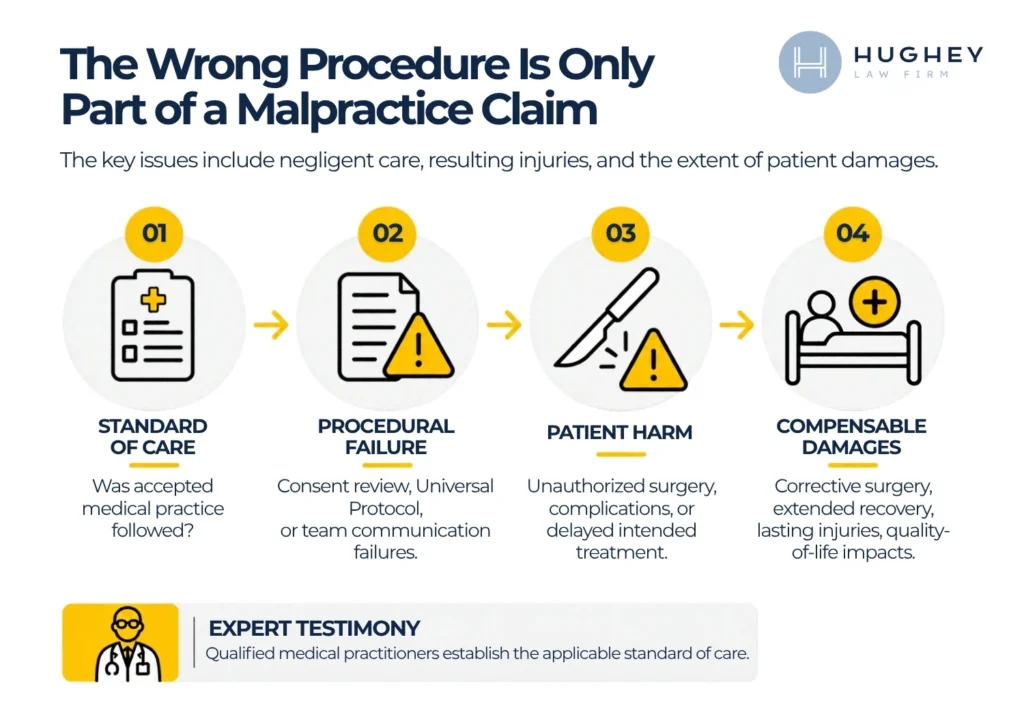
The patient must have suffered actual, compensable harm. In wrong procedure cases, the existence of damages is rarely disputed. However, the scope of damages, including the need for corrective surgery, extended recovery time, permanent catastrophic injuries, and long-term impacts on quality of life, is typically where disputes arise.
Compensation Available for Wrong Procedure Victims in South Carolina
The cost of undoing the procedure, treating its complications, and performing the intended procedure that was never carried out.
This includes additional hospitalizations, specialist care, physical therapy, and medication resulting from the procedure and any complications it caused.
Lost wages during an extended recovery period and reduced future earning capacity if the harm from the procedure results in permanent limitations.
Compensation for the pain of an unnecessary operation, recovery, and chronic pain resulting from complications.
In South Carolina, the psychological impact of undergoing an operation without consent, losing trust in the medical system, and managing the anxiety and trauma of a never event is recognized as a compensable damage category.
When a wrong procedure results in death, surviving family members may pursue a wrongful death claim under South Carolina law to receive compensation for funeral expenses, lost financial support, loss of companionship, and mental anguish.
How Hughey Law Firm Handles Wrong Procedure Cases in South Carolina
Nathan Hughey, a fourth-generation South Carolinian, founded Hughey Law Firm after spending years defending medical providers and insurance companies. He then built a firm devoted to representing injured patients. This background in defense work means that Hughey Law Firm attorneys understand exactly how hospitals and their insurers evaluate, defend, and minimize wrong procedure claims and know what it takes to overcome these strategies.
The firm has recovered over $300 million in verdicts and settlements for South Carolina injury victims. Medical malpractice and hospital negligence cases are a core part of that record. All cases are handled on a contingency fee basis. You pay no attorney fees unless compensation is recovered on your behalf.
You can call (843) 881-8644 or complete our contact form to schedule a free consultation and connect with our team.
Speak With a South Carolina Wrong Procedure Attorney Today
Hughey Law Firm offers free, confidential consultations for all wrong-procedure and medical malpractice inquiries. Call (843) 881-8644 or contact us online to get started. There is no fee unless we recover compensation for you.

Related Practice Areas
Frequently Asked Questions
What if the wrong procedure did not cause any obvious permanent injury?
A lack of permanent injury does not necessarily mean that you have no claim. Depending on the circumstances, a patient may incur medical expenses, require additional treatment, experience pain, or suffer other losses resulting from an unnecessary or incorrect procedure. An attorney can review the medical records and circumstances to determine whether a potential claim exists.
How Long Do I Have to File a Malpractice Claim for a Wrong Procedure in South Carolina?
In South Carolina, medical malpractice claims must generally be filed within three years of the treatment, omission, or operation that caused the injury. Alternatively, they can be filed within three years of when the injury was or reasonably should have been discovered. However, the law places a six-year limit from the date of the underlying treatment or event, with certain exceptions and tolling rules. South Carolina also requires specific steps before a medical malpractice lawsuit can be filed, including a notice of intent and pre-litigation mediation.
What if I signed a consent form for the wrong procedure before the surgery?
Signing a consent form does not necessarily prevent a claim if the wrong procedure was performed due to an error in the patient’s care. To determine whether negligence occurred, the circumstances surrounding the consent, the procedure performed, and the information provided to the patient would need to be reviewed.
Is undergoing the wrong procedure automatically considered medical malpractice in South Carolina?
Not necessarily. While performing the wrong procedure may indicate that the standard of care was not met, a medical malpractice claim generally requires evidence of negligence and causation. Medical records and expert testimony may be needed to prove these facts.
Can I sue the hospital as well as the surgeon who performed the wrong procedure?
Potentially. Depending on the circumstances, a hospital may be held responsible for its own failures in patient care or for the actions of its employees involved in the procedure. Other members of the medical team may also be involved in a claim. An attorney can review the facts to determine which parties may be responsible.