






Results & Settlements
- Auto and Trucking Accidents, Dram Shop, Wrongful Death
- Auto and Trucking Accidents
- Auto and Trucking Accidents
- Auto and Trucking Accidents
- Automobile Accident
- Automobile Accident, Featured Cases
- Auto and Trucking Accidents, Dram Shop, Wrongful Death
- Auto and Trucking Accidents
- Auto and Trucking Accidents
Although rear-end crashes are among the most common traffic collisions in South Carolina, they are not simple. Insurance companies often minimize these claims, dispute the severity of injuries, and shift blame onto the struck vehicle. An experienced South Carolina car accident lawyer can push back against these tactics and gather the evidence needed to achieve a fair outcome.
Key Takeaways
- According to South Carolina Code Section 56-5-1930, drivers are required to maintain a safe following distance. This means that the trailing driver is generally presumed to be at fault in a rear-end crash. However, fault is not always automatic, and comparative negligence arguments can affect the amount of compensation a victim receives.
- Injuries from rear-end collisions, including whiplash, herniated discs, and traumatic brain injuries, often do not show up on initial imaging and can worsen in the days following the crash. Therefore, seeking medical attention on the day of the collision is critical for health and claim purposes.
- South Carolina follows modified comparative negligence under Section 15-38-15 of the South Carolina Code. Rear-end crash victims who share partial fault can still recover compensation as long as their assigned fault does not exceed 50%. However, recovery is reduced proportionally by the victim’s percentage of fault.
- The statute of limitations for rear-end collision personal injury claims in South Carolina is three years from the date of the crash, according to South Carolina Code Section 15-3-530. Missing this deadline will permanently eliminate your right to seek compensation.
- The Hughey Law Firm has recovered over $300 million for South Carolina injury victims and handles all rear-end collision cases on a contingency fee basis. You pay no attorney fees unless compensation is recovered on your behalf.
South Carolina Rear-End Collision Guide
Why Rear-End Collisions Cause Serious Injuries
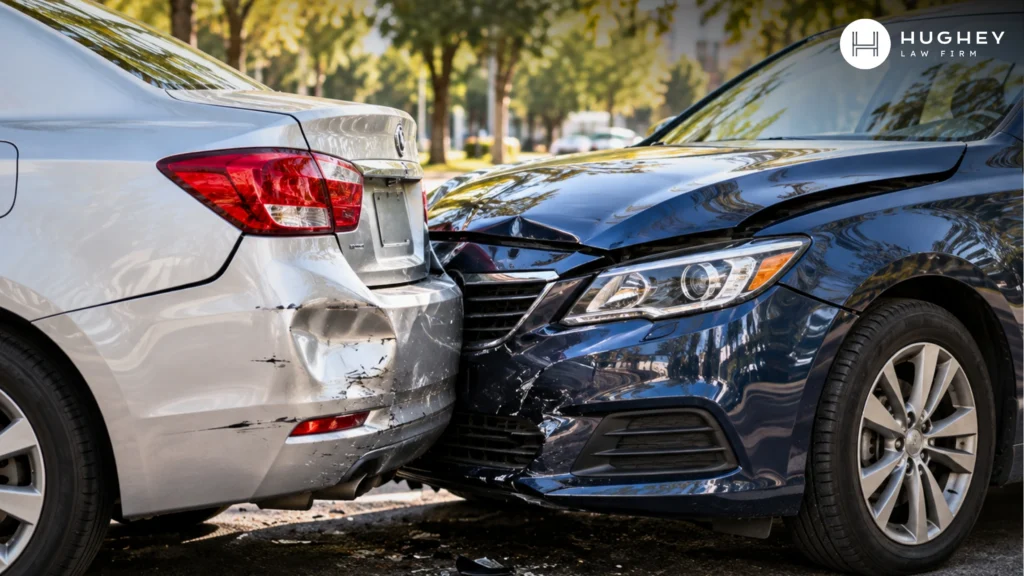
The most frequently diagnosed rear-end injury involves damage to the neck's muscles, tendons, and ligaments. Symptoms include pain, stiffness, headaches, and a reduced range of motion, which can persist for months.
The force of a rear-end collision can compress spinal discs, causing them to rupture or protrude and press on nerve roots. Symptoms include radiating arm or leg pain, numbness, and weakness.
Even without direct head contact, the brain can sustain a concussion from rapid acceleration and deceleration. Cognitive symptoms, memory issues, and headaches after a rear-end collision should be evaluated by a physician.
Lower back disc damage and muscle injuries are common in rear-end collisions, especially for drivers whose seats transmit the force of the collision upward through the spine.
Bracing against a steering wheel or seatbelt at the moment of impact can cause rotator cuff tears and shoulder joint injuries requiring surgery and extended rehabilitation.
What Causes Rear-End Crashes in South Carolina?
Car AccidentDrivers who are looking at their phones, adjusting their navigation systems, or paying attention to anything other than the road ahead cannot react in time to a vehicle that is slowing down or stopping in front of them. Distracted driving is the leading cause of rear-end crashes nationally and in South Carolina.
South Carolina law requires drivers to maintain a reasonable and prudent following distance (South Carolina Code Section 56-5-1930). A driver who tailgates at highway speeds may have only a fraction of a second to react when traffic ahead slows suddenly.
Drowsy drivers have slower reaction times and are more likely to drift or fail to notice brake lights ahead. Fatigue is a particular factor in rear-end commercial trucks crashes on South Carolina’s interstate corridors.
Who Is at Fault in a South Carolina Rear-End Crash?
- The front vehicle reverses unexpectedly or performs a sudden, unprovoked hard stop;
- A multi-vehicle chain-reaction crash pushes the middle vehicle into the one ahead;
- A commercial truck driver violates Federal Motor Carrier Safety Administration (FMCSA) hours-of-service regulations and causes a fatigue-related rear-end crash;
- A defective braking system on the rear vehicle contributes to the driver’s inability to stop in time; or
- Road hazards, inadequate signage, or government-maintained road defects contribute to the crash.
South Carolina follows modified comparative negligence under South Carolina Code Section 15-38-15. This means that a victim of a rear-end crash who shares partial fault can still recover compensation, provided their assigned percentage of fault does not exceed fifty percent. Compensation is reduced proportionally by the victim’s assigned percentage of fault. For example, if a jury assigns the victim twenty percent of the fault, their damages award is reduced by twenty percent.
What to Do After a Rear-End Crash in South Carolina
- First, call 911 and stay at the scene. A police report creates an official record of the crash, which is one of the first documents that an attorney or insurance adjuster will request. South Carolina law requires you to report any crash that causes injury or property damage exceeding $1,000.
- Seek medical attention immediately. Symptoms of rear-end injuries are often delayed. Whiplash, disc injuries, and concussions may not be fully apparent until 24 to 72 hours after the crash. A same-day medical visit creates a contemporaneous record tying your injuries to the collision. Gaps in treatment are used by insurers to dispute claims.
- Document the scene. Take photographs of both vehicles, their positions relative to the road, skid marks, traffic signals, road conditions, and your visible injuries. If there are witnesses, collect their names and contact information before they leave.
- Do not give a recorded statement to the at-fault driver’s insurance company. South Carolina does not require you to speak with the other driver’s insurance company before consulting an attorney. Recorded statements are used to find inconsistencies that reduce claim value.
- Contact Hughey Law Firm. The sooner a South Carolina personal injury lawyer is involved, the sooner evidence can be preserved. This includes surveillance footage from nearby businesses or traffic cameras that may be overwritten within 24 to 72 hours.
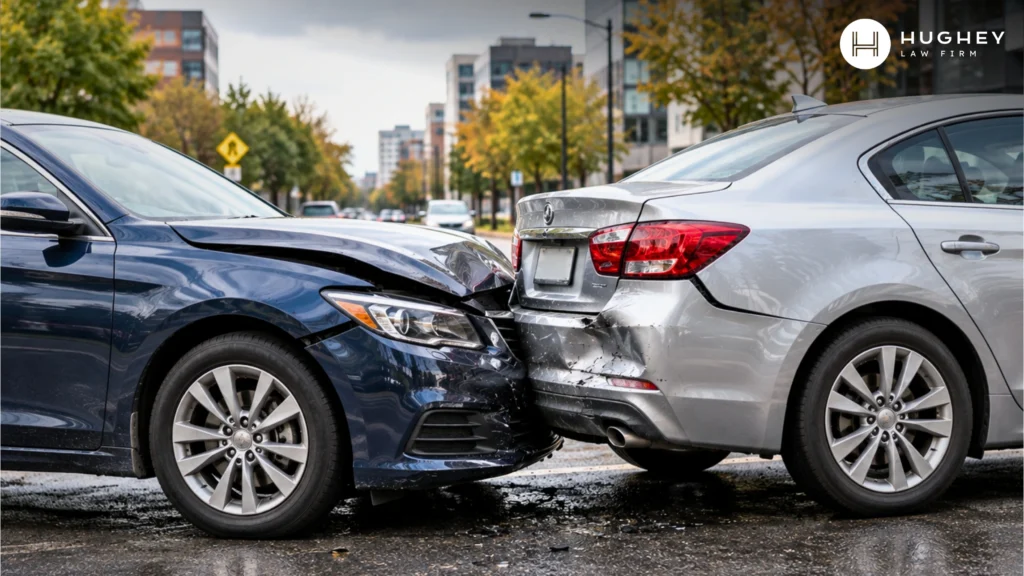
Compensation Available After a South Carolina Rear-End Crash
Emergency care, ambulance transport, imaging, specialist visits, physical therapy, surgery, prescription medications, and projected future medical costs if the injury requires ongoing treatment.
Wages lost during recovery and reduced future earning capacity if the injuries result in permanent limitations that affect the victim's ability to work.
Repair or replacement of the vehicle and any personal property damaged in the crash.
Compensation for physical pain, headaches, disrupted sleep, and chronic discomfort frequently caused by rear-end injuries over the course of months or years of recovery.
Recognized damage categories in South Carolina personal injury cases include anxiety about driving, depression, and PTSD.
These are available when the at-fault driver's conduct was particularly egregious, such as texting while driving on the highway or driving while significantly impaired.
According to South Carolina’s statute of limitations under South Carolina Code Section 15-3-530, rear-end crash victims have three years from the date of the collision to file a personal injury lawsuit. Wrongful death claims arising from fatal rear-end crashes have the same three-year deadline from the date of death. Missing this deadline eliminates the right to seek compensation, regardless of how strong the evidence may be.
You can call (843) 881-8644 or complete our contact form to schedule a free consultation and connect with our team.
How Hughey Law Firm Handles South Carolina Rear-End Collision Cases
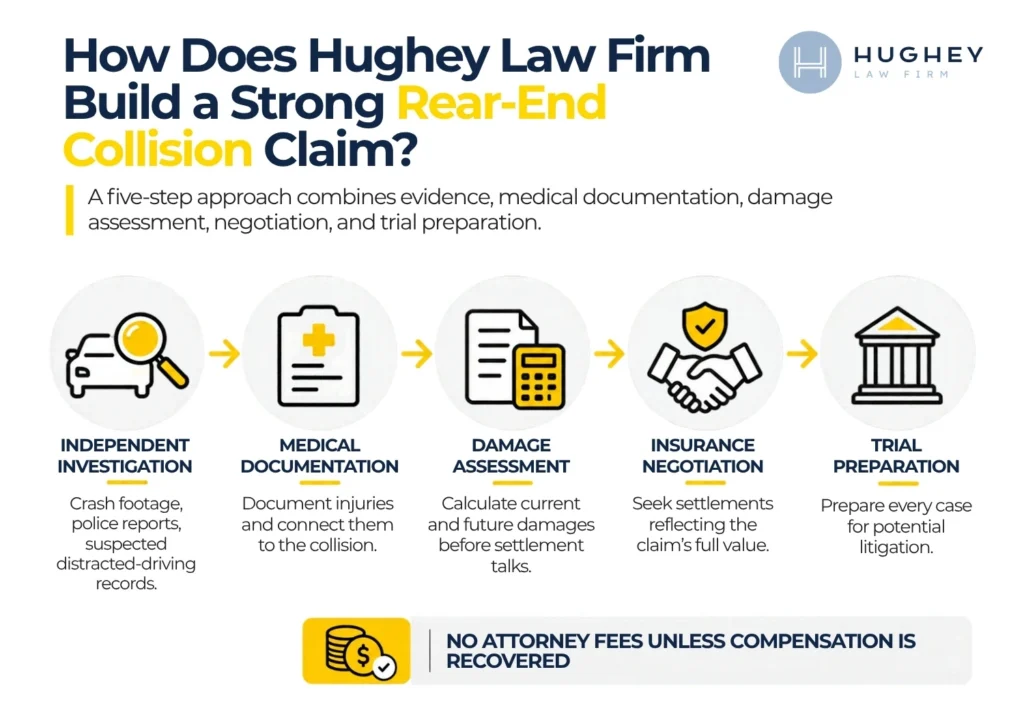
- Investigates the crash independently, including securing footage, obtaining the police report, and reviewing the at-fault driver’s cell phone records when distracted driving is suspected
- Works with medical professionals to document the full scope of injuries and link them to the crash. This counters insurer arguments that the injuries were pre-existing or minor
- Calculates all current and projected future damages before any settlement discussion begins
- Negotiates directly with the at-fault driver’s insurance company. We do not accept any settlement that does not reflect the full value of the claim
- Prepares every case for trial. This shows the insurer that a lowball offer will result in litigation
Ready to Discuss Your Rear-End Collision Case?
The South Carolina car accident lawyers at Hughey Law Firm offer free, no-obligation case evaluations. Call (843) 881-8644 or contact us online to get started.

Related Practice Areas
Frequently Asked Questions About South Carolina Rear-End Crashes
What if the driver who hit me does not have insurance?
If the at-fault driver does not have insurance, your uninsured motorist coverage may help cover your losses. If the driver’s insurance does not cover all your damages, underinsured motorist coverage may also be available. An attorney can review applicable policies and circumstances to determine what coverage is available.
Can I Still Recover Compensation if I Was Not Wearing a Seatbelt?
South Carolina law does not allow failure to wear a seatbelt to be treated as negligence or contributory negligence. It generally cannot be used as evidence in a civil action. However, other factors may still affect the value or outcome of a claim depending on the circumstances of the crash.
How long do I have to file a claim after a rear-end crash in South Carolina?
South Carolina generally allows three years to file a personal injury claim, though this deadline may vary based on the circumstances. Wrongful death claims are also generally subject to a three-year deadline, beginning on the date of death. Because important evidence can become more difficult to preserve over time, it is important to address a potential claim as soon as possible.
What if I had pre-existing neck or back problems before the crash?
A pre-existing condition does not necessarily prevent you from recovering compensation. If a rear-end crash worsened an existing condition, you may be able to recover for the additional harm caused by the crash. Medical records and expert opinions may help establish how the collision affected your condition.
Is the driver who rear-ended me automatically at fault in South Carolina?
Not necessarily. While South Carolina law requires drivers to maintain a reasonable and prudent following distance, fault depends on the circumstances of the crash. Factors such as a chain-reaction collision, an unexpected event, or a mechanical problem may affect how liability is determined.