


- Featured Cases, Nursing Home
- Assisted Living, Featured Cases, Nursing Home
- Featured Cases, Group Home Abuse & Neglect, Nursing Home
- Nursing Home
- Nursing Home
- Assisted Living, Nursing Home
- Nursing Home
- Hospital Neglect, Nursing Home
- Nursing Home
Key Takeaways
- According to South Carolina Code Section 15-3-530, the statute of limitations for breach of contract and most civil claims is three years from the date the claim accrues or is discovered. Missing this deadline usually results in the permanent loss of the right to sue.
- Title 39, Chapter 5 of the South Carolina Code, also known as the South Carolina Unfair Trade Practices Act (SCUTPA), provides remedies against unfair methods of competition and deceptive trade practices. These remedies include the potential for treble damages and attorney fees when violations are willful or knowing.
- South Carolina recognizes tortious interference with a contract or prospective contractual relations as a business tort, allowing businesses to seek compensation when a third party wrongfully disrupts an existing or potential business relationship.
- The South Carolina Trade Secrets Act protects confidential business information from misappropriation and provides injunctive relief and damages, including exemplary damages in cases of willful misappropriation.
- Hughey Law Firm has recovered over $325 million for South Carolina clients. The firm’s founder spent years as a defense attorney for institutional defendants before building a litigation firm devoted to representing individuals and businesses seeking accountability.
South Carolina Civil and Business Litigation Guide
What Civil and Business Litigation Covers in South Carolina
Civil litigation covers a wide range of disputes. At Hughey Law Firm, our civil and business litigation practice focuses on cases in which a party has suffered real, quantifiable harm due to another party’s breach of a legal obligation, violation of a contract, fraudulent activity, or unfair business practices.
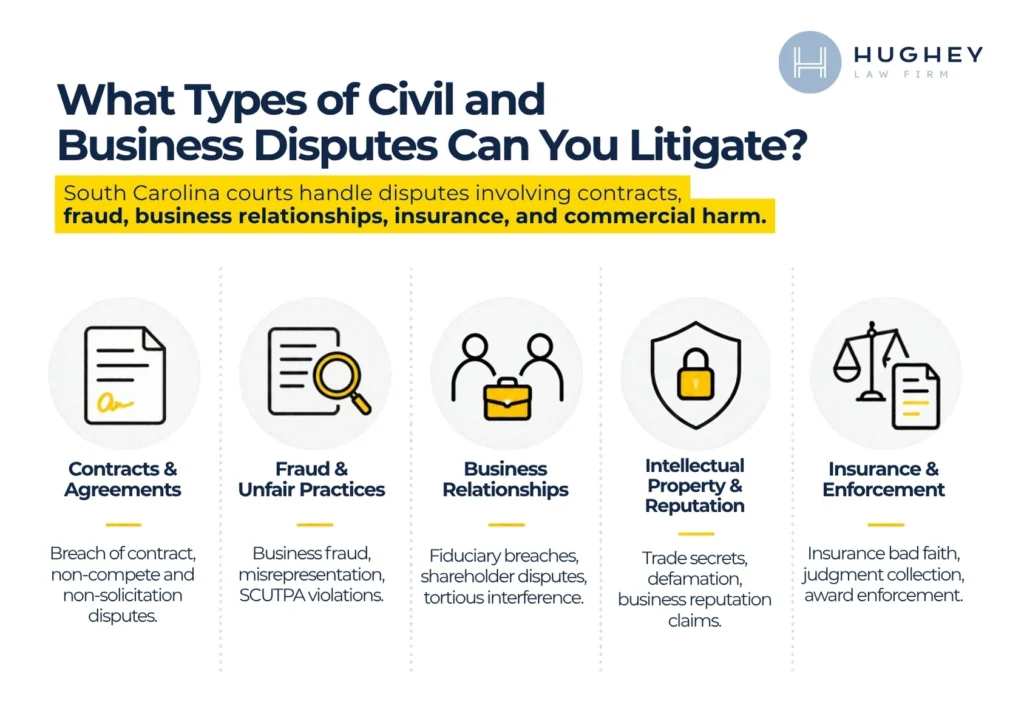
The firm handles civil and business disputes across the following categories:
- Breach of contract and failure to perform
- Business fraud and fraudulent misrepresentation
- Unfair trade practices and SCUTPA violations
- Breach of fiduciary duty by partners, officers, or directors
- Tortious interference with contract or business relationships
- Trade secret misappropriation
- Non-compete and non-solicitation agreement disputes
- Shareholder and partnership disputes
- Insurance bad faith
- Collection of judgments and enforcement of awards
- Defamation and business reputation claims
Breach of Contract Disputes in South Carolina
South Carolina courts recognize both written and oral contracts. However, certain types of contracts, including agreements for the sale of goods exceeding $500 that are governed by the South Carolina Uniform Commercial Code, as well as contracts for the transfer of real property, must generally be in writing to be enforceable under the statute of frauds.
In South Carolina, when one party breaches a contract, the non-breaching party is entitled to be placed in the position they would have been in had the contract been performed through an award of expectation damages. If expectation damages are difficult to calculate, courts may award reliance damages for costs incurred in preparation to perform. If the breach was accompanied by fraudulent conduct, South Carolina law recognizes a separate claim for breach of contract involving a fraudulent act, which may result in an award of punitive damages.
The statute of limitations for breach of contract claims in South Carolina is three years from the date the breach occurred or was discovered, according to South Carolina Code Section 15-3-530. According to South Carolina’s discovery rule, the limitations period does not begin until the plaintiff knew or should have known of the breach. This is particularly relevant in cases involving ongoing contractual relationships or concealed breaches.
South Carolina's Unfair Trade Practices Act
SCUTPA is one of the most significant statutes in South Carolina civil and business litigation. It establishes a private right of action for individuals and businesses that have been harmed by unfair or deceptive trade practices, and it provides remedies that surpass those allowed by standard negligence or breach of contract claims.
SCUTPA claims commonly arise in the following business contexts:
- Deceptive advertising or marketing that causes harm to consumers or competitors
- Misrepresentations made during a business transaction or acquisition
- Fraudulent billing or invoicing practices
- Unfair practices by insurance companies when handling claims
- Deceptive conduct in real estate transactions
- Competitive practices that cross the line from aggressive to unlawful
Business Torts: When Competitors or Third Parties Cross the Line

Tortious interference with a contract occurs when someone intentionally and without justification causes one party to break an existing contract with another. To prove this claim, one must show that a valid contract existed, the defendant knew about it, intentionally induced the breach without justification, and caused actual damages.
Tortious interference with prospective business relations occurs when someone intentionally and without justification prevents a business from forming a new relationship. This occurs when someone uses wrongful conduct to prevent a business relationship from forming. Since no contract exists yet, these claims usually require stronger evidence of improper conduct.
The South Carolina Trade Secrets Act protects trade secrets, including formulas, customer lists, processes, and technical data that derive economic value from their secrecy. A business whose trade secrets have been misappropriated by a former employee, competitor, or vendor can pursue injunctive relief to stop the use of the information, as well as damages for economic harm. Willful or malicious misappropriation may result in an award of exemplary damages of up to twice the amount of actual damages, as well as attorney’s fees.
Resolving Business Disputes: Litigation, Mediation, and Arbitration
In South Carolina, civil and business disputes can be resolved through a trial in state or federal court, court-ordered mediation, or private arbitration if the contract requires it. The appropriate forum depends on the nature of the dispute, the terms of the contract, and the speed and cost considerations of each party.
Not every business dispute ends in trial. South Carolina courts require mediation before most civil cases can be scheduled for trial. Additionally, many commercial contracts include mandatory arbitration clauses that require disputes to be resolved through a private arbitration process rather than in court.
proceeds through the Circuit Court of Common Pleas. Most civil business disputes in South Carolina are tried in circuit court before a judge or jury, depending on the nature of the claim and the parties' preferences.
has jurisdiction over business disputes in South Carolina when the parties are from different states and the amount in controversy exceeds $75,000, or when the dispute involves a federal statute. Federal cases proceed under the Federal Rules of Civil Procedure in the United States District Court for the District of South Carolina.
is mandatory before most South Carolina civil trials. Mediation involves a neutral third-party mediator who facilitates settlement negotiations. Parties who reach a mediated settlement avoid trial and the uncertainty of a jury verdict.
is a binding dispute resolution process involving a private arbitrator or panel. When a contract's arbitration clause applies, the parties usually cannot opt for litigation instead. Determining whether an arbitration clause applies and is enforceable under South Carolina law is an important initial step in analyzing any business dispute.
If you believe your loved one has been abused or neglected, call (843) 881-8644 to schedule a free consultation, fill our contact form or connect through live chat to speak with our team.
Speak With a South Carolina Business Litigation Attorney Today

Call (843) 881-8644 or contact us online for a free, confidential consultation. There is no fee unless we recover compensation for you.
Related Practice Areas
Frequently Asked Questions About South Carolina Civil and Business Litigation
Can I recover attorney fees in a South Carolina business litigation case?
Possibly. South Carolina generally requires each party to pay its own attorney fees, unless a law or contract states otherwise. However, certain claims, including qualifying SCUTPA claims, may allow for the recovery of attorney fees.
Does every business dispute have to go to court?
No, businesses may resolve disputes through negotiation, mediation, or arbitration. Some contracts require arbitration, and court rules may require mediation before trial. The best option depends on the dispute and any applicable agreements.
What remedies are available in a South Carolina business dispute?
Depending on the claim, remedies may include financial compensation, court orders requiring specific actions or prohibiting certain conduct, punitive damages, or attorney fees. Some claims, including certain violations of South Carolina’s Unfair Trade Practices Act (SCUTPA), may allow for additional damages or fees.
What is the difference between civil litigation and criminal prosecution?
Civil litigation resolves disputes between parties and often involves compensation or court orders. Criminal prosecutions are brought by the government to punish violations of criminal law. The same conduct may lead to both civil and criminal cases.
How long do I have to file a civil lawsuit in South Carolina?
The deadline depends on the type of claim. Many contract, business tort, and personal injury claims have a three-year filing deadline, but there are exceptions. Claims against government entities may have additional requirements, so it is important to consult an attorney promptly.