





- Featured Cases, Nursing Home
- Assisted Living, Featured Cases, Nursing Home
- Featured Cases, Group Home Abuse & Neglect, Nursing Home
- Nursing Home
- Nursing Home
- Assisted Living, Nursing Home
- Nursing Home
- Hospital Neglect, Nursing Home
- Nursing Home
Key Takeaways
- Catastrophic injuries are generally defined as those resulting in permanent disability, long-term impairment, or an inability to return to one’s pre-injury employment or activities. This classification is legally significant because it directly affects how damages are calculated, particularly projected future medical expenses and lost future earnings.
- In South Carolina, the statute of limitations for catastrophic personal injury claims is three years from the date of the injury, according to South Carolina Code Section 15-3-530. If the injury involves a government entity, shorter notice deadlines and damage caps under the South Carolina Tort Claims Act may apply.
- South Carolina’s modified comparative negligence rule, found in South Carolina Code Section 15-38-15, allows injured victims to recover compensation even if they are partially at fault, provided their assigned percentage does not exceed fifty percent. Recovery is reduced proportionally.
- Calculating damages for catastrophic injuries requires the expertise of forensic economists, life care planners, and vocational rehabilitation experts to project decades of future medical costs, lost earning capacity, and lifetime care needs. Accepting any settlement before this analysis is complete risks permanently undervaluing the claim.
- The Hughey Law Firm has recovered over $325 million for South Carolina injury victims, including multiple seven-figure results in cases involving catastrophic and life-altering injuries.
South Carolina Catastrophic Injury Guide
What Qualifies as a Catastrophic Injury?

Some of the most serious injuries in South Carolina personal injury cases include the following:
These injuries can cause lasting problems with memory, concentration, behavior, and mobility. Severe cases may require long-term care and prevent a person from returning to work.
Damage to the spinal cord can result in partial or complete loss of movement or sensation. Severe injuries may require ongoing medical care, mobility equipment, home modifications, and daily assistance.
Losing a limb may require surgery, rehabilitation, and prosthetic devices. Some people also experience phantom limb pain, emotional distress, and the need for ongoing treatment.
Serious burns may require hospitalization, skin grafts, multiple surgeries, long-term scar management, and rehabilitation.
can affect a person's ability to work, perform daily activities, and live independently. Rehabilitation and assistive services can help individuals adapt to these changes.
Damage to organs such as the liver, kidneys, spleen, or lungs can lead to lasting health problems, the need for additional treatment, or permanent impairment. Severe cases may require ongoing medical care or an organ transplant.
Common Causes of Catastrophic Injuries in South Carolina
In South Carolina, catastrophic injuries most commonly result from motor vehicle crashes, commercial truck collisions, workplace accidents, falls from height, medical malpractice, premises liability incidents, and defective product failures. Each type of accident has a different liability framework and evidentiary approach.
Catastrophic injuries can happen in many situations in South Carolina. These injuries often result from serious crashes, dangerous working conditions, medical errors, or falls that cause permanent harm.
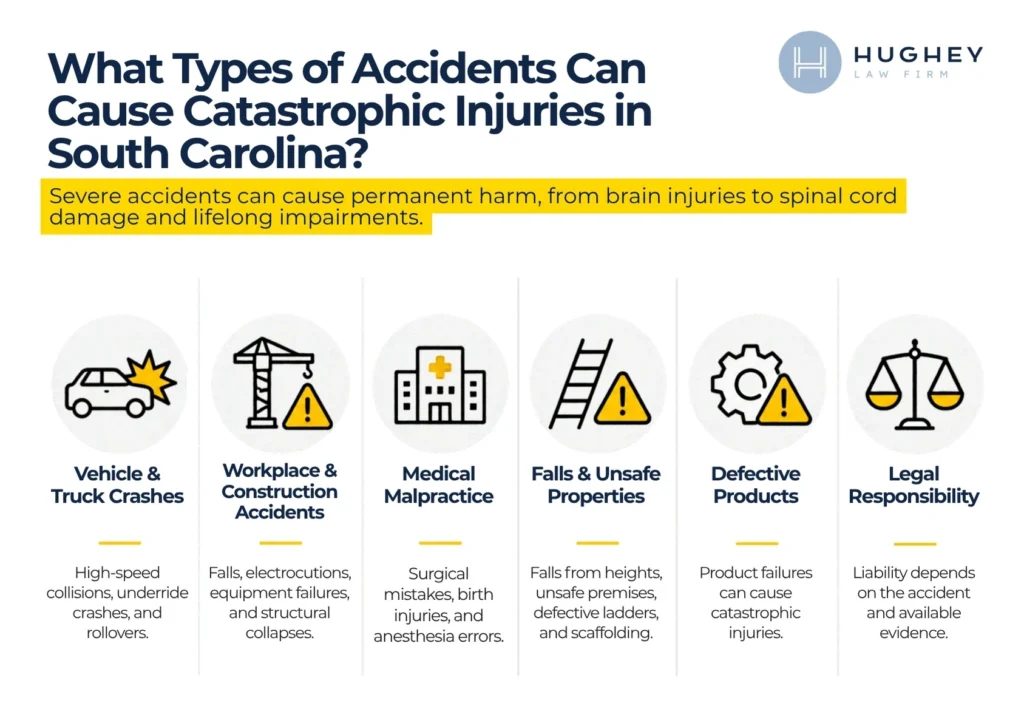
- Motor vehicle and commercial truck crashes are a major cause of catastrophic injuries. Car and truck crashes are a leading cause of catastrophic injuries. High-speed collisions, truck underride crashes, and rollovers can result in traumatic brain injuries, spinal cord damage, and severe internal injuries. In truck accident cases, violations of federal safety rules, including Federal Motor Carrier Safety Administration (FMCSA) hours-of-service requirements, may demonstrate negligence.
- Workplace and Construction Accidents: Falls from heights, electrocutions, equipment malfunctions, and structural collapses can result in life-altering injuries. Workers’ compensation may cover eligible workplace injuries. In some cases, injured workers may also have claims against other responsible parties, such as equipment manufacturers, property owners, or contractors.
- Medical Malpractice: Medical errors can lead to permanent and severe injuries. Examples include surgical mistakes that cause nerve damage or paralysis, birth injuries that result in lifelong impairments, and anesthesia errors that cause brain damage. These cases can involve complex legal and procedural requirements in South Carolina.
- Falls and Premises Liability: Falls from heights and dangerous property conditions can result in spinal cord injuries, traumatic brain injuries, and serious fractures. Such incidents may be caused by inadequate fall protection at construction sites, defective ladders or scaffolding, or unsafe conditions on commercial or residential properties.
Calculating Damages in a South Carolina Catastrophic Injury Case
In South Carolina, catastrophic injury damages include economic damages for lifetime medical expenses, lost earning capacity, and care costs, as well as non-economic damages for physical pain, emotional suffering, and lost quality of life. Accurate calculations require forensic economic analysis, life care planning, and vocational rehabilitation expert testimony before any settlement is negotiated.
Catastrophic injuries can result in lifelong medical expenses, lost income, and permanent changes to a person’s quality of life. According to South Carolina law, injured individuals can seek compensation for several types of damages.
- Emergency care
- Surgeries
- Ongoing medical treatment
- Rehabilitation
- Therapy
- Future medical needs
- Wheelchairs
- Prosthetics
- Other assistive equipment
- Home modifications
- Personal care
- Lost wages
- Reduced future earning capacity
Courts may award punitive damages when a defendant’s conduct is willful, wanton, or reckless. Whether they apply depends on the facts and evidence.
According to South Carolina Code Section 15-38-15, compensation may be reduced based on the injured person’s share of fault. Those found to be more than 50% at fault generally cannot recover damages.
The firm has recovered over $325 million for South Carolina injury victims, including the following results across catastrophic and serious injury categories:
- $5.425 million when a client suffered catastrophic injuries after a commercial truck collided with his pickup
- $2.025 million when a client was seriously injured after a truck collided with his motorcycle
- $1.65 million for a car accident victim
- $3.375 million for the family of a resident who died due to facility neglect
Past results do not guarantee future outcomes. Each case is evaluated on its own facts and circumstances. All cases are handled on a contingency fee basis. You pay no attorney fees unless compensation is recovered.
Speak With a South Carolina Catastrophic Injury Attorney Today
The injuries with the highest stakes demand the highest level of legal representation. The South Carolina personal injury lawyers at Hughey Law Firm have the experience, the resources, and the commitment to pursue what these cases are truly worth.

Call (843) 881-8644 or contact us online for a free, confidential consultation. There is no fee unless we recover compensation for you.
Related Practice Areas
Frequently Asked Questions About South Carolina Catastrophic Injury Claims
What is the difference between a catastrophic injury claim and a workers’ compensation claim?
Workers’ compensation generally covers eligible workplace injuries without requiring proof of fault but does not usually pay for pain and suffering. If a third party, such as an equipment manufacturer or contractor, contributed to the injury, you may also have a separate personal injury claim.
What if the at-fault party does not have enough insurance to cover your injuries?
An attorney can review other potential sources of compensation, such as underinsured motorist coverage, umbrella policies, or claims against other potentially responsible parties. Available coverage depends on the circumstances and applicable policies.
How is the value of a catastrophic injury case determined?
It depends on medical expenses, future care needs, lost income, reduced earning capacity, pain and suffering, and the injury’s impact on your life. Experts can help estimate long-term costs and losses.
Can I recover compensation if I was partly at fault for my catastrophic injury?
Yes, South Carolina generally allows recovery if you are not more than 50% at fault. However, your compensation is reduced by your share of responsibility.
How long do I have to file a catastrophic injury claim in South Carolina?
Generally, you have three years to file a personal injury claim, but exceptions may apply. Claims against government entities have additional requirements and deadlines, so consult an attorney as soon as possible.
Should I expect my South Carolina Catastrophic injury claim to go to court?
In most cases, South Carolina catastrophic injury claims will settle out of court. Most insurance companies and lawyers recognize that going to court will substantially increase the legal costs associated with the claim, so they will try to reduce those costs as much as possible.
However, you should prepare to go to court if needed, including having an experienced attorney on your side who will guide you through the process and keep your rights uppermost in everyone’s mind.
How long should I expect it to take to receive a settlement for my South Carolina catastrophic injury claim?
When you have catastrophic injuries, and the catastrophic medical bills that go along with them, you may want to settle your claim as soon as possible. Unfortunately, it can take time to settle your claim. Often, your attorney will advise waiting until you further recover from your catastrophic injuries before moving forward with your South Carolina catastrophic injury claim.
Severe burns, spinal cord injuries, and traumatic brain injury can all have dramatically different recovery times and prognoses depending on your specific injuries and the medical care you receive.
Likewise, if you suffer a limb amputation as a result of your accident, you may need time to learn whether you will require stump revisions or other procedures related to your loss.
Unexpected infections and complications can cause your medical bills to shoot higher, your recovery time to lengthen, and your eventual capability to look very different.
In many cases, an attorney will advise that you wait until at least six months after your accident before filing your South Carolina catastrophic injury claim, since, at that time, you will have a much better idea of what your medical expenses and eventual prognosis will look like.
Other factors may also contribute to the length of time it takes to settle your claim.
- The amount you ask for. Because you suffered catastrophic injuries in your accident, you may have equally catastrophic medical bills to go along with them. As a result, you may ask for much more in compensation than people who suffered only minor injuries in an accident. Many insurance companies will drag their heels longer on claims with a high financial value, which can extend the time needed to settle your claim.
- How much negotiation do you have to do? Often, you will need to go through multiple rounds of negotiation before you can reach an agreement with the insurance company or liable party after the accident. While you want to maximize the funds you receive as much as possible to make it easier for you to pay your medical bills and rebuild your life after the accident, the insurance company or liable party may want to minimize how much they have to pay out as much as possible. As a result, you may go back and forth for some time before settling. You may also extend the time needed to receive your settlement if you need to go through mediation with a court-appointed mediator or take your claim to court.
Plan for it to take several months to receive the compensation you deserve after your accident. The insurance company may try to wear you down to help decrease its liability as much as possible. Work closely with your attorney to learn more about your legal right to compensation and how to maximize it.
What should I do about my medical bills after a catastrophic injury in South Carolina?
Medical expenses often seem to pile up very quickly following an accident. In fact, many victims consider managing their medical expenses to be one of the biggest financial challenges they have to deal with after their accident.
As the injured party, you must take responsibility for figuring out how to pay those bills.
You have several options for managing your medical costs after your accident.
- You can use your medical insurance. Health insurance helps provide an incredibly valuable buffer when you suffer significant injuries in an accident. Your health insurance may require you to handle copays and deductibles on your own. Nevertheless, health insurance will cover many of the expenses associated with catastrophic injuries, especially when it comes to long-term treatments. Consult your health insurance company to learn more about your coverage for catastrophic injuries, including how a South Carolina catastrophic injury claim can affect your health insurance coverage.
- You can make arrangements through the hospital. Many hospitals, especially those associated with South Carolina universities, may offer you reasonable payment arrangements that can make it easier for you to handle your medical bills. These hospitals understand that most people do not plan for catastrophic injuries and their aftermath. To help make coping easier, they may lower your bills or help you make payment arrangements that fit your current budget.
- You can use the funds from a South Carolina catastrophic injury claim to help cover your medical bills. The funds you receive from a South Carolina catastrophic injury claim can make it easier for you to cover many of the medical expenses associated with your accident. Often, however, you may have medical bills come due long before the funds for that claim arrive. An attorney can submit a letter of protection that shows your intent to pay for those medical bills once you receive the funds from your South Carolina catastrophic injury claim.
How much does it cost to hire an attorney for a catastrophic injury claim in South Carolina?
All too many people avoid hiring an attorney because they fear the cost. In reality, however, a South Carolina catastrophic injury attorney is often more affordable than you think.
Many attorneys will begin by offering a free consultation to go over your accident, your claim, and the injuries you suffered. During that consultation, the attorney will decide whether to accept your case, and you get the chance to decide whether you want to work with a specific attorney.
The attorney will choose to accept your claim on a contingent fee basis. In a contingency fee claim, you will pay your legal fees based on a percentage of the claim the attorney recovers.
Do I really need an attorney to handle a South Carolina catastrophic injury claim?
If you suffered catastrophic injuries in an accident in South Carolina, you want to have an experienced South Carolina catastrophic injury attorney on your side.
Many accident victims find that working with an experienced catastrophic injury attorney can help increase the compensation offered following an accident. Insurance companies often take victims more seriously when they have an attorney working for them.
An attorney can also:
Help you understand how much compensation you deserve. One of the biggest errors made by catastrophic injury victims involves underestimating the compensation they really deserve for their injuries.
You may hear from the insurance company that covers the liable party shortly after your accident. In fact, that insurance company may get in touch before you leave your hospital room or even fully understand the extent of your injuries and what your recovery will look like. The insurance company may give you a settlement offer at that time.
That settlement offer does not necessarily reflect the full compensation you deserve. Instead, it can represent the insurance company’s attempt to minimize its financial liability, leaving you with higher expenses and no way to compensate for them.
By talking to an attorney, you can get a better idea of how much compensation you really deserve.
Investigate your claim. Following an accident with catastrophic injuries, you may need to prove who caused your accident, including what factors contributed to your injuries. An attorney can help investigate that claim and give you a better idea of exactly how your accident occurred.
That investigation can also turn up evidence that could help prove your claim, increasing the odds that you will get the compensation that you deserve.
Provide peace of mind. You have enough to deal with in the aftermath of catastrophic injuries. You may need to manage your recovery, handle therapy appointments, and even arrange for modifications to your home. You have to decide how to handle work responsibilities and manage your household despite your injuries.
You should not have to deal with everything in your South Carolina catastrophic injury claim on top of that.
Working with an attorney can provide immense peace of mind. This could help ensure that your claim will get handled as smoothly as possible. You can turn over many of the tasks associated with your claim to your attorney, which can help you focus on the other aspects of your recovery.