





- Featured Cases, Premises Liability
- Featured Cases, Premises Liability
- Featured Cases, Premises Liability, Slip & Fall
- Premises Liability
- Premises Liability
- Premises Liability
- Premises Liability
- Premises Liability
When property owners are negligent and fail to ensure that their premises are reasonably safe, and a visitor is injured as a result, the victim may hold the property owner liable for any resulting damages. The team of experienced attorneys at Hughey Law Firm knows all too well how failures to address even the simplest hazards can result in life-altering injuries.
If you were injured on someone else’s property because the owner failed to fix or warn you about a hazard, a South Carolina premises liability lawyer from Hughey Law Firm can help. We also understand how challenging it can be for injured individuals to prove their right to compensation. We are here to help fight for the rights of individuals injured on someone else’s property and to help them obtain the compensation they deserve.
Key Takeaways
- According to South Carolina law, property owners must keep their premises reasonably safe. However, in slip-and-fall cases, you must typically demonstrate that the owner created the hazard or was aware of it.
- Your status on the property (invitee, licensee, trespasser, or child) determines the duty owed to you by the owner, with paying customers receiving the strongest protection.
- Key evidence includes photos, an incident report, witness names, and medical records, as surveillance video can be erased quickly.
- In South Carolina, you generally have three years to file a claim against a private owner, but claims involving government property follow different rules.
- You can still recover damages if you are 50% or less at fault. Hughey Law Firm takes premises liability cases on a contingency fee basis.
South Carolina Premises Liability Guide
Hughey Law Firm’s Success Story
The team of South Carolina personal injury lawyers at Hughey Law Firm understands how devastating premises liability cases are for victims and their families alike. We also know how to provide injured victims with empathic legal representation as they pursue justice. With experience and skill, the team at Hughey Law Firm has handled hundreds of personal injury cases involving a variety of accidents, recovering more than $300 million for our clients in settlement awards and verdicts to date.
Past results do not guarantee future outcomes. Each case is unique and depends on its own facts and circumstances.
What Is Premises Liability in South Carolina?
- Slip and fall accidents
- Elevator and escalator accidents
- Broken stairway accidents
- Negligent security accidents
- Building code violation accidents
- Poor lighting accidents
- Supermarket or grocery store accidents
- Dog bite accidents
- Swimming pool accidents
- Balcony, deck, or porch collapses
- Fire-related injuries from poor fire safety precautions
- Construction site hazards, such as debris and unsafe barriers
- Park and playground injuries from unsafe equipment or neglected maintenance
- Obstructions and falling objects, such as overhangs, loose displays, and clutter
Many of these cases come down to one simple failure: someone knew about a danger, or should have known, and did nothing.
Where Premises Liability Injuries Happen
Premises liability injuries happen in businesses, public places, residential properties, and work zones across South Carolina. Dangerous conditions exist in most locations, whether business, residential, or public.
- Businesses. Grocery stores, retail and department stores, restaurants, nightclubs and bars, casinos, fitness centers, salons, shopping malls, resorts and hotels, and amusement or theme parks.
- Public places. Government buildings, parks, and sidewalks.
- Residential properties. Condo and apartment complexes and private homes.
- Work zones. Construction sites.
South Carolina’s Premises Liability Laws
The South Carolina Recreational Use Statute mitigates liability for landowners whose property is consistently used for recreational purposes. It states that the landowner generally owes no duty to keep the land safe for people who have permission to use it for recreation, such as camping, hiking, or hunting. The protection does not apply to grossly negligent, willful, or malicious failures to guard or warn against a danger, or when the owner charges a fee for entry.
Elements to Prove When Demonstrating Fault in South Carolina
Before an individual can recover damages in a premises liability claim, the victim needs to prove the following elements:
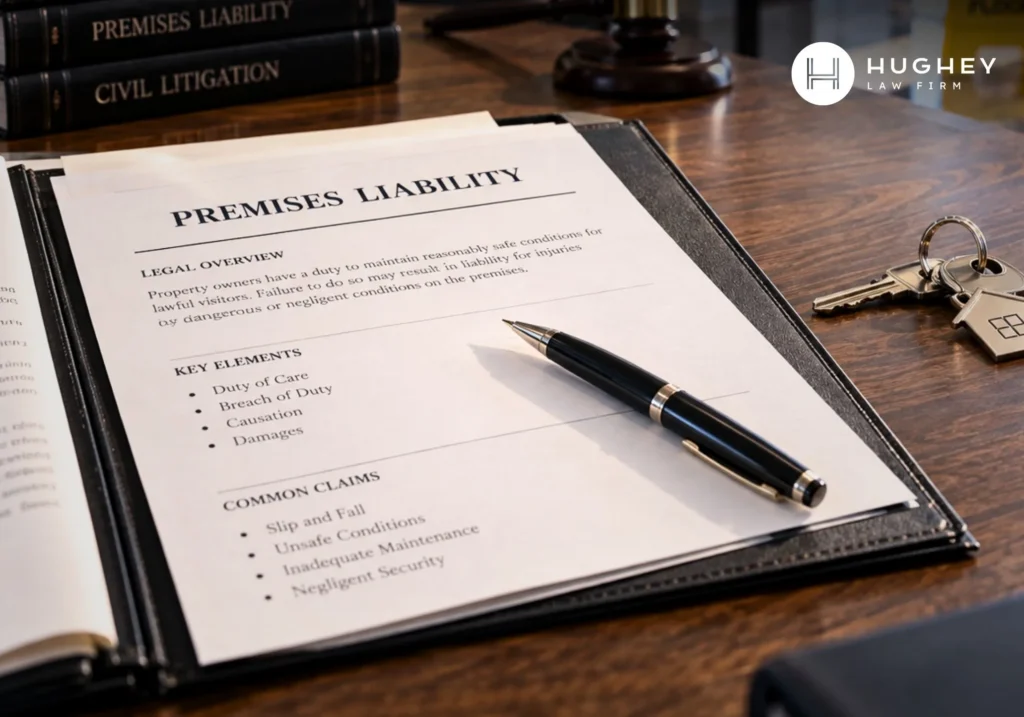
- The defendant owed the victim a specific duty of care.
- The defendant breached this duty of care by their negligent act.
- This breach resulted in the victim’s accident.
- The victim endured damages because of this accident.
In South Carolina slip-and-fall cases, you must show either that the owner or its employees created the dangerous condition, or that the owner had actual or constructive knowledge of it. Constructive knowledge means the hazard was there long enough that a reasonable inspection would have found it. Cleaning logs, inspection records, and surveillance video can show how long a spill or defect was present.
South Carolina follows a modified comparative negligence rule, set in Nelson v. Concrete Supply Co. If you are found more than 50% at fault, you cannot recover. If you are 50% or less at fault, your award is reduced by your percentage. Effective January 1, 2026, Act 42 (H. 3430) also reformed the state’s joint and several liability rules, which can matter when more than one party shares fault.
Call (843) 881-8644 to connect with a South Carolina Premises Liability Attorney and schedule a free consultation.
South Carolina’s Categories of Guests
An attractive nuisance is:
- An exposed dangerous condition that the property owner has failed to take reasonable actions to prevent children from being injured by the condition; or
- An artificial condition on the land that is attractive to children and that the property owner has failed to reasonably protect children from.
Who Can Be Held Liable for a Premises Liability Injury?
South Carolina’s Deadline to File a Premises Liability Claim
In South Carolina, the statute of limitations allows injured victims to file a premises liability claim within three years of the date of the accident. However, generally, injured victims should initiate the claims process as soon as they are able. Delays in filing a claim may increase the likelihood that evidence and witnesses are no longer accessible or that memories of the incident fade. Although there are a few limited exceptions, such as for minor children, in most cases, when the statute of limitations expires, victims will be barred from seeking compensation for their injuries.
If the accident happened on public or government-owned property, the South Carolina Tort Claims Act may apply, with its own procedures and a shorter deadline. Check with your attorney to ensure you do not miss any important dates.
The clock starts the day of the accident, so waiting rarely helps and often hurts.
What Do You Need to Do if You Have Been Injured on Another’s Property in South Carolina?
Even if you do not think you have been seriously injured, it is still essential to get checked out by a medical professional. Some injuries, even life-threatening injuries, do not show immediate symptoms. Seeking a medical evaluation can reveal whether you may have injuries you are unaware of, provide you with the medical treatment you need, and document any injuries you suffered. Documentation of the injuries will be crucial evidence if you decide to pursue a claim.
If possible, make sure to take photos or videos of the accident scene, depicting the dangerous condition that caused your injuries. Photograph your visible injuries, the weather, the lighting, and any other aspects of the area that could help illustrate the defect or dangerous condition. Photo evidence can support your claims, should the property owner try to discredit your recollection of how your injuries occurred. Do this as soon as possible, in case the landowner quickly corrects the hazardous condition.
Having witness statements to corroborate your recollection of the accident may be essential to proving a claim. If individuals witnessed the accident, victims should gather the names and contact information of the witnesses.
Report the incident to the property owner or their agent and ask for a copy. Write down what happened as soon as possible, including weather, lighting, and signage, and keep a journal of your recovery. Save receipts and bills for every expense. Document conversations with insurance adjusters and property managers. Avoid posting about your injury on social media, which could harm your claim.
What Are Typical Injuries Sustained in a South Carolina Premises Liability Case?
Common premises liability injuries include head and neck injuries, traumatic brain injuries, back injuries, broken or dislocated bones, soft tissue injuries, lacerations, bite wounds, drownings, and electrocution.
- Head and neck injuries
- Traumatic brain injuries
- Back injuries
- Lacerations and bruising
- Bite wounds
- Soft tissue injuries (e.g., strained or torn ligaments)
- Broken or dislocated bones
- Drownings
- Electrocution injuries
For severe or permanent harm, see our catastrophic injury practice.
The injury you suffer shapes the damages you can pursue, which the next section explains.
What Damages Can You Pursue in South Carolina?
You may seek compensation for past and future medical expenses, including bills, physical therapy, medications, and other medical treatments necessary to their recovery. Medical costs may also include any required rehabilitative services, any at-home care services, and travel expenses to and from medical appointments. For future expenses, you may need to progress through several stages of recovery before a physician can accurately predict your future treatment plan.
Lost earnings can include both past and future income that you could not collect due to missed work while recovering from your injuries. In addition, you may recover lost bonuses, benefits, commissions, and even promotions. In certain instances, your injuries may keep you from returning to work in the same capacity as before the accident. If you suffered permanent limitations or disabilities, you may seek damages for lost future earning capacity.
Damages for pain and suffering offer you compensation for the physical and emotional impacts directly resulting from your injuries. You may seek recovery for your pain or discomfort. When awarding damages for pain and suffering, courts consider the extent of the injuries, the duration of recovery, the victims’ age and general health, and the type of treatments required.
If a premises liability accident killed a close family member, you may qualify to file a wrongful death action. Compensation can include burial expenses, funeral expenses, medical bills, lost wages, loss of companionship, and loss of consortium for spouses of deceased victims. See our wrongful death practice.
In certain, particularly egregious, circumstances, the court may award victims punitive damages. However, punitive damages are special damages that require showing the property owner’s actions or failure to act were especially negligent and egregious. Punitive damages are imposed as a form of punishment to deter dangerous behavior in the future. South Carolina limits punitive damages to the greater of three times the compensatory damages or $500,000, with some exceptions.
How Hughey Law Firm Handles Premises Liability Cases
Call Hughey Law Firm Today

Contact Hughey Law Firm today for a free consultation and case evaluation. Reach us at any time at (843) 881-8644 or through our online contact page.
Past results do not guarantee future outcomes. The information on this page is for general informational purposes only and does not constitute legal advice.
Related Practice Areas
Frequently Asked Questions About South Carolina Premises Liability Lawyers
What are the most common types of premises liability claims?
Slip, trip, and fall injuries are the most common. Others include stairway and elevator accidents, negligent security, dog bites, swimming pool accidents, and falling objects. The full list appears above.
What if the insurance company offers a quick settlement?
The insurance company’s goal is to achieve a quick and inexpensive settlement. If the insurance company contacts you and makes an offer, you should not accept or sign a release or any other documents until you have consulted an experienced South Carolina premises liability lawyer. Accepting an offer may prevent you from receiving full and fair compensation.
Can I Afford a Premises Liability Lawyer?
Yes. At Hughey Law, we believe everyone should be able to access top-tier legal representation regardless of their financial standing. We work on a contingency fee basis, so you pay nothing for our services unless we win your case for you. No consultation fees, no upfront costs, no out-of-pocket expenses. That is our no-win, no-fee arrangement.
Do I Need a South Carolina Premises Liability Attorney?
Yes. These cases require extensive evidence, and victims are often coping with significant injuries and medical costs. An experienced attorney can gather evidence, interview witnesses, and file documents correctly and on time.
Can I recover if I was partly at fault?
Often yes. If you are 50% or less at fault, your recovery is reduced by your share. If you are more than 50% at fault, you cannot recover.
Do I have to prove the owner knew about the hazard?
In most slip-and-fall cases, yes. You generally must show the owner created the hazard or had actual or constructive knowledge of it and did not fix it.
What if I was hurt at a rental property or apartment?
The tenant, the landlord, or a repair company may be liable, depending on who controlled the hazard and who handled repairs.
What if I was hurt on government property?
Different procedures and shorter deadlines may apply under the South Carolina Tort Claims Act. Speak with an attorney quickly.