






Results & Settlements
- Featured Cases, Nursing Home
- Assisted Living, Featured Cases, Nursing Home
- Featured Cases, Group Home Abuse & Neglect, Nursing Home
- Nursing Home
- Nursing Home
- Assisted Living, Nursing Home
- Nursing Home
- Hospital Neglect, Nursing Home
- Nursing Home
Key Takeaways
- According to South Carolina law, construction defects fall into one of four categories: design, material, workmanship, and subsurface. Most construction defect claims fall under one or more of these categories, and identifying the correct category is key to determining which parties bear liability.
- South Carolina imposes a three-year statute of limitations on construction defect claims, starting from the date the defect is discovered. An absolute eight-year statute of repose under South Carolina Code Section 15-3-640 bars all claims after eight years from the substantial completion of the construction, regardless of discovery.
- The Right to Cure Act of South Carolina, codified at Section 40-59-810 of the South Carolina Code, requires property owners to provide builders with written notice of construction defects and an opportunity to inspect and make repairs before filing a civil lawsuit for residential construction. Compliance with this pre-suit process is mandatory.
- Construction law practitioners have identified South Carolina as one of the most active states in the country for construction defect litigation, driven by its climate, coastal conditions, and high volume of residential and commercial development.
- The Hughey Law Firm handles all construction defect cases on a contingency fee basis for personal injury claims arising from defective construction. For property damage and contractual defect claims, fee arrangements are discussed during the initial consultation.
South Carolina Construction Defect Claims Guide
What Is a Construction Defect in South Carolina?
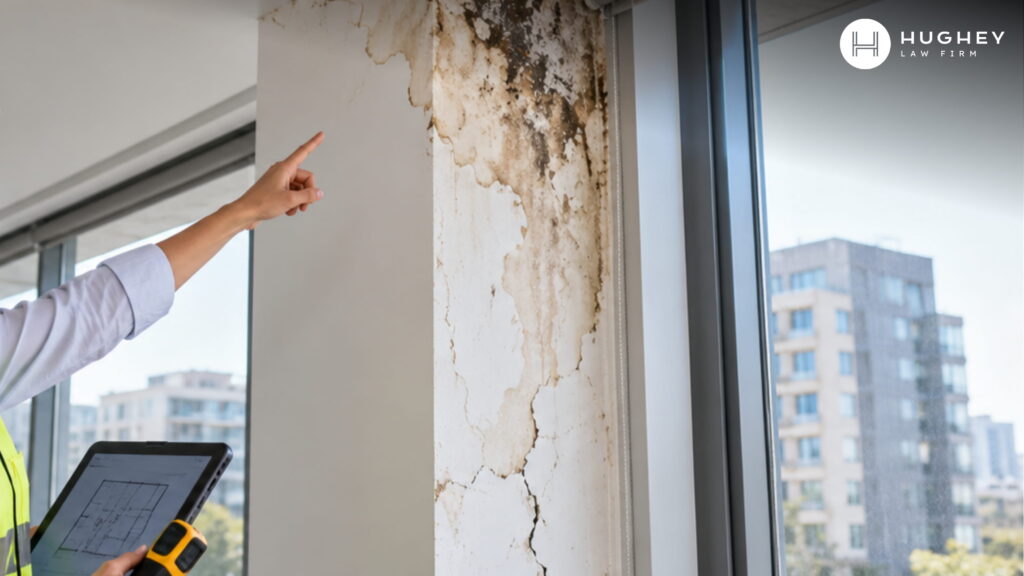
However, not every construction problem rises to the level of a legally actionable defect. In South Carolina, a construction professional is held liable if they fail to meet the applicable standard of care for their specialty, if the defect causes actual damage, and if the defect is not the result of ordinary wear and deterioration over time.
South Carolina law recognizes the following categories of construction defects.
- Design defects occur when an architect, engineer, or other design professional creates inadequate, structurally unsound, or noncompliant plans or specifications, resulting in construction that fails. Design defects can affect the entire project because every element built to a flawed design is compromised from the outset.
- Material defects occur when defective, substandard, or inappropriate building materials are incorporated into the construction. Product liability claims against manufacturers or suppliers may arise alongside negligence claims against the contractor who selected or installed the defective materials.
- Workmanship defects are the most common category in South Carolina construction defect litigation. These defects arise when a contractor or subcontractor performs work that fails to meet the applicable standard for their trade. Examples include improper installation of windows and doors, faulty roofing work, inadequate waterproofing, improper framing, code violations, and installation errors in mechanical, electrical, or plumbing systems.
Subsurface or geotechnical defects occur when inadequate soil testing or failure to account for subsurface conditions results in foundation failure, settlement, cracking, or other structural damage. These defects can be particularly severe and expensive to remediate.
South Carolina's Right to Cure Act: What Property Owners Must Do Before Filing Suit
A residential property owner in South Carolina must comply with the procedural requirements of South Carolina Code Section 40-59-810 et seq., also known as the Right to Cure Act, before filing a lawsuit over a construction defect.
The Right to Cure Act gives builders an opportunity to address defects before litigation begins and reduces the number of disputes that proceed directly to court. However, it does not require property owners to accept an inadequate repair offer or waive their right to sue if the builder does not respond appropriately.
Non-residential construction defects are governed by a similar framework under South Carolina Code Section 40-11-430, enacted through the Notice and Opportunity to Cure Non-Residential Construction Defects Act.
Deadlines for Construction Defect Claims in South Carolina
In South Carolina, construction defect claims are subject to a three-year statute of limitations from the time the defect is discovered and an eight-year statute of repose from the date of substantial completion, according to South Carolina Code Section 15-3-640. The statute of repose establishes an absolute deadline that cannot be extended except in limited circumstances.
Understanding these two time limits is essential to protecting the right to pursue compensation for construction defects in South Carolina.
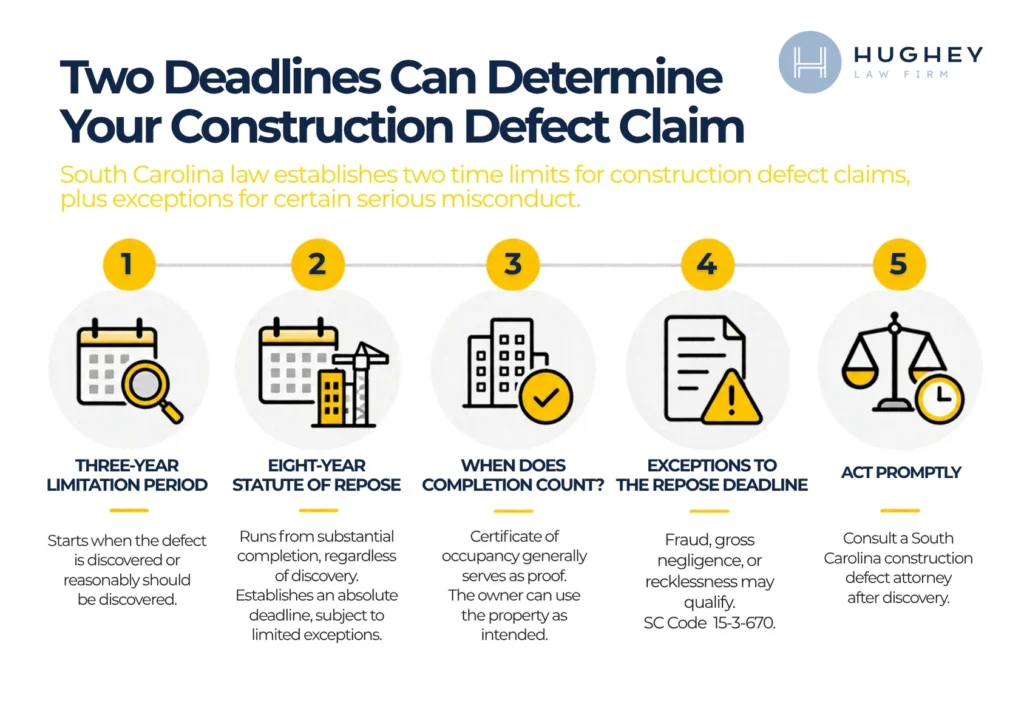
- Three-year statute of limitations: According to South Carolina’s general tort statute, a construction defect claim must be filed within three years from the date the owner discovered, or through reasonable diligence should have discovered, the defect. The discovery rule means that the clock starts when the owner knew or should have known about the defect, not when the defect first developed.
- Eight-year statute of repose under SC Code 15-3-640: South Carolina Code Section 15-3-640 provides an absolute outer limit of eight years from the substantial completion of the construction project, regardless of when the defect was discovered. This is not a limitations period that can be extended by the discovery rule. If eight years have passed since substantial completion, the claim is time-barred even if the defect was not discovered until after that period. A certificate of occupancy is considered proof of substantial completion unless the parties agree otherwise in writing. The South Carolina Supreme Court has clarified that substantial completion means the degree of completion at which the owner can use the property for its intended purpose.
- Exception for fraud, gross negligence, and recklessness: South Carolina Code Section 15-3-670 provides that the statute of repose cannot be used as a defense to claims based on fraud, gross negligence, or recklessness. When a construction professional deliberately conceals a known defect or acts with reckless disregard for the quality of the work, the statute of repose may not protect them. Because the deadline framework is complex and the consequences of missing a deadline are severe, consulting a South Carolina construction defect attorney as soon as a defect is discovered is essential.
Who Can Be Held Responsible for Construction Defects in South Carolina?
In South Carolina, liability for construction defects can fall on the general contractor, subcontractors, architects, engineers, material manufacturers, and suppliers. In some cases, it can also fall on the developer who sold the property. Multiple parties may share liability for a single defect.
One of the most critical functions in a South Carolina construction defect case is identifying every responsible party. Often, multiple parties contribute to a single defect through overlapping failures in design, specification, material supply, and installation.
are responsible for the overall quality of construction and the work performed by their subcontractors. A general contractor who improperly supervises subcontractors, approves defective work, or fails to verify code compliance is liable alongside the specific trade responsible for the defect.
are directly liable for defects in their own scope of work. For example, a roofing subcontractor who installs flashing incorrectly, a framing subcontractor who deviates from plans, or a plumbing subcontractor whose work fails and causes water damage may all be named as defendants in a construction defect action.
are liable when defective designs or engineering specifications cause deficiencies. Claims of design professional negligence require expert testimony to establish what the applicable professional standard was and how the defendant's work fell short.
may face product liability claims when their defective products are incorporated into the construction and fail despite proper installation. South Carolina recognizes strict liability for defective products under its product liability framework.
may be liable under implied warranty theories when they sell a newly constructed property with latent defects that the buyer could not have discovered upon inspection.
How Hughey Law Firm Handles Construction Defect Cases in South Carolina
Founding attorney Nathan Hughey established the firm based on the principle that injured and damaged South Carolinians should have access to the same quality of representation that large institutional defendants have in these cases. This commitment extends to construction defect claimants who are up against contractors backed by experienced defense counsel and commercial general liability insurance carriers.
Past results do not guarantee future outcomes. Each case is evaluated based on its unique facts and circumstances.
Speak With a South Carolina Construction Defect Attorney Today

Call (843) 881-8644 or contact us online for a free, confidential consultation. There is no fee unless we recover compensation for you.
Related Practice Areas
Frequently Asked Questions About South Carolina Construction Defect Claims
What damages are available in a South Carolina construction defect case?
Depending on the circumstances, compensation may include the cost of repairing the defect, loss in property value, water damage, mold remediation, and other related losses. A property owner may also be able to seek damages for loss of use. If the defect causes personal injury, additional damages may be available, such as compensation for medical expenses, lost wages, and pain and suffering.
Can multiple parties be held liable for the same construction defect?
Yes. Depending on the cause of the defect, potentially responsible parties may include general contractors, subcontractors, architects, engineers, or manufacturers of defective materials. The responsibility of each party depends on the evidence and applicable law. An attorney can help identify liable parties and assess potential claims against them.
Can I file a construction defect claim if I purchased the property from someone else, not the original builder?
Possibly. Depending on the defect, the available legal grounds, and the time since construction was completed, a subsequent property owner may have a claim. South Carolina’s statute of repose generally applies regardless of who currently owns the property. An attorney can review the purchase history, warranties, and timeline to determine if a claim is possible.
Does South Carolina require me to give the builder a chance to fix the defect before I can sue?
In many residential construction defect cases, South Carolina law requires homeowners to provide written notice of the claim and give the contractor an opportunity to inspect and respond before filing a lawsuit. Separate notice-and-cure rules apply to nonresidential construction. The requirements and deadlines depend on the type of property and claim, so homeowners should review the process with an attorney before taking action. (South Carolina Code, Title 40, Chapters 59 and 11).
How Long Do I Have to File a Construction Defect Claim in South Carolina?
Depending on the type of claim, South Carolina generally allows three years to file a claim after a construction defect is discovered or reasonably should have been discovered. However, a separate statute of repose generally sets an eight-year limit from the substantial completion of construction, with certain exceptions. The right-to-cure process may also affect the timeline, so it is important to seek legal advice promptly after discovering a defect. (South Carolina Code § 15-3-640).