



Why Do Families Throughout South Carolina Trust Hughey Law Firm for Elder Abuse Cases?
- Nathan Hughey, our founder, began his legal career defending nursing homes.
- Nathan Hughey teaches other attorneys about elder abuse law.
- Attorneys and law firms across South Carolina refer elder abuse cases to us.
- Over 70% of our caseload consists of elder abuse cases.
- Since 2007, we have resolved over 1,000 elder abuse cases in South Carolina.
The results described above are specific to those cases and are not intended to predict or guarantee the outcome of any future case. Each case is unique, and outcomes depend on the particular facts and legal circumstances involved. Hiring a lawyer is an important decision that should not be based solely on advertisements.
What Are Nursing Home Wandering and Elopement?
- Wandering involves aimless or repetitive movement that can put a resident at risk, even if they remain inside the facility. For example, a wandering resident may walk into another resident’s room, which could lead to conflict or an altercation. They may also enter areas such as stairwells, kitchens, and chemical storage closets that are not meant for resident access. Wandering most often occurs in residents with cognitive impairment, including dementia or Alzheimer’s disease. The National Institute on Aging highlights wandering and getting lost as some of the most critical life-threatening behaviors associated with progressive memory loss.
- Elopement happens when wandering goes a step further. It is when a resident leaves a supervised, secure area unnoticed and unsupervised, often leaving the facility entirely. Elopement is far more dangerous than wandering because a resident who leaves the building is exposed to traffic, inclement weather, and an environment that is no longer monitored by staff.
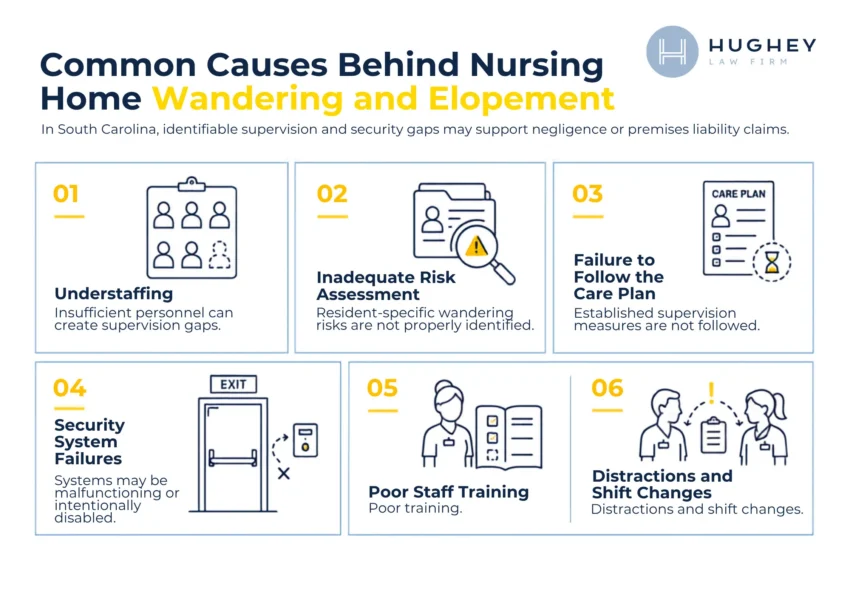
Common Causes of Charleston Nursing Home Wandering and Elopement
- Understaffing
- Inadequate risk assessment
- Failure to follow the care plan
- Malfunctioning or disabled security systems
- Poor staff training
- Distractions and shift changes
Dangers of Wandering and Elopement for Nursing Home Residents
Who Can Be Held Liable for Wandering and Elopement Injuries?
- The facility itself
- Facility administrators
- Individual staff members
- Third-party security or maintenance contractors
Compensation Available in Charleston Wandering and Elopement Cases
- Economic damages cover concrete financial losses, including emergency medical treatment, hospitalization, surgery, rehabilitation, and funeral or burial expenses in fatal cases.
- General damages address the human cost of the incident, including pain and suffering, emotional trauma, and the loss of companionship suffered by surviving family members.
- Wrongful death damages are available when a wandering or elopement incident results in a resident’s death. South Carolina law allows the personal representative of the estate to pursue this claim on behalf of surviving family members.
- Punitive damages may be available under South Carolina Code Section 15-32-510 when there is clear and convincing evidence that the facility’s conduct was willful, wanton, or reckless, such as a documented pattern of ignoring known security failures.
South Carolina Nursing Home Elopement Laws and Regulations
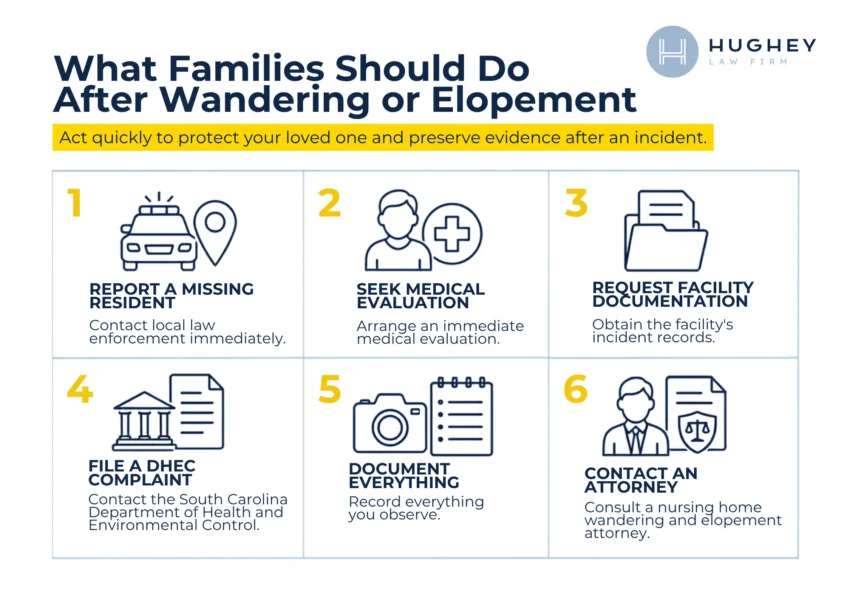
What Families Should Do After a Wandering or Elopement Incident
- Report the incident to local law enforcement immediately if your loved one is missing.
- Seek immediate medical evaluation
- Request the facility’s documentation
- File a complaint with the South Carolina Department of Health and Environmental Control
- Document everything you observe
- Contact a nursing home wandering and elopement attorney
Contact a Charleston Nursing Home Elopement Attorney Today
If your loved one has wandered away from or eloped from a nursing home or assisted living facility in Charleston, you do not have to face this alone. The Hughey Law Firm has represented families throughout the Charleston metropolitan area and across South Carolina. We handle every case with the urgency and seriousness it deserves.
We work on a contingency basis, so you will not pay any attorney fees until we win your case.
Call (843) 881-8644 for a free consultation, fill out our contact form, or use live chat to speak with our team now. We represent families throughout Charleston, the Lowcountry, and across South Carolina.

Disclaimer: The information on this page is intended for general informational purposes only and does not constitute legal advice. Every case is different. Past results do not guarantee future outcomes. Hiring a lawyer is an important decision that should not be based solely on advertisements. Ask us to send you free written information about our qualifications and experience before you decide. The Hughey Law Firm is located in Charleston, South Carolina.
Frequently Asked Questions
Are assisted living facilities responsible for preventing resident elopement?
Yes. Assisted living facilities carry the same basic duty to assess wandering risk and provide appropriate supervision as nursing homes, even though the two facility types operate under different licensing structures.
What should I do if my loved one goes missing from a nursing home?
Contact local law enforcement immediately, notify the facility, and once your loved one is safe, request all documentation related to the incident and contact an attorney.
How can I prove that a nursing home was negligent?
Evidence including the resident’s care plan, staffing schedules, security footage, supervision logs, and witness statements can show whether the facility identified the wandering risk and failed to act on it.
Can a family file a lawsuit after a nursing home elopement incident?
Yes. Families can pursue a negligence claim against the facility, and if the incident resulted in death, surviving family members may pursue a wrongful death claim.
Are nursing homes required to monitor residents who are at risk of wandering?
Yes. Facilities are required to assess every resident for wandering risk, document that risk in the care plan, and provide supervision appropriate to the level of risk identified.
Can a nursing home be held liable if a resident wanders away?
Yes. If a facility failed to properly assess a resident’s wandering risk, follow the resident’s care plan, or maintain adequate supervision and security, the facility can be held legally liable for resulting injuries.
Why are residents with dementia at a higher risk of wandering and elopement?
Dementia and Alzheimer’s disease affect memory, judgment, and the ability to recognize danger, making residents with these conditions far more likely to wander or attempt to leave a facility without understanding the risk involved.