





Why Do Families Throughout South Carolina Trust Hughey Law Firm for Elder Abuse Cases?
- Nathan Hughey, our founder, began his legal career defending nursing homes.
- Nathan Hughey teaches other attorneys about elder abuse law.
- Attorneys and law firms across South Carolina refer elder abuse cases to us.
- Over 70% of our caseload consists of elder abuse cases.
- Since 2007, we have resolved over 1,000 elder abuse cases in South Carolina.
The results described above are specific to those cases and are not intended to predict or guarantee the outcome of any future case. Each case is unique, and outcomes depend on the particular facts and legal circumstances involved. Hiring a lawyer is an important decision that should not be based solely on advertisements.
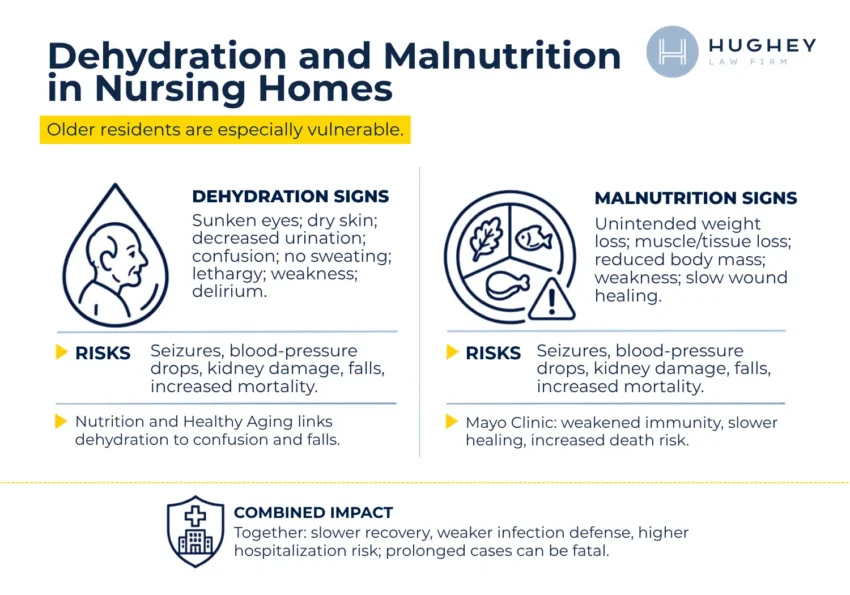
What Are Dehydration and Malnutrition in Nursing Homes?
The Dangers of Dehydration and Malnutrition in Charleston Nursing Homes
Common Causes of Nursing Home Dehydration and Malnutrition
- Understaffing: Assisting with feeding and hydration takes time. When a facility does not have enough staff on duty, residents who need help eating or drinking are often rushed or overlooked entirely.
- High staff turnover: Frequent staff changes make it harder for caregivers to notice gradual changes in a resident’s eating habits or weight since consistent observation over time is necessary to catch early warning signs.
- Lack of proper screening: Facilities are expected to regularly assess residents for risk of dehydration and malnutrition. Skipping these assessments allows treatable problems to progress unnoticed.
- Failure to accommodate dementia-related eating challenges: Residents with memory impairment often need extra encouragement, a calm and structured mealtime environment, and/or hands-on assistance. Facilities that do not adjust their approach for these residents put them at a significantly higher risk.
- Poor meal quality or appeal: A senior’s appetite is already affected by age-related changes in smell and taste. Facilities that serve unappealing or poorly prepared food exacerbate this issue rather than addressing it.
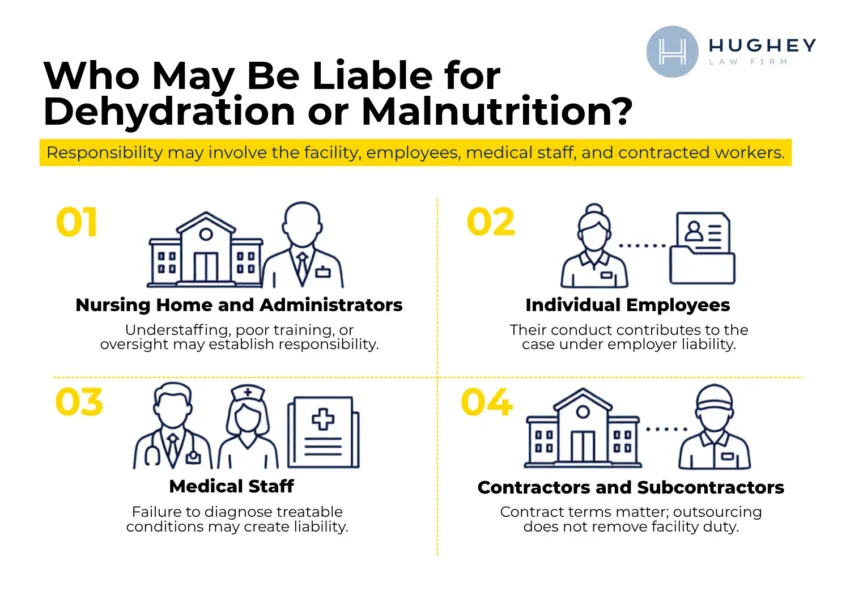
Who Can Be Held Liable for Nursing Home Dehydration or Malnutrition?
- The nursing home and its administrators. A facility is responsible for the negligent acts of its employees. If a resident becomes dehydrated or malnourished due to understaffing, poor training, or inadequate oversight, the facility itself bears responsibility.
- Individual employee. Nutrition staff, care workers, and aides acting within the scope of their jobs are covered by their employer’s liability; however, their individual conduct is still part of building the case.
- Medical staff. Doctors and nurses responsible for a resident’s healthcare can be held liable for failing to diagnose an obvious, treatable condition, even if they are employed directly by the facility.
- Contracted or subcontracted workers. When a facility uses subcontracted nurses or healthcare workers, liability depends on the specific contractual relationship. However, the facility’s overall duty to the resident does not disappear simply because it outsourced part of the staffing.
Compensation Available in Charleston Nursing Home Neglect Cases
- Economic damages cover tangible expenses, such as medical bills, hospital stays, physical and psychological therapy, medical equipment, lost income, and funeral or burial costs in fatal cases.
- Future medical and long-term care needs are a significant part of many of these claims. Severe dehydration or malnutrition can result in lasting organ damage or the need for extended recovery that requires ongoing care well beyond the initial hospitalization.
- General damages cover intangible costs, such as pain and suffering, loss of bodily function, scarring, and strain on family relationships.
- Wrongful death damages are available when dehydration or malnutrition contributes to a resident’s death. South Carolina law allows surviving family members to pursue these damages separately from the underlying negligence claim.
- Punitive damages may be available under South Carolina Code Section 15-32-510 if there is clear and convincing evidence that the facility acted with willful, wanton, or reckless disregard.
Common Defenses Used in Nursing Home Neglect Cases
- No negligence: First, the facility argues that it met the appropriate standard of care and that the resident’s condition was not preventable.
- Comparative negligence: The facility argues that the resident or their family bears some responsibility. Under South Carolina’s modified comparative fault rule, a plaintiff who is found to be fifty-one percent or more at fault recovers nothing.
- Unrelated injury: Since dehydration and malnutrition can cause a variety of medical problems, some facilities claim that subsequent injuries are unrelated to the initial neglect.
Contact Our Charleston Nursing Home Dehydration and Malnutrition Attorney
If your loved one has suffered from dehydration or malnutrition in a Charleston-area nursing home, know that you don’t have to face this alone. The Hughey Law Firm has represented victims of nursing home neglect throughout the Charleston metro region and across South Carolina. We handle every case with the seriousness it deserves.
We work on a contingency basis, so you will not pay any attorney fees until we win your case.
Call (843) 881-8644 for a free consultation, fill out our contact form, or use live chat to speak with our team now. We represent families throughout Charleston, the Lowcountry, and across South Carolina.
Disclaimer: The information on this page is intended for general informational purposes only and does not constitute legal advice. Every case is different. Past results do not guarantee future outcomes. Hiring a lawyer is an important decision that should not be based solely on advertisements. Ask us to send you free written information about our qualifications and experience before you decide. The Hughey Law Firm is located in Charleston, South Carolina.
Frequently Asked Questions
How long do I have to file a nursing home neglect lawsuit in South Carolina?
In most South Carolina cases, the deadline is three years from the date of the injury or its discovery. Because facility records can be lost over time, contacting an attorney as soon as possible helps protect your family’s evidence and legal rights.
Can dehydration or malnutrition lead to wrongful death?
Yes. Severe, prolonged dehydration or malnutrition can be fatal, and surviving family members may pursue wrongful death damages when neglect contributed to a resident’s death.
Can I sue a nursing home for failing to provide food or water?
Yes. Failing to provide adequate food and water is a basic form of neglect under South Carolina law, and a facility that fails in this duty can be held civilly liable for the resulting harm.
How do I report nursing home neglect in South Carolina?
Report concerns to the facility administrator in writing, file a complaint with the South Carolina Department of Health and Environmental Control, and contact a nursing home neglect attorney to evaluate your loved one’s situation.
Can a nursing home be held liable for dehydration or malnutrition?
Yes. Nursing homes are responsible for monitoring residents’ food and fluid intake and assisting those who cannot feed or hydrate themselves. When a facility fails in this duty and a resident is harmed, the facility can be held legally liable.
What are the signs of malnutrition in elderly nursing home residents?
Unintended weight loss, muscle wasting, weakness, slow-healing wounds, and a weakened immune system are common signs of malnutrition in nursing home residents.
What are the signs of dehydration in a nursing home resident?
Sunken eyes, dry or inelastic skin, decreased urination, confusion, lack of sweating, lethargy, weakness, and delirium are common signs of dehydration in elderly residents.