



- Nursing Home / Assisted Living Facility
- Nursing Home / Assisted Living Facility
- Featured Cases, Nursing Home
- Nursing Home / Assisted Living Facility
- Assisted Living, Featured Cases, Nursing Home
- Nursing Home / Assisted Living Facility
- Nursing Home / Assisted Living Facility
- Featured Cases, Group Home Abuse & Neglect, Nursing Home
- Nursing Home / Assisted Living Facility
- Nursing Home
Key Takeaways
- Although they are related, wandering and elopement are distinct risks. Wandering refers to aimless movement within the facility. Elopement refers to a resident leaving the facility unsupervised and undetected. Both are foreseeable risks that nursing homes are legally required to prevent.
- According to federal regulations under 42 CFR 483.25, nursing homes must assess each resident’s elopement risk upon admission. They must also develop an individualized care plan that addresses the risk and implement appropriate monitoring and environmental safeguards. Failure to do so constitutes a violation of the federal conditions of participation.
- According to the Alzheimer’s Association, six in ten people with dementia will wander at some point during the course of their illness. Therefore, nursing homes that accept residents with dementia or Alzheimer’s disease are aware that elopement risk is inherent to their population.
- The Centers for Medicare & Medicaid Services (CMS) has classified elopement-related accidents as Never Events, meaning they are serious, largely preventable occurrences that should not happen when proper safety systems are in place. Injuries resulting from elopement incidents are non-reimbursable under Medicare when they occur as a result of preventable facility failures.
- The Hughey Law Firm has recovered over $325 million for injury victims in South Carolina, including a $1.375 million settlement for the family of a resident who escaped a facility and died. All cases are handled on a contingency fee basis.
South Carolina Nursing Home Wandering & Elopement Lawyers Guide
The Difference Between Wandering and Elopement

Both types of incidents are foreseeable and preventable. They give rise to nursing home negligence claims in South Carolina when the facility’s failures cause harm to the resident.
What Federal Law Requires Nursing Homes to Do
Nursing homes that participate in Medicare or Medicaid, which includes virtually every licensed facility in South Carolina, must comply with the federal conditions of participation under 42 CFR Part 483. Several provisions apply directly to wandering and elopement prevention.
According to 42 CFR 483.20, facilities must conduct a comprehensive assessment of every resident upon admission and after any significant change in condition. This assessment must include an evaluation of the resident's cognitive function, behavioral symptoms, and indicators of wandering behavior. A facility that accepts a resident with dementia but fails to formally assess that resident's risk of wandering has failed this basic obligation before the resident's first night.
Pressure ulcers of stage two or higher in a mobile resident or in a facility with adequate staffing are almost always a sign of neglect. Facilities are required to implement care plans to prevent pressure ulcers in residents at risk, so the development of these ulcers signals a failure of that duty.
According to 42 CFR 483.21, each resident must have an individualized care plan that addresses identified risks, including elopement risk. The care plan must specify the monitoring protocols, environmental safeguards, and staff interventions that will be used to keep the resident safe. A generic plan that does not address a specific resident's wandering behavior or elopement risk is inadequate.
According to 42 CFR 483.25, facilities must provide adequate supervision and assistance to prevent accidents. The regulation specifically requires that the resident environment be as free as possible from accident hazards. For a resident with a documented risk of eloping, an unsecured exit door is an accident hazard.
Federal staffing regulations require facilities to have sufficient nursing staff to provide care that meets residents' needs. A chronically understaffed facility cannot provide the monitoring that high-elopement-risk residents require, and this type of staffing failure is a recognized basis for negligence liability.
How Nursing Home Elopement Happens
The most common causes of nursing home elopement are inadequate risk assessment at admission, the absence of individualized care plans that address wandering behavior, understaffing that leaves high-risk residents unsupervised, malfunctioning or absent door alarm systems, and inadequate staff training on elopement prevention protocols.
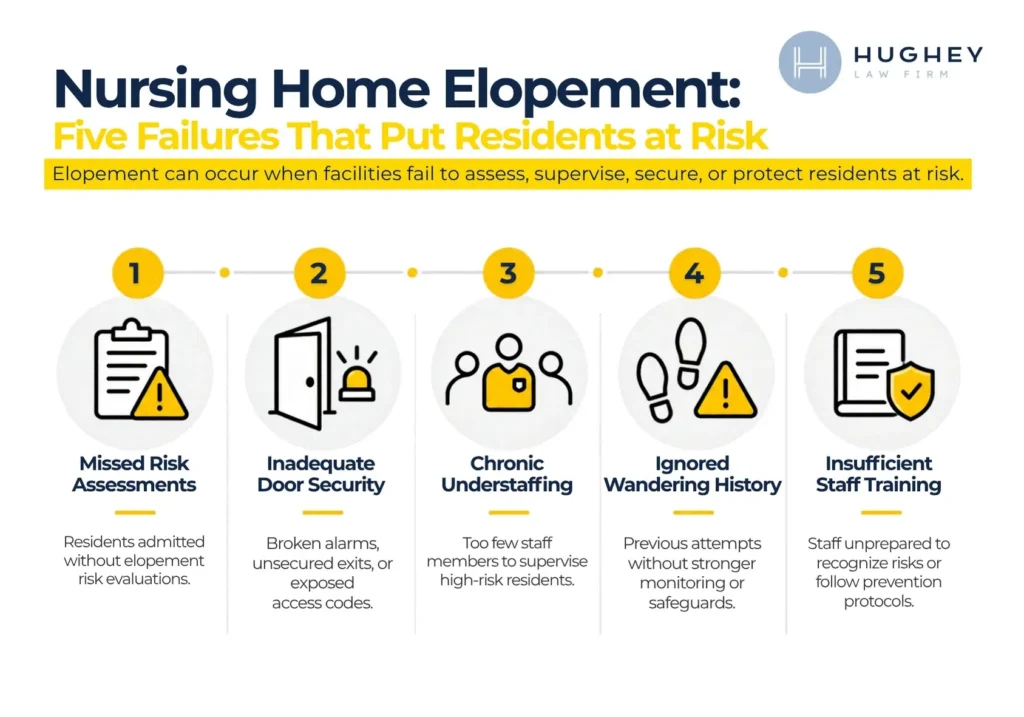
Elopement is not a random event. It follows predictable patterns and results from identifiable facility failures. The most common causes seen in South Carolina nursing home negligence cases include the following:
Modern facilities are required to have secured exits, functioning door alarms, and delayed egress systems on exterior doors used by residents. A door alarm that was never repaired, a coded exit door with the code posted in a visible location, or a side entrance routinely propped open by staff represent systemic security failures, not one-time oversights.
A cognitively impaired resident identified as high risk for elopement requires direct supervision, which cannot be provided when a single aide is responsible for more than a dozen residents. Facilities that operate below safe staffing levels cannot provide adequate supervision for the most at-risk residents.

Injuries and Outcomes From Nursing Home Wandering and Elopement
Elopement from a nursing home can result in fatal or catastrophic outcomes, including death by exposure, drowning, traffic accidents, falls, assault, and hypothermia. Within the facility, wandering can cause falls, injuries from accessing hazardous materials, and harm from resident-to-resident confrontations.
In South Carolina, the consequences of elopement range from serious to fatal and depend heavily on where the resident goes after leaving and how long they remain undetected. For example, a resident who walks into traffic on a busy road immediately faces life-threatening risk. A resident who wanders into a wooded area in the summer heat is at risk of heat stroke. A resident who crosses a parking lot at night faces traffic and fall risks with no assistance nearby.
Common outcomes documented in elopement cases include:
A disoriented resident who exits a facility and walks toward a road cannot recognize or respond to traffic appropriately. South Carolina's mix of high-speed rural roads and commercial corridors makes this risk particularly severe.
South Carolina's warm climate and abundant waterways, including ponds, lakes, and drainage infrastructure on or near facility grounds, create drowning risks for residents who wander toward water.
South Carolina's summer temperatures pose a serious risk of heat illness for elderly residents who are outdoors without fluids or shade for an extended period.
A resident who traverses parking lots, uneven terrain, or roadways without assistance faces a high risk of falling, particularly at night or in wet conditions.
A cognitively impaired resident who is found wandering outside a facility is vulnerable to criminal exploitation by strangers.
The firm has recovered over $325 million for South Carolina injury victims, including the following results that are directly relevant to this practice area:
- $1.375 million for the family of a resident who escaped the facility and died
- $3.375 million for the loved ones of a resident who died due to neglect.
Contact a South Carolina Nursing Home Elopement Attorney Today
If your loved one wandered from or eloped from a South Carolina nursing home and was injured or killed, the South Carolina nursing home abuse lawyers at Hughey Law Firm are prepared to investigate immediately, preserve the evidence, and hold the facility accountable for its failures.

Call (843) 881-8644 or contact us online for a free, confidential consultation. There is no fee unless we recover compensation for you.
Related Practice Areas
Frequently Asked Questions About Nursing Home Wandering and Elopement in South Carolina
What compensation is available in a nursing home elopement lawsuit?
Depending on the circumstances, it may include compensation for medical expenses, the cost of additional care or relocation, and damages for physical pain and emotional distress. If a resident dies as a result of an elopement incident, a wrongful death claim may also be possible. In some cases involving particularly serious or wrongful conduct, punitive damages may be available.
How long do I have to file a nursing home elopement claim in South Carolina?
The deadline depends on the type of claim and the circumstances of the case. South Carolina has specific statutes of limitations that may apply to personal injury and wrongful death claims. Since important evidence can become unavailable over time, it is important to speak with an attorney as soon as possible after an elopement incident.
What evidence is most important in a nursing home elopement case?
Important evidence may include the resident’s admission and risk assessments, care plan, staffing records, incident reports, surveillance footage, door alarm records, and documentation of any previous wandering or safety concerns. It is important to preserve this evidence promptly because some records, such as surveillance footage, may not be retained indefinitely.
Can a nursing home be held liable if my loved one had no prior history of wandering?
A lack of previous wandering or elopement does not necessarily prevent a claim. Nursing homes are expected to assess each resident’s individual needs and risks, and provide appropriate care and supervision. If the facility failed to recognize or respond to a foreseeable risk, resulting in harm to the resident, the circumstances may support a negligence claim.
What is the difference between wandering and elopement in a nursing home?
Wandering generally refers to repetitive or aimless movement by a resident and is often associated with cognitive impairment. Elopement occurs when a resident leaves the facility without the knowledge or authorization of the staff. Both situations may raise concerns about whether the facility provided adequate supervision and safety measures.