Seven Charged in South Carolina Health Care Fraud Takedown as State Targets Medicaid Abuse Affecting Vulnerable Adults
Elder Abuse
The arrests, which were announced on June 25, are part of a nationwide enforcement effort that has uncovered $6.5 billion in alleged fraudulent claims against Medicare, Medicaid, and other federal healthcare programs.
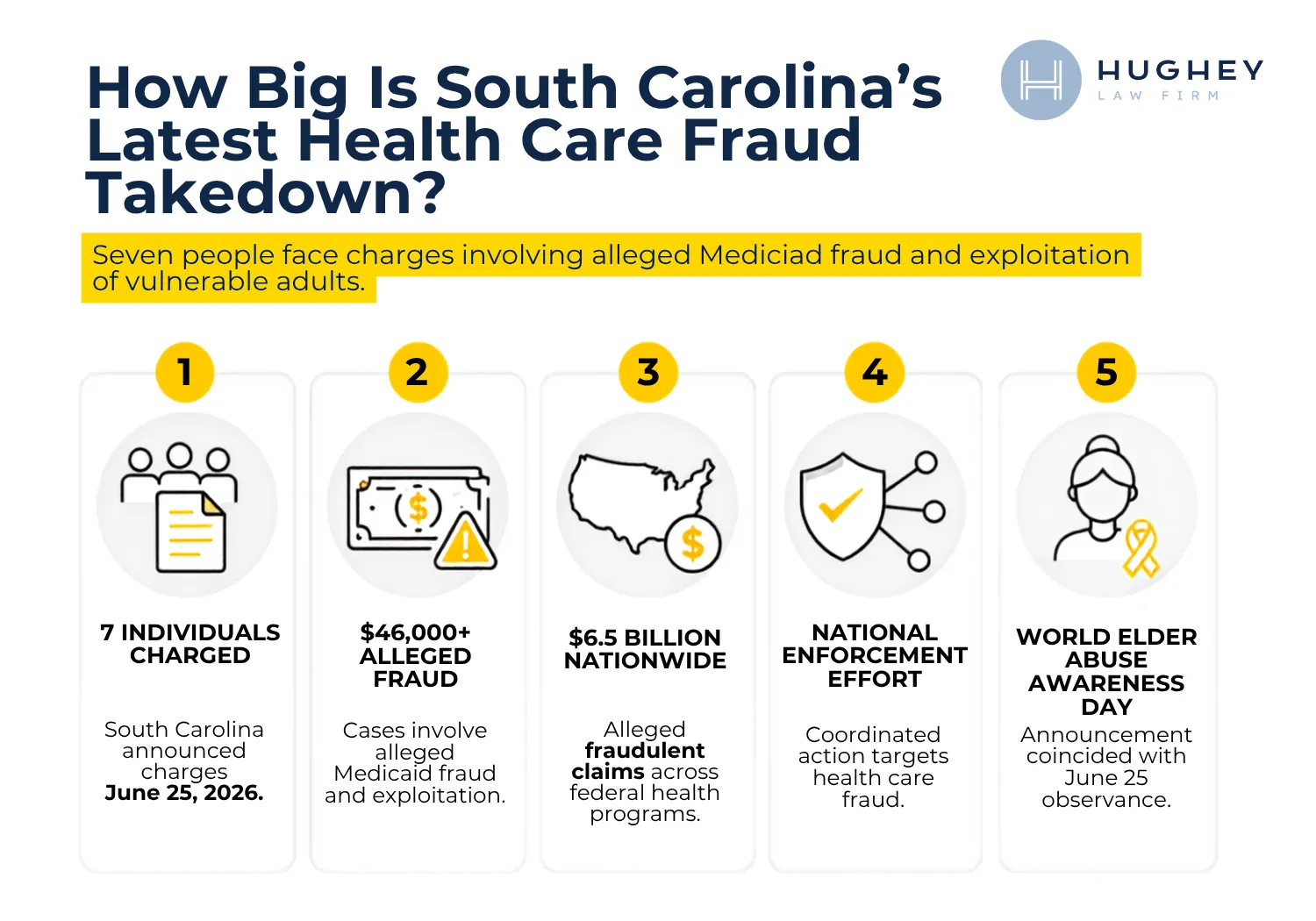
COLUMBIA, S.C. – On June 25, 2026, South Carolina Attorney General Alan Wilson announced criminal charges against seven individuals as part of a coordinated national effort to combat healthcare fraud targeting government benefit programs. The cases involve more than $46,000 in alleged fraud and include charges related to Medicaid fraud and the financial exploitation of vulnerable adults.
The announcement coincided with World Elder Abuse Awareness Day and reflects a broader enforcement push led by the U.S. Department of Justice. According to the Attorney General’s Office, nationwide roundups tied to this “health care fraud takedown” have identified $6.5 billion in alleged fraudulent claims submitted to Medicare, Medicaid, and other federal health care benefit programs.
What the South Carolina Cases Involve
The seven cases announced by the Attorney General’s Office involve various alleged offenses, ranging from falsified medical records to the direct financial exploitation of vulnerable adults.
According to the Attorney General’s press release, among those charged was a Medicaid patient’s attorney who allegedly used Cash App to transfer approximately $16,500 from the victim’s funds to make personal payments on a new vehicle. A Seneca resident allegedly attempted to steal a vulnerable adult’s property by forging a deed that falsely transferred ownership of real property to herself. A Walterboro nursing assistant is being prosecuted for allegedly falsifying timesheets to make it appear that she had provided care to a Medicaid patient when she had not. This resulted in a reported loss of nearly $15,000 to the program.
The office said that all 41 cases currently being prosecuted fall under vulnerable adult abuse or Medicaid provider fraud. “This historic takedown highlights the critical importance of stopping fraud and protecting our neighbors,” said Attorney General Wilson in the press release.
Who Is Most at Risk
South Carolina’s Medicaid program serves a diverse population, but its financial impact is concentrated among the state’s most vulnerable residents. According to Dr. Katherine Hempstead, a policy analyst at the Robert Wood Johnson Foundation, approximately 80% of Medicaid enrollees in South Carolina are families. However, seniors and people with disabilities account for most program spending due to their complex, ongoing healthcare needs.
In South Carolina, more than 60% of Medicaid spending goes toward vulnerable and elderly adults, making them frequent targets of the type of abuse documented in these cases.
Home-based care services, on which many seniors and people with disabilities depend, are particularly expensive and susceptible to fraud. Patients in rural counties, who already have limited access to health care facilities, often require in-home care and are frequently targeted by providers willing to exploit the billing system and the patients themselves.
“Fraud is a problem in all kinds of insurance programs, public and private,” said Hempstead. “Insurance creates an opportunity for fraud. Medicaid is no different.”
The Scale of the Problem in South Carolina
According to reporting by The State newspaper, out of the $11.5 billion that South Carolina’s Department of Health and Human Services has spent on Medicaid so far in 2026, state courts have ordered approximately $1.3 million in restitution during the same period.
The disparity between lost funds and recovered restitution reflects the broader challenge of health care fraud enforcement. The cases announced on June 25 represent only a portion of ongoing prosecutions. The Attorney General’s Office has indicated that their enforcement activity extends beyond the two-week takedown period.
“While the collective impact of enforcement actions like the Takedown is monumental, our work extends far beyond this roughly two-week period,” said Wilson.
What This Means for Families in South Carolina
The cases announced in June illustrate a pattern that elder abuse attorneys and family advocates have documented for years. The people most likely to be exploited are those least equipped to recognize or report the abuse.
Financial exploitation of a vulnerable adult, the legal standard used in several of the current cases, encompasses unauthorized transfers of funds, forged documents affecting property ownership, and misuse of a position of trust or authority over someone unable to protect their own interests.
South Carolina’s Omnibus Adult Protection Act provides legal protections for vulnerable adults and holds accountable those who exploit them. Families who discover that a loved one has been financially exploited by a caregiver, attorney, facility employee, or other trusted party may have criminal reporting options and civil legal remedies available to them.
Reporting suspected exploitation to the South Carolina Department of Health and Environmental Control or Adult Protective Services at 1-888-CARE-211 is typically the appropriate first step. Documentation of suspicious transactions, changes to financial accounts, or alterations to property records should be preserved as early as possible because this type of evidence becomes more difficult to reconstruct over time.
Relevant Legal Context
The cases announced by the Attorney General’s Office show that the financial exploitation of vulnerable adults can take many forms. One example is exploitation by individuals who have legal authority over a victim, such as an attorney managing a client’s funds. South Carolina law permits the criminal prosecution of those responsible, as well as civil claims by victims or their families to recover lost assets.
Families who believe a loved one has been financially exploited by a caregiver, facility employee, or other trusted individual should consult an attorney experienced in elder abuse and vulnerable adult protection. This will help them understand what civil remedies may be available, either alongside or independently of any criminal investigation.
If Your Family Has Been Affected, Contact Hughey Law Firm
Do you suspect that a vulnerable adult in your family has been financially exploited by a caregiver, facility, or other person of trust? Hughey Law Firm represents families throughout Charleston and South Carolina in cases of elder abuse and exploitation of vulnerable adults.
Contact us at (843) 881-8644 or fill out the contact form to schedule a free consultation. Every case is evaluated based on its unique facts and circumstances. Past results do not guarantee future outcomes.
Disclaimer: This article is intended for general informational purposes only and does not constitute legal advice. If you believe a loved one has been the victim of elder abuse or financial exploitation, consult a qualified attorney for guidance specific to your situation.

Nathan Hughey, an attorney and fourth-generation South Carolinian, founded Hughey Law Firm in 2007. Before that, he spent five years defending nursing homes and insurance companies. Leveraging his experience, he now advocates for those injured or wronged by such entities, securing over $300 million in verdicts and settlements.