What Are the Common Types of Truck Accidents?
Truck AccidentsThe common types of truck accidents include jackknifes, rollovers, underride collisions, tire blowouts, and lost load incidents, each caused by a unique set of circumstances such as driver error, mechanical failure, or improper cargo loading. These collisions involving large commercial vehicles are often complex and can result in significant consequences for everyone involved.
Facing the road ahead after a serious collision can feel uncertain. Knowing more about the situation you are in is a powerful first step toward finding clarity and a path forward.
Key Takeaways about the Common Types of Truck Accidents
- Several distinct types of truck accidents occur on roads, including jackknifes, rollovers, underride accidents, and tire blowouts.
- The cause of a truck crash can often be traced back to factors like driver fatigue, improper maintenance, speeding, or unsecured cargo.
- Federal and state regulations govern the trucking industry, and a violation of these rules can be a key factor in determining responsibility.
- Due to their immense size and weight, commercial trucks can cause severe damage and injuries when they are involved in a collision with smaller passenger vehicles.
- The evidence in a truck accident case is often complex, involving driver logs, vehicle maintenance records, and data from the truck’s “black box.”
- Identifying the specific type of truck accident is an important step in an investigation to understand how the incident occurred.
Understanding the Forces at Play in a Commercial Truck Crash
Large commercial trucks, also known as tractor-trailers or semi-trucks, are a constant presence on South Carolina’s highways, from I-26 carrying goods to and from the Port of Charleston to I-95 connecting states along the coast. While essential for our economy, their sheer size and weight create a potential for serious danger.
An average passenger car weighs about 4,000 pounds, while a fully loaded semi-truck can legally weigh up to 80,000 pounds. This massive difference in mass means that when a collision happens, the occupants of the smaller vehicle are far more vulnerable.
The physics involved are stark. The force of a collision is determined by mass and speed, meaning a heavy truck carries immense momentum. This can lead to different and often more severe types of accidents than those involving only passenger cars. Below, we explore some of the most frequent kinds of truck accidents seen on our roads.
Jackknife Accidents: A Sudden and Dangerous Fold
A jackknife accident is one of the most recognizable types of truck crashes. It happens when the trailer of a large truck swings out to the side, folding in toward the cab at a 90-degree angle, much like a closing pocketknife. This sudden motion can cause the truck driver to lose complete control, often leading to the truck skidding or sliding across multiple lanes of traffic.
Several factors can contribute to a jackknife incident, including:
- Improper Braking: A driver suddenly slamming on the brakes can cause the wheels to lock up, leading to a skid that initiates the jackknife;
- High Speeds: Taking a curve or turn too quickly can cause the trailer’s momentum to carry it outward, swinging it around;
- Slick Road Conditions: Rain, ice, or oil on the road, especially prevalent during a surprise Charleston downpour, can reduce traction and make a jackknife more likely;
- Equipment Failure: Malfunctioning brakes or other mechanical issues can contribute to a loss of control.
When a truck jackknifes, it can block entire highways, causing multi-car pileups and creating a hazardous situation for all nearby drivers.
Rollover Accidents
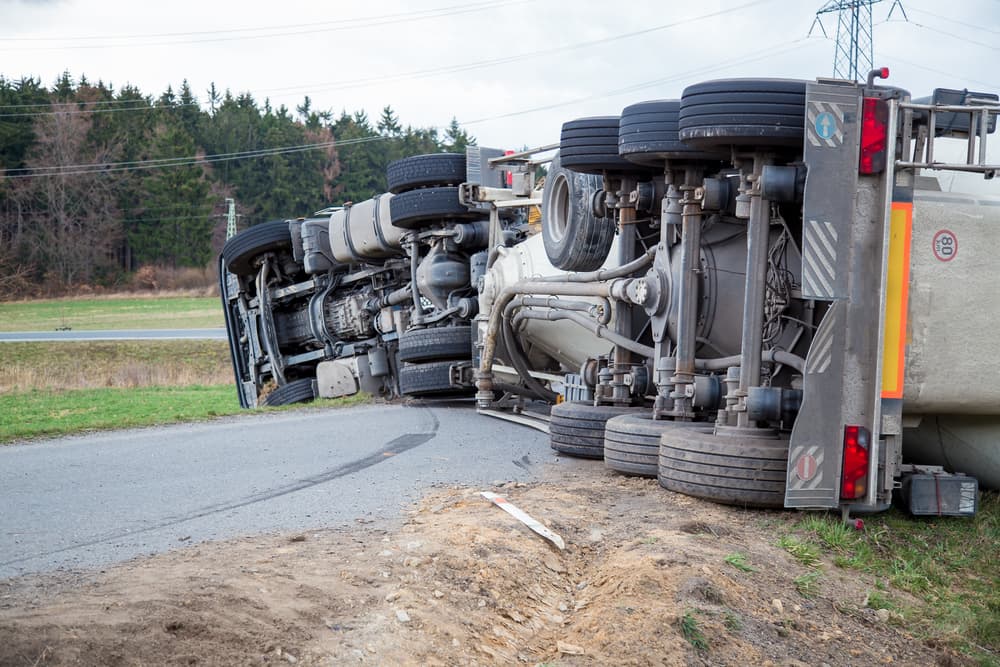 A rollover accident occurs when a truck tips over onto its side or roof. Because of their high center of gravity, large trucks are more susceptible to rollovers than smaller vehicles. These incidents are incredibly destructive, as the truck can crush other vehicles and spill its cargo across the roadway, creating additional hazards.
Common causes of rollovers often involve issues of stability and speed.
- Taking Turns Too Fast: This is a leading cause of rollovers. The high center of gravity makes the truck unstable when turning, and excessive speed can cause it to tip.
- Improperly Loaded Cargo: If cargo is unbalanced, too heavy on one side, or not secured properly, it can shift during transit. This shift in weight can easily destabilize the truck and lead to a rollover.
- Tripping: A truck can “trip” on an object like a soft shoulder, a curb, or guardrail, causing it to roll over.
- Driver Fatigue: According to the Federal Motor Carrier Safety Administration (FMCSA), driver fatigue can impair judgment and reaction time, making a driver more likely to make a critical error that leads to a rollover.
Rollover accidents can be particularly complicated because they may involve multiple factors, including driver action, road conditions, and how the cargo was loaded by a separate company.
Underride and Override Accidents: A Frightening Scenario
Underride accidents are among the most serious types of truck collisions. An underride crash happens when a smaller passenger vehicle slides underneath the side or rear of a semi-truck’s trailer. An override accident is the opposite, where the truck runs over a smaller vehicle.
Federal regulations require most large trailers to have a rear underride guard—a steel bar designed to prevent cars from sliding underneath. However, these guards are not always effective, especially in high-speed collisions, and they are not required on the sides of trailers.
The danger is clear: when a car goes under a trailer, the trailer’s body can shear off the top of the car, leading to devastating consequences. These accidents often happen when a truck makes a wide turn, changes lanes without seeing a car in its blind spot, or is parked on the shoulder of a road without proper visibility.
Tire Blowouts: An Explosive Loss of Control
You have likely seen shredded pieces of tire, often called “road gators,” littering the sides of highways like I-526. These are the remnants of a truck tire blowout. A blowout is a sudden and rapid loss of air pressure in a tire, which can feel like a small explosion to the driver. When a steer tire (one of the front two tires) on a truck blows, it can cause the driver to lose steering control instantly, pulling the truck sharply to one side.
A blowout on a trailer tire can be less dramatic but still dangerous, potentially causing the trailer to sway or fishtail. Causes of tire blowouts can include:
- Poor Maintenance: Trucking companies are responsible for regularly inspecting and maintaining their vehicles. Under-inflated, worn, or defective tires are at high risk of blowing out;
- Overloading: Exceeding the weight limit for the truck or its tires puts immense stress on them, increasing the chance of failure;
- Road Hazards: Hitting debris or a large pothole can damage a tire and lead to a blowout.
A tire blowout can trigger a chain reaction, leading to a jackknife, rollover, or a collision with other vehicles as the driver struggles to regain control.
Lost Load or Spilled Cargo Accidents
Trucks transport everything from lumber and steel coils to gravel and liquid chemicals. If this cargo is not properly secured, it can fall off the truck and onto the road, creating a sudden and unavoidable hazard for following vehicles. A driver swerving to avoid fallen debris can lose control and crash, or their vehicle can be struck directly by the falling cargo.
The FMCSA has detailed cargo securement rules that dictate how different types of materials must be tied down, blocked, or contained. A failure to follow these regulations can be a direct cause of a lost load accident. The responsibility for securing the cargo can lie with the truck driver, the trucking company, or the company that loaded the freight, making these cases complex.
Blind Spot Accidents: The “No-Zone”
 Commercial trucks have large blind spots on all four sides, often referred to as “No-Zones.” These are areas where the truck driver cannot see other vehicles in their mirrors. The largest blind spots are:
- Directly in front of the cab;
- Directly behind the trailer;
- Along the right side of the truck, extending out several lanes.
Accidents frequently happen when a car is traveling in a truck’s blind spot and the truck driver changes lanes, turns, or merges. While all drivers should be aware of these No-Zones, truck drivers also have a responsibility to be extra cautious and check their surroundings thoroughly before maneuvering.
Pursuing Accountability with an Affordable Approach
After a serious truck accident, the financial strain can be significant. Medical bills, lost wages, and vehicle repairs add up quickly. The idea of hiring a lawyer can seem like another expense you cannot handle. This is where an affordable fee structure can make a real difference.
Many personal injury firms operate on a contingency fee basis, often described as “no win, no fee.” This arrangement means you do not pay any attorney’s fees unless the law firm successfully recovers money for you through a settlement or a verdict.
The fee is a percentage of the total recovery, which makes professional legal help accessible to everyone, regardless of their financial situation. This “no win, no fee” model allows you to focus on your recovery while a legal team works on your behalf.
Common Types of Truck Accident FAQs
Here are some answers to frequently asked questions about the different types of commercial truck accidents.
What makes a truck accident claim different from a car accident claim?
Truck accident claims are generally more complex than car accident claims due to several factors. They often involve more severe injuries, multiple potentially responsible parties (the driver, the trucking company, the cargo loader, the vehicle manufacturer), and a complex web of federal and state trucking regulations that may have been violated.
Can the trucking company be held responsible for a crash caused by its driver?
Yes, in many cases, the trucking company can be held responsible. Under a legal principle called vicarious liability, an employer is often responsible for the negligent actions of its employees while they are on the job. Additionally, a company could be directly negligent if it failed to properly train a driver, encouraged drivers to violate hours-of-service rules, or did not properly maintain its vehicles.
How do I prove the truck driver or company was at fault?
Proving fault in a truck accident requires a thorough investigation and gathering of evidence. This can include the police report, witness statements, photos and videos from the scene, the driver’s logbooks, maintenance records for the truck, and data from the truck’s electronic data recorder (or “black box”), which records information about speed, braking, and other operational details just before a crash.
How long do I have to file a claim after a truck accident in South Carolina?
In South Carolina, the statute of limitations for most personal injury claims, including those from a truck accident, is generally three years from the date of the incident. A statute of limitations is a law that sets a strict time limit on your right to file a lawsuit. It is important to act promptly, as missing this deadline can mean losing your right to seek compensation.
What if the truck was a government vehicle, like a mail truck or a military vehicle?
Claims involving government vehicles follow a different set of rules and have much shorter deadlines and specific procedural requirements under the South Carolina Tort Claims Act or the Federal Tort Claims Act. The process is distinct from a claim against a private company, and it is crucial to understand these specific requirements.
Contact a Truck Accident Attorney Today
If you have been injured in a truck accident in the Charleston or Mt. Pleasant area, you may be facing a challenging road to recovery. Having a dedicated legal advocate on your side can help you seek the accountability and compensation you deserve.
The team at Hughey Law Firm has a history of standing up to large insurance and trucking companies on behalf of injured individuals. With a track record of securing over $300 million in verdicts and settlements, we are prepared to put our experience to work for you. If you’ve been injured in a commercial truck crash, contact Hughey Law Firm for a free, no-obligation consultation to discuss your case. We operate on a “no win, no fee” basis, so you can get the help you need without upfront costs.

Nathan Hughey, an attorney and fourth-generation South Carolinian, founded Hughey Law Firm in 2007. Before that, he spent five years defending nursing homes and insurance companies. Leveraging his experience, he now advocates for those injured or wronged by such entities, securing over $300 million in verdicts and settlements.