
Key Takeaways about the Common Types of Truck Accidents
- Several distinct types of truck accidents occur on roads, including jackknifes, rollovers, underride accidents, and tire blowouts.
- The cause of a truck crash can often be traced back to factors like driver fatigue, improper maintenance, speeding, or unsecured cargo.
- Federal and state regulations govern the trucking industry, and a violation of these rules can be a key factor in determining responsibility.
- Due to their immense size and weight, commercial trucks can cause severe damage and injuries when they are involved in a collision with smaller passenger vehicles.
- The evidence in a truck accident case is often complex, involving driver logs, vehicle maintenance records, and data from the truck’s “black box.”
- Identifying the specific type of truck accident is an important step in an investigation to understand how the incident occurred.
Understanding the Forces at Play in a Commercial Truck Crash
- Improper Braking: A driver suddenly slamming on the brakes can cause the wheels to lock up, leading to a skid that initiates the jackknife;
- High Speeds: Taking a curve or turn too quickly can cause the trailer’s momentum to carry it outward, swinging it around;
- Slick Road Conditions: Rain, ice, or oil on the road, especially prevalent during a surprise Charleston downpour, can reduce traction and make a jackknife more likely;
- Equipment Failure: Malfunctioning brakes or other mechanical issues can contribute to a loss of control.
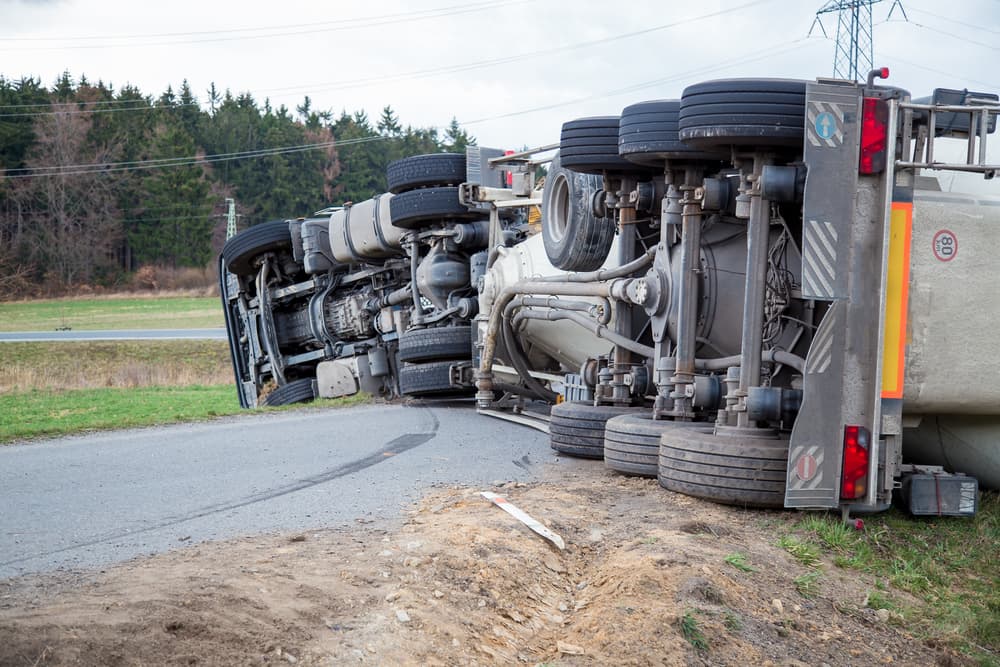
- Taking Turns Too Fast: This is a leading cause of rollovers. The high center of gravity makes the truck unstable when turning, and excessive speed can cause it to tip.
- Improperly Loaded Cargo: If cargo is unbalanced, too heavy on one side, or not secured properly, it can shift during transit. This shift in weight can easily destabilize the truck and lead to a rollover.
- Tripping: A truck can “trip” on an object like a soft shoulder, a curb, or guardrail, causing it to roll over.
- Driver Fatigue: According to the Federal Motor Carrier Safety Administration (FMCSA), driver fatigue can impair judgment and reaction time, making a driver more likely to make a critical error that leads to a rollover.
- Poor Maintenance: Trucking companies are responsible for regularly inspecting and maintaining their vehicles. Under-inflated, worn, or defective tires are at high risk of blowing out;
- Overloading: Exceeding the weight limit for the truck or its tires puts immense stress on them, increasing the chance of failure;
- Road Hazards: Hitting debris or a large pothole can damage a tire and lead to a blowout.

- Directly in front of the cab;
- Directly behind the trailer;
- Along the right side of the truck, extending out several lanes.
Pursuing Accountability with an Affordable Approach
What makes a truck accident claim different from a car accident claim?
Truck accident claims are generally more complex than car accident claims due to several factors. They often involve more severe injuries, multiple potentially responsible parties (the driver, the trucking company, the cargo loader, the vehicle manufacturer), and a complex web of federal and state trucking regulations that may have been violated.
Can the trucking company be held responsible for a crash caused by its driver?
Yes, in many cases, the trucking company can be held responsible. Under a legal principle called vicarious liability, an employer is often responsible for the negligent actions of its employees while they are on the job. Additionally, a company could be directly negligent if it failed to properly train a driver, encouraged drivers to violate hours-of-service rules, or did not properly maintain its vehicles.
How do I prove the truck driver or company was at fault?
Proving fault in a truck accident requires a thorough investigation and gathering of evidence. This can include the police report, witness statements, photos and videos from the scene, the driver’s logbooks, maintenance records for the truck, and data from the truck’s electronic data recorder (or “black box”), which records information about speed, braking, and other operational details just before a crash.
How long do I have to file a claim after a truck accident in South Carolina?
In South Carolina, the statute of limitations for most personal injury claims, including those from a truck accident, is generally three years from the date of the incident. A statute of limitations is a law that sets a strict time limit on your right to file a lawsuit. It is important to act promptly, as missing this deadline can mean losing your right to seek compensation.
What if the truck was a government vehicle, like a mail truck or a military vehicle?
Claims involving government vehicles follow a different set of rules and have much shorter deadlines and specific procedural requirements under the South Carolina Tort Claims Act or the Federal Tort Claims Act. The process is distinct from a claim against a private company, and it is crucial to understand these specific requirements.